How AI Mortgage Underwriting Actually Works in 2026
When you apply for a mortgage in 2026, your application almost certainly passes through an automated underwriting system (AUS) before a human ever sees it. The two dominant systems are Fannie Mae's Desktop Underwriter (DU) and Freddie Mac's Loan Product Advisor (LPA). Together they process more than 75% of all conventional mortgage applications in the United States. Private lenders including JPMorgan Chase, Rocket Mortgage, and United Wholesale Mortgage have also deployed proprietary AI models that layer on top of these systems.
The Data Pipeline
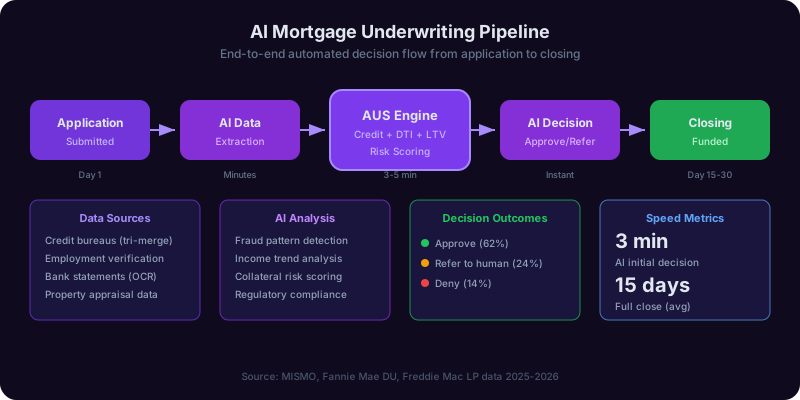
When your lender submits your application to the AUS, the system pulls data from multiple sources simultaneously:
- Credit bureau data: Your FICO scores from all three bureaus (Equifax, Experian, TransUnion), payment history, outstanding balances, credit utilization, account ages, and public records
- Income and employment verification: The system connects to The Work Number (maintained by Equifax) and IRS databases to verify reported income against W-2s, tax transcripts, and employer payroll records
- Asset verification: Bank account balances, investment accounts, and gift fund documentation are cross-referenced through services like Plaid and Finicity
- Property data: The system pulls the appraisal, comparable sales data, property tax history, flood zone status, and title information
- Debt obligations: Student loans, car payments, credit card minimums, child support, and any other recurring financial commitments
How the AI Makes Its Decision
The AUS evaluates your application against Fannie Mae's underwriting guidelines or Freddie Mac's eligibility rules and assigns one of several recommendations. Desktop Underwriter returns an Approve/Eligible, Approve/Ineligible, or Refer with Caution finding. Loan Product Advisor issues an Accept, Caution, or Streamlined Accept response. A clean approval means the AI has determined your risk profile meets all automated criteria. A referral or caution means the system identified something that requires human judgment, and a manual underwriter must review your file.
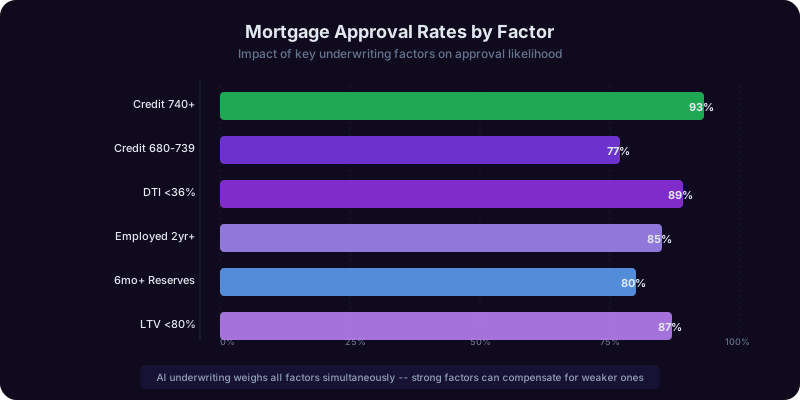
The AI does not simply apply rigid thresholds. Modern systems use machine learning models trained on millions of historical loan outcomes to weigh risk factors in combination. A borrower with a 680 credit score, 28% DTI, and 20% down payment may receive a clean approval, while a borrower with the same 680 score, 43% DTI, and 5% down payment may be referred for manual review. The algorithm considers the interaction between risk factors, not each one in isolation.
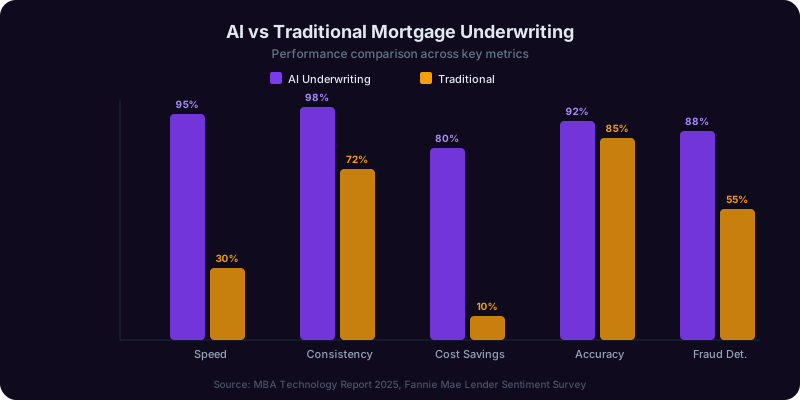
The entire automated evaluation typically completes in 3-15 minutes. Compare that to traditional manual underwriting, which takes 3-7 business days for an initial determination. This speed is why most lenders default to automated underwriting for every application and only escalate to manual review when the AUS flags issues.
Traditional vs. AI Underwriting: What Changed and What It Means for You
Understanding the differences between traditional and AI-driven underwriting is not academic. It directly affects how you should prepare your application and what happens if your first submission is not approved.
Processing Speed
| Metric | Traditional Manual | AI Automated |
| Initial decision | 3-7 business days | 3-15 minutes |
| Document review | 2-5 business days per round | Instant verification for supported sources |
| Conditional approval to clear-to-close | 7-14 business days | 3-7 business days |
| Total application-to-closing | 45-60 days average | 25-35 days average |
Rocket Mortgage reported in early 2026 that 62% of their approved loans moved from application to conditional approval within 24 hours using their proprietary AI stack. This compressed timeline benefits buyers in competitive markets where sellers favor offers with fast closing dates.
Consistency and Objectivity
Traditional underwriting involved significant subjectivity. Two human underwriters reviewing the same file could reach different conclusions, particularly on borderline cases. AI underwriting applies the same criteria identically to every application. This consistency is a double-edged sword: it eliminates favorable human discretion along with unfavorable bias, but it also means the same weakness in your application will trigger the same result every time you resubmit without changes.
What AI Evaluates That Humans Did Not
Modern AI underwriting systems analyze data points that were impractical for human reviewers to process:
- Payment velocity patterns: Not just whether you pay on time, but whether your payment timing has changed. Suddenly paying bills at the last minute after years of early payment may signal financial stress.
- Income trajectory: AI systems that access payroll verification data can evaluate whether your income is stable, growing, or declining over the past 12-24 months.
- Deposit pattern analysis: Irregular large deposits into your bank account before a mortgage application raise flags. AI cross-references these against documented income sources.
- Comparable property analysis: The system evaluates the appraisal against a broader dataset of comparable sales than a human appraiser typically considers.
When Manual Underwriting Is Better for You
AI underwriting is not always the best path. Manual underwriting may produce a better outcome if you have:
- Non-traditional credit history: If you have limited credit accounts but a strong record of on-time rent, utility, and insurance payments, a manual underwriter can consider these. AI systems are improving here, but many still rely heavily on traditional credit bureau data.
- Recent credit events with explanation: A medical bankruptcy two years ago with otherwise perfect credit before and after. A human underwriter can weigh the context. The AUS sees the bankruptcy and flags it.
- Self-employment with complex income: Business owners with strong income that does not fit neatly into W-2 verification models often benefit from a human who can interpret tax returns in context.
- Large gift funds for down payment: While AI systems process gift letters, complex gift fund structures (multiple family members contributing, funds passing through intermediary accounts) may require human judgment.
If an AUS returns a referral or denial, ask your lender whether manual underwriting is an option before assuming you are declined. FHA and VA loans in particular have established manual underwriting paths. The Consumer Financial Protection Bureau's rate exploration tool lets you see how different credit profiles affect available rates in your area.
Credit Score Optimization for AI-Evaluated Mortgage Applications
Your credit score remains the single most influential factor in AI mortgage underwriting. The score determines whether you are approved, what interest rate you receive, and whether you qualify for the best loan programs. In 2026, mortgage lenders pull a tri-merge credit report and use the middle score across your three FICO scores (not the highest, not the lowest) for underwriting. For joint applications, the lender uses the lower of the two applicants' middle scores.
How Credit Score Tiers Affect Your Rate
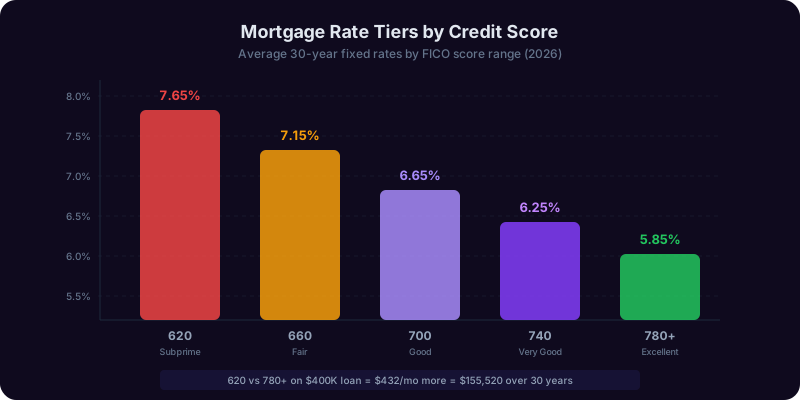
Mortgage rates are not a single number. They are priced in tiers based on credit score, loan-to-value ratio, and loan type. Here is what a borrower purchasing a $400,000 home with 10% down ($360,000 loan) pays at different score tiers with 2026 average rates:
| FICO Score | Estimated Rate | Monthly P&I | Total Interest (30 yr) | Cost vs. 760+ |
| 760+ | 6.25% | $2,217 | $438,048 | -- |
| 720-739 | 6.65% | $2,310 | $471,587 | +$33,539 |
| 700-719 | 6.85% | $2,357 | $488,504 | +$50,456 |
| 680-699 | 7.10% | $2,416 | $509,810 | +$71,762 |
| 660-679 | 7.45% | $2,499 | $539,738 | +$101,690 |
| 620-659 | 7.90% | $2,607 | $578,407 | +$140,359 |
The difference between a 760 and a 660 score costs $101,690 in additional interest over the life of a 30-year loan. Moving from 680 to 720, a jump many borrowers can achieve in 3-6 months with the right strategy, saves more than $38,000.
The 90-Day Pre-Application Credit Sprint
If you are planning to apply for a mortgage in the next 3-6 months, here is the priority-ordered action plan that produces the fastest score improvement:
- Pay down credit card balances to under 10% utilization (or under 5% if possible). This is the single fastest score lever. A borrower carrying 45% utilization who pays down to 8% can see a 40-80 point increase within one billing cycle. Pay down the highest-utilization cards first.
- Dispute errors on your credit reports. Pull your free reports from AnnualCreditReport.com and check for inaccurate late payments, accounts that are not yours, and incorrect balances. Successful disputes can add 20-50 points.
- Do not open any new credit accounts. Each new application adds a hard inquiry and lowers your average account age. Both hurt your score. Avoid store credit card offers completely.
- Do not close any existing credit accounts. Closing a card reduces your total available credit and increases utilization.
- Become an authorized user on a family member's old, low-utilization card if you need a score boost from account age.
- Set up autopay on every account. One missed payment during your mortgage preparation can drop your score 60-110 points.
For a complete breakdown of what drives your score and how to optimize each factor, our guide on understanding your credit score covers the full scoring model. The Finance Copilot can help you build a personalized credit improvement plan based on which factors are currently limiting your score.

Get Answers From the Finance Copilot
Ask a specialist AI copilot the question you just read about. Your first conversation needs no signup and no card.
DTI Ratio Strategies: The Number AI Cares About Most After Credit Score
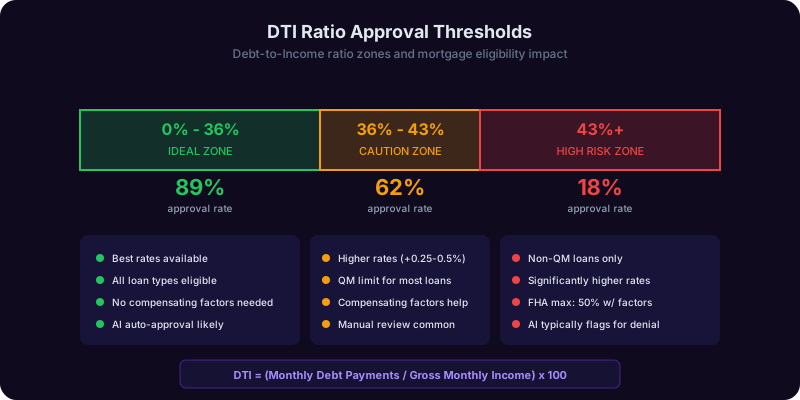
Your debt-to-income (DTI) ratio is the second most critical factor in AI mortgage underwriting. It measures the percentage of your gross monthly income that goes toward debt payments. AI underwriting systems evaluate two DTI calculations:
- Front-end DTI (housing ratio): Your proposed monthly mortgage payment (principal, interest, taxes, insurance, PMI, and HOA fees) divided by gross monthly income. Most lenders cap this at 28-31%.
- Back-end DTI (total debt ratio): All monthly debt payments (housing plus car loans, student loans, credit card minimums, personal loans, child support) divided by gross monthly income. Conventional loans typically cap at 43-45%, though some programs allow up to 50%.
How AI Evaluates DTI Differently Than Human Underwriters
A human underwriter could look at a 46% DTI and consider that the borrower just paid off their car loan next month, effectively dropping the ratio to 38%. The AUS calculates DTI based on what the credit report shows right now. It does not factor in future changes unless you wait until the payoff reports to the bureaus.
This means timing matters enormously. If you are close to a DTI threshold, paying off a debt before applying (and waiting 30-45 days for it to report) can change the automated outcome from a referral to an approval.
DTI Reduction Strategies
| Strategy | Impact | Timeline |
| Pay off a car loan ($350/mo payment) | Reduces DTI by ~4-5% on $90K income | Immediate (after payoff reports) |
| Pay off student loan ($250/mo) | Reduces DTI by ~3-4% on $90K income | Immediate (after payoff reports) |
| Pay down credit cards to zero balance | Eliminates minimum payments from DTI | 30-45 days after payment reports |
| Add a co-borrower with income | Increases denominator significantly | Immediate on application |
| Increase income (raise, side income documented for 2+ years) | Increases denominator | Must be documented and verifiable |
The Income Side of DTI
AI systems verify income through specific channels and accept specific documentation depending on your employment type:
- W-2 employees: The AUS pulls data from The Work Number or verifies against the most recent two years of W-2s and your most recent 30 days of pay stubs. Base salary is straightforward. Overtime, bonus, and commission income typically require a 2-year history and the system averages the amounts.
- Self-employed borrowers: The system evaluates your last two years of federal tax returns including all schedules. It calculates net income after deductions. This is where many self-employed borrowers run into trouble: aggressive tax deductions that reduced your tax bill also reduce the income the AUS sees. A business grossing $200,000 with $140,000 in deductions shows only $60,000 in qualifying income.
- Rental income: If you own rental property, the AUS typically counts 75% of rental income (assuming 25% vacancy and expense factor) and offsets the rental property's mortgage payment.
Compensating Factors That Help at High DTI
If your DTI exceeds 43%, AI systems look for compensating factors that offset the risk:
- Large cash reserves: Having 6-12 months of mortgage payments in savings after closing
- High credit score: A 780+ FICO score paired with a 46% DTI is treated differently than a 680 score with the same DTI
- Significant down payment: Putting 20%+ down demonstrates financial capacity and reduces lender risk
- Residual income: Money left over after all debts and living expenses are paid (VA loans explicitly require this calculation)
The Finance Copilot can help you calculate your current DTI, model different payoff scenarios, and determine the optimal strategy for reducing your ratio before applying. If you want to strengthen your overall financial position first, our guide on building an emergency fund covers how much cash reserve you should maintain.
Documentation Requirements: What AI Underwriting Needs and How to Prepare
AI underwriting systems are only as good as the data they receive. Incomplete or inconsistent documentation is the number one reason applications receive conditional approvals with extensive stipulations or are referred to manual review. The better your documentation package, the faster and smoother your approval.
Standard Documentation Checklist
Regardless of your employment type, every mortgage application requires these baseline documents:
| Document | What AI Verifies | Common Issues |
| Government-issued ID | Identity confirmation | Expired ID will stall the process |
| Social Security number | Credit pull authorization | Name mismatches between documents |
| 2 most recent pay stubs | Current income, YTD earnings | Gaps in pay periods, employer name changes |
| W-2s (last 2 years) | Income consistency and trajectory | W-2 income not matching tax return income |
| Federal tax returns (last 2 years) | Total income, deductions, liabilities | Unfiled returns, amended returns not included |
| Bank statements (last 2-3 months) | Asset verification, down payment sourcing | Large unexplained deposits, overdrafts |
| Investment account statements | Reserve fund verification | Recent large withdrawals |
The Large Deposit Problem
This trips up more buyers than any other documentation issue. AI systems flag any deposit in your bank account that exceeds 50% of your total monthly qualifying income as a large deposit requiring explanation. If you earn $7,500/month gross, any single deposit over $3,750 that is not clearly identifiable as payroll will need a paper trail.
Common triggers and their solutions:
- Cash gifts from family: Require a signed gift letter, proof of the donor's ability to give (their bank statement), and a paper trail showing the transfer. The donor must confirm the gift does not need to be repaid.
- Transfers between your own accounts: Provide statements for both accounts showing the matching transfer.
- Sale of personal property: Provide a bill of sale, the listing advertisement, and the deposit documentation.
- Tax refund: Provide IRS documentation or the refund deposit showing the IRS as the source.
- Bonus or commission payment: Your employer's pay stub or a letter confirming the payment.
Self-Employed Borrower Documentation
Self-employed borrowers face the heaviest documentation burden because AI systems must establish income stability without the standardized reporting that W-2 employment provides. In addition to the standard checklist, you will need:
- Profit and loss statement: Year-to-date, signed by you (some lenders require CPA preparation)
- Business tax returns (last 2 years): Including all schedules, K-1s, and business financial statements
- Business bank statements (last 2-3 months): Separate from personal accounts
- Business license: Proof the business is active and in good standing
- CPA or tax preparer letter: Some lenders require a letter from your accountant confirming the business is active
The AI calculates your qualifying income by averaging your net self-employment income over the past two years. If your income is declining year over year, the system may use the lower year or flag the application for review. If your income is increasing, the two-year average will be lower than your current income, which can be frustrating but is standard practice.
How to Prepare Your Documentation Package
Start gathering documents 60-90 days before you plan to apply. Here is the preparation timeline:
- 90 days out: Pull your credit reports and scores. Identify and dispute any errors. Begin credit optimization.
- 60 days out: Open a dedicated savings account if your down payment is spread across multiple accounts. Consolidate funds and create a clear paper trail. Stop making large cash deposits.
- 45 days out: Gather all tax returns, W-2s, and business documentation. Ensure your tax returns are filed and not amended.
- 30 days out: Collect the most recent bank statements and pay stubs. Ensure your bank statements show a stable or growing balance with no overdrafts.
- Application day: Have everything organized in a digital folder. Respond to any additional documentation requests within 24 hours to keep the process moving.
The Finance Copilot can help you create a personalized documentation checklist based on your employment type and financial situation. For more on avoiding expensive mistakes during the home buying process, see our guide on first-time home buyer mistakes.
AI Bias in Mortgage Lending: What Borrowers Should Know
AI mortgage underwriting promises objectivity, but the reality is more complicated. Algorithmic bias in lending is a documented concern that federal regulators, academics, and civil rights organizations are actively studying and addressing. As a borrower, understanding these issues helps you protect your rights and recognize when an adverse decision may warrant further investigation.
The Evidence of Algorithmic Bias
A 2023 study by the National Bureau of Economic Research found that algorithmic mortgage underwriting reduced racial disparities in approval rates by approximately 40% compared to human underwriters. However, it did not eliminate them. The remaining disparities stem from the training data itself: AI models learn from historical lending outcomes that reflect decades of discriminatory practices. If borrowers in certain zip codes were historically denied loans at higher rates, the model may learn to associate characteristics correlated with those zip codes as higher risk.
The CFPB's Home Mortgage Disclosure Act (HMDA) data shows that in 2025, Black applicants were denied conventional mortgages at 1.8 times the rate of white applicants, and Hispanic applicants at 1.4 times the rate, even after controlling for income and credit score. These disparities have narrowed from historical levels but persist in AI-driven systems.
Types of Bias in AI Underwriting
- Training data bias: Models trained on historical data inherit past discriminatory patterns. If lenders previously undervalued homes in minority neighborhoods (a practice linked to historical redlining), appraisal models may continue to undervalue properties in those areas.
- Proxy variable bias: Even though AI systems cannot legally use race, ethnicity, or national origin as factors, other variables can serve as proxies. Zip code, educational institution, and even banking patterns can correlate with protected characteristics.
- Feature selection bias: The choice of which data points to include in the model affects outcomes. A model that heavily weights credit score length disadvantages younger borrowers and immigrants who may have shorter credit histories despite stable income.
Regulatory Responses
Federal regulators have intensified oversight of AI in lending:
- The CFPB issued guidance in 2024 requiring lenders to provide specific, accurate reasons for adverse actions even when using complex AI models. A vague "declined by automated system" is not sufficient.
- The Equal Credit Opportunity Act (ECOA) and Fair Housing Act apply to AI systems just as they do to human underwriters. Lenders are liable for discriminatory outcomes regardless of whether a human or algorithm made the decision.
- The Federal Reserve and OCC now require model risk management programs that include bias testing for AI underwriting systems.
- Several states, including Illinois, Colorado, and New York, have enacted AI-specific lending fairness laws that require disparate impact testing before deployment.
What You Can Do as a Borrower
- Request your adverse action notice. If you are denied or offered unfavorable terms, the lender must provide specific reasons. If the reasons seem generic or do not match your financial profile, push back.
- File complaints with the CFPB. If you believe your application was treated unfairly, file a complaint at consumerfinance.gov/complaint. The CFPB investigates patterns across lenders.
- Apply to multiple lenders. Different lenders use different AI models with different training data and risk thresholds. A denial at one lender does not mean denial everywhere.
- Request manual underwriting. If you believe the AI system did not fairly evaluate your application, ask whether the lender offers manual underwriting as an alternative.
- Document non-traditional creditworthiness. Rent payment history, utility payments, and insurance premiums can be presented to manual underwriters even if the AUS did not consider them.
AI bias in lending is improving but remains an active area of concern. Being an informed borrower means knowing your rights under fair lending laws and understanding that an automated denial is not necessarily the final word.
AI Rate Comparison Tools: Finding the Best Mortgage Deal in 2026
The mortgage market in 2026 is more transparent than ever, but navigating it still requires comparing dozens of variables across multiple lenders. AI-powered comparison tools have fundamentally changed how borrowers shop for rates, moving beyond simple rate tables to personalized, real-time analysis.
The Current Rate Landscape
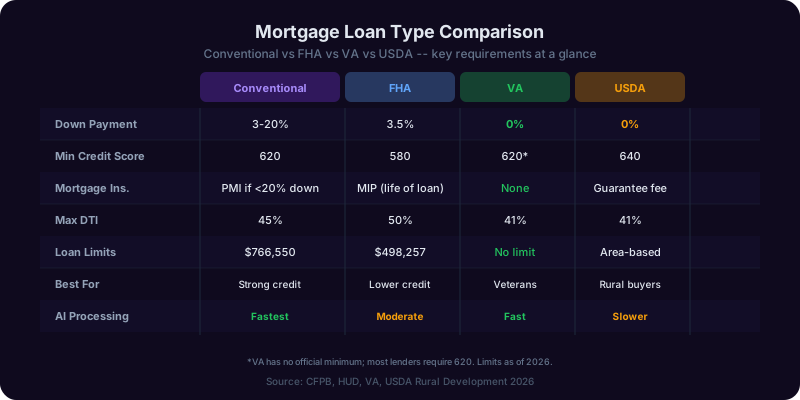
As of mid-2026, the average 30-year fixed conventional mortgage rate sits at approximately 6.25-6.75%, depending on borrower profile. The Federal Reserve's rate adjustments through 2025 and early 2026 brought rates down from the 7.5%+ peaks of late 2023. Here is what different loan types look like:
| Loan Type | Average Rate (Mid-2026) | Down Payment | Best For |
| 30-year fixed conventional | 6.25% - 6.75% | 3-20% | Most borrowers, rate stability |
| 15-year fixed conventional | 5.50% - 6.00% | 3-20% | Faster payoff, lower total interest |
| FHA 30-year fixed | 6.00% - 6.50% | 3.5% minimum | Lower credit scores (580+), smaller down payment |
| VA 30-year fixed | 5.75% - 6.25% | 0% | Veterans and active military |
| USDA 30-year fixed | 6.00% - 6.50% | 0% | Rural and suburban areas |
| 5/1 ARM | 5.50% - 6.00% | 5-20% | Short-term ownership (under 5-7 years) |
How AI Comparison Tools Work
Traditional rate comparison meant visiting Bankrate or LendingTree, entering your basic information, and receiving a list of rates that may or may not apply to your actual situation. AI-powered tools go further:
- Soft-pull pre-qualification: Some platforms now use soft credit pulls to provide rate quotes based on your actual credit profile without impacting your score.
- Total cost analysis: AI calculates not just the rate but the total cost of each loan option including origination fees, points, PMI duration, and closing costs. A 6.50% rate with $4,000 in origination fees may cost more over 10 years than a 6.75% rate with zero fees.
- Break-even analysis: If a lender offers to buy down your rate by paying points, the AI calculates exactly how many months you must stay in the home to recoup the upfront cost.
- Refinance modeling: AI tools project when refinancing becomes advantageous based on rate trend models and your breakeven timeline.
The 14-Day Rate Shopping Strategy
As discussed in our first-time home buyer guide, FICO treats all mortgage inquiries within a 14-day window as a single inquiry (45 days for newer FICO models). Here is how to use that window effectively:
- Week 1, Day 1-2: Submit applications to 3-5 lenders. Include at least one large bank, one credit union, one online lender, and one mortgage broker.
- Week 1, Day 3-5: Receive Loan Estimates from each lender. By law, lenders must provide a Loan Estimate within 3 business days of receiving your application.
- Week 2, Day 6-10: Compare Loan Estimates line by line. Focus on the APR (which includes fees), not just the interest rate. Ask each lender to match or beat competing offers.
- Week 2, Day 11-14: Lock your rate with the best lender.
The CFPB found that borrowers who compare five or more lenders save an average of $3,000-$5,000 over the life of the loan compared to borrowers who accept the first offer. On a $360,000 loan, the difference between the best and worst offer you receive will typically be 0.25-0.75% in rate, translating to $18,000-$55,000 in total interest.
The Finance Copilot can help you compare Loan Estimates, understand the total cost of each option, and identify which lender offers are genuinely competitive versus which are front-loaded with hidden fees. For tips on understanding your credit report before rate shopping, see our guide on what makes a good credit score.
How to Use AI Tools Throughout Your Mortgage Journey
The mortgage process involves financial analysis, document preparation, legal review, and ongoing decision-making across weeks or months. AI tools are most valuable when used at specific decision points rather than as a generic assistant. Here is how to integrate AI guidance at each stage.
Stage 1: Pre-Application Financial Assessment
Before you talk to a lender, use AI to assess your readiness:
- Credit score analysis: The Finance Copilot can help you understand your current credit profile, identify factors limiting your score, and model how specific actions (paying down a card, disputing an error) will affect your number.
- Affordability calculation: Input your income, debts, expected down payment, and local tax and insurance rates. AI can calculate your maximum comfortable purchase price based on the 28/36 rule (housing costs under 28% of gross income, total debt under 36%) and compare it to what lenders will actually approve, which is often more than you should borrow.
- DTI optimization: Model different debt payoff scenarios to find the most efficient path to a competitive DTI ratio.
Stage 2: Lender Comparison and Rate Shopping
Once you have Loan Estimates from multiple lenders, AI tools help you make an apples-to-apples comparison:
- Total cost modeling: Compare the true cost of each offer over your expected ownership period, not just the monthly payment.
- Points analysis: Determine whether paying discount points makes sense based on how long you plan to stay in the home. A point costs 1% of the loan amount ($3,600 on a $360,000 loan) and typically lowers the rate by 0.25%. The breakeven is usually 4-6 years.
- Closing cost negotiation: Identify which fees are negotiable (origination, title insurance, appraisal) and which are fixed (recording fees, transfer taxes).
Stage 3: Application and Underwriting
During the underwriting process, AI helps you respond to conditions efficiently:
- Document interpretation: When the underwriter requests additional documentation, AI can explain what is needed and why.
- Letter of explanation drafting: If the underwriter asks for an explanation of employment gaps, large deposits, or credit events, AI can help you draft clear, concise letters that address the specific concern.
- Scenario modeling: If underwriting conditions change your loan terms, AI can help you evaluate whether the revised terms are still favorable or whether switching lenders makes more sense.
Stage 4: Closing Preparation
In the final days before closing, AI tools help you verify everything is in order:
- Closing Disclosure review: Compare every line item on the Closing Disclosure to the original Loan Estimate. AI can flag discrepancies and explain which variances are legally permitted.
- Wire transfer verification: While AI cannot prevent wire fraud, it can educate you on the specific red flags to watch for and the verification steps to follow.
- Final cost calculation: Confirm the exact amount you need to bring to closing and ensure your funds are properly sourced and documented.
Stage 5: Post-Closing Monitoring
Your mortgage journey does not end at closing:
- Refinance monitoring: AI can track rate movements and alert you when refinancing becomes financially advantageous based on your current rate, remaining balance, and estimated closing costs.
- PMI removal tracking: If you are paying PMI, AI can calculate when you will reach 20% equity and remind you to request cancellation. Many borrowers overpay PMI by months or years because they do not track their equity buildup.
- Property tax assessment monitoring: Track your assessed value against market value and flag when an appeal may save money.
The Home Copilot is designed to help with ongoing homeownership decisions, from maintenance planning to insurance review. For broader financial planning that accounts for your mortgage within your overall budget, the Finance Copilot provides year-round guidance.
This is general information, not financial advice. Consult a mortgage professional or financial advisor for guidance specific to your situation.
Frequently Asked Questions
Recommended Copilots
Related Articles
Get Answers From the Finance Copilot
Ask a specialist AI copilot the question you just read about. Your first conversation needs no signup and no card.