
Why Most People Leave $5,000-$15,000 on the Table
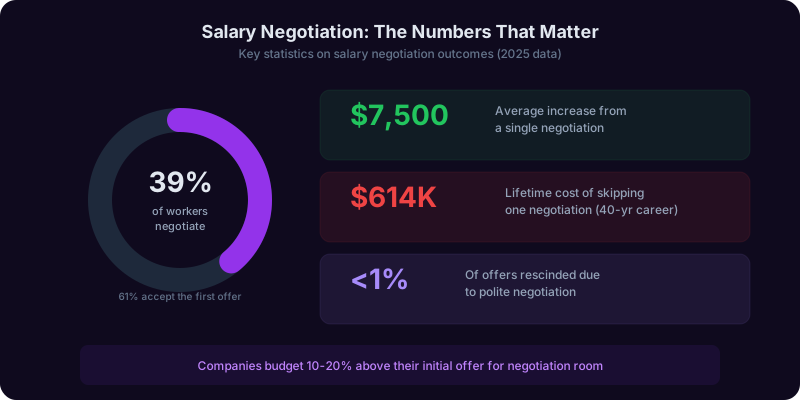
The single most expensive conversation you will ever avoid is the one about your salary. According to a 2025 survey by Fidelity Investments, only 39% of workers attempted to negotiate their most recent job offer. The other 61% accepted the first number they were given. The average successful negotiation resulted in a $7,500 increase over the initial offer. That is $7,500 you leave behind every time you say yes too quickly.
But the real cost is not $7,500. It is compounding. Every raise, bonus, and retirement contribution you earn for the rest of your career is calculated as a percentage of your current salary. When you start $7,500 lower, every future increase starts from a lower base. The math is straightforward and brutal:
- Year 1: You accept $75,000 instead of negotiating to $82,500. You are $7,500 behind.
- Year 5: With 3% annual raises, the gap has grown to $8,691 per year. Cumulative loss: $40,913.
- Year 10: The annual gap is $10,077. Cumulative loss: $93,862.
- Year 20: The annual gap is $13,545. Cumulative loss: $216,441.
- Year 40 (full career): Cumulative loss: $614,773. And that does not include the lost 401(k) match, lost employer contributions, or lost investment returns on those contributions.
When you factor in lost retirement contributions and their growth at a modest 7% annual return, one skipped negotiation can cost you over $1 million in lifetime wealth.
Why People Do Not Negotiate
Researchers at Carnegie Mellon found that the reasons people avoid negotiating are predictable and almost always wrong:
- Fear of losing the offer (46%): In reality, fewer than 1% of employers rescind offers because a candidate negotiated. Hiring managers expect it.
- Did not know they could (26%): Most people assume the first offer is the only offer. It almost never is. Companies budget for negotiation, typically building in 10-20% above the initial number they present.
- Felt uncomfortable (18%): Negotiation feels confrontational if you have never been taught a framework. With a script, it feels like a normal professional conversation.
- Worried about starting off on the wrong foot (10%): Managers respect candidates who negotiate professionally. It signals confidence and self-awareness.
The Gender and Race Gap in Negotiation
The negotiation gap is not equal. Data from Harvard Business Review shows that men are 4x more likely to negotiate salary than women, and this single behavioral difference accounts for an estimated $500,000 in lifetime earnings gap between men and women with identical qualifications in identical roles. Black and Hispanic workers negotiate at even lower rates, often due to well-documented penalties for assertiveness that do not apply equally to white men.
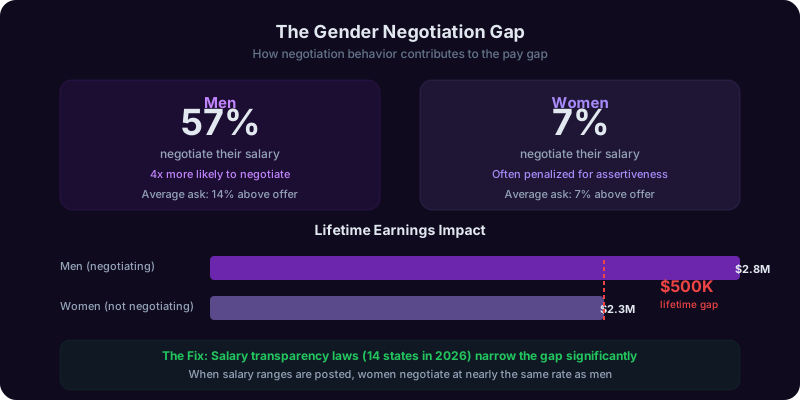
The fix is structural: when companies post salary ranges (now required by law in 14 states as of 2026), the negotiation gap narrows significantly. But until every company is transparent about pay bands, the scripts and strategies in this guide are your best tool for closing the gap yourself.
The Salary Copilot can help you research your market rate and build a personalized negotiation strategy based on your specific role, location, and experience level.
See our real-world walkthrough: negotiating a raise.
The Research Phase: Know Your Number Before You Talk
Walking into a salary negotiation without research is like walking into a car dealership without checking Kelley Blue Book. You will get taken. The single most important thing you can do before any negotiation is determine your market rate with precision. Here is exactly how to do it.
Step 1: Cross-Reference at Least Three Data Sources
No single source is perfectly accurate. Use multiple sources and look for where the numbers converge:
- Glassdoor Salary Explorer: Best for role-specific data at named companies. Filter by company size, location, and years of experience. Glassdoor reports both base salary and total compensation. Reliability: good for large companies, weaker for small ones. Free.
- Levels.fyi: The gold standard for tech compensation data. Reports verified base salary, stock grants, and bonus separately. If you are in engineering, product, design, or data science at a tech company, this is your primary source. Free.
- Payscale: Offers a free salary report after you fill out a detailed profile. Best for non-tech roles and mid-market companies. Their data skews slightly low compared to actual offers, so treat Payscale numbers as a floor. Free for basic reports.
- Bureau of Labor Statistics (BLS): The Occupational Employment and Wage Statistics (OEWS) program provides government-collected wage data by metro area and occupation. Less granular than private sources but unbiased. Free at bls.gov/oes.
- Salary.com: Comprehensive data with percentile breakdowns (10th, 25th, 50th, 75th, 90th). Useful for understanding where you fall in the range. Free for basic data.
- LinkedIn Salary Insights: Available through LinkedIn Premium. Useful for comparing across regions and seniority levels.
Step 2: Build Your Salary Range
After reviewing your sources, you should have a range. Organize it into three numbers:
| Number | Definition | When to use it |
|---|---|---|
| Floor | The lowest you will accept. Below this, you walk away. | Never share this number out loud. This is your private red line. |
| Target | The realistic market rate for your skills and experience. Typically the 60th-75th percentile. | This is what you genuinely expect to reach. Anchor your negotiation here. |
| Stretch | The high end of the range. The 85th-95th percentile for your role. | This is the number you say out loud first. Start here to leave room for negotiation. |
For example, if you are a Senior Product Manager in Austin, TX with 6 years of experience, your research might show:
- Glassdoor: $145,000-$175,000 base
- Levels.fyi: $155,000-$190,000 total comp
- Payscale: $138,000-$168,000 base
- LinkedIn: $148,000-$180,000 base
Your range: Floor: $150,000 | Target: $170,000 | Stretch: $185,000
Step 3: Understand Total Compensation
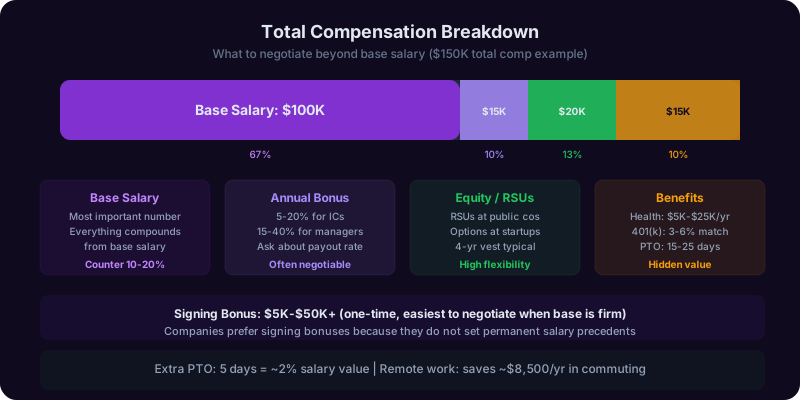
Base salary is only part of your compensation. Before you negotiate, understand the full picture:
- Base salary: Your guaranteed annual pay. This is the most important number because everything else compounds from it.
- Annual bonus: Typically 5-20% of base for individual contributors, 15-40% for managers. Ask whether the bonus is guaranteed or performance-based, and what the typical payout rate is (many companies target 100% but pay 80-120%).
- Equity/Stock: RSUs, stock options, or profit sharing. For public companies, RSUs have a clear dollar value. For startups, options are speculative. We cover this in detail in Section 6.
- Benefits value: Health insurance ($5,000-$25,000 annual value), 401(k) match (typically 3-6% of salary), and other benefits add $15,000-$40,000 in total compensation that most people ignore in negotiations.
A Career Copilot session can help you map out the total compensation picture for specific companies and roles so you negotiate with the full picture in mind.
New Job Offer Negotiation: Word-for-Word Scripts
You got the offer. The recruiter calls with a number. Your heart is pounding. This is the moment where most people either say "that sounds great" or fumble through an awkward attempt at negotiation. Neither is necessary. Here are the exact words to use.
The Phone Call Script: When the Recruiter Calls With the Offer
When the recruiter calls, your only job is to express enthusiasm without committing to the number. Never accept or reject an offer on the spot. Here is exactly what to say:
You: "Thank you so much for the offer. I am genuinely excited about this role and about working with [Company Name]. I want to give this the thoughtful consideration it deserves. Could I have a few days to review the full details and get back to you?"
The recruiter will say yes. They always say yes. If they press for a faster timeline, say:
You: "I completely understand. This is a big decision and I want to make sure I am saying yes for the right reasons. Would [specific date, 3-5 business days out] work?"
During those days, you finalize your research, prepare your counter, and write your negotiation email.
The Counter Offer Email Template
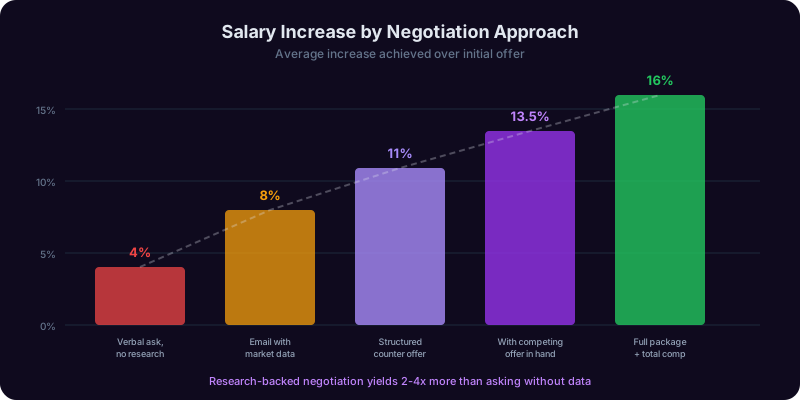
Email is better than phone for your counter offer. It gives both sides time to think, creates a written record, and removes the pressure of real-time negotiation. Use this template:
Subject: Re: [Your Name] - Offer for [Role Title]
Hi [Recruiter Name],
Thank you again for extending this offer. I have spent the last few days reflecting on the opportunity, and I am very enthusiastic about joining [Company Name] as a [Role Title]. The team, the mission, and the scope of the role are exactly what I am looking for in my next step.
After reviewing the compensation package alongside current market data for this role in [City/Region], I would like to discuss the base salary. Based on my research across multiple compensation sources, the market range for a [Role Title] with [X years] of experience in [City] is [$Target-$Stretch]. Given my [specific qualification #1 - e.g., track record of increasing revenue 40% at my current company] and [specific qualification #2 - e.g., the specialized certification that directly applies to this role], I believe a base salary of [$Stretch Number] would better reflect the value I will bring to the team.
I want to be transparent: this is not about squeezing every dollar. It is about starting our working relationship at a number that feels right for the contribution I plan to make. I am confident we can find a package that works well for both of us.
I am happy to discuss this further at your convenience. Thank you for your time and consideration.
Best,
[Your Name]
Handling "What Are Your Salary Expectations?"
This question comes up in interviews, sometimes before you even have an offer. The goal is to avoid naming a number first while remaining professional. Here are three proven responses: Try our AI interview prep tool for step-by-step help.
Option A - Deflect to their range:
"I would love to learn more about the role first so I can give you a thoughtful answer. Could you share the budgeted range for this position?"
Option B - Give a researched range (when pressed):
"Based on my research and the scope of this role, I am targeting a total compensation in the range of [$Target] to [$Stretch]. But I am flexible and open to discussing the full package once we determine there is a mutual fit."
Option C - In states with salary transparency laws (CA, CO, NY, WA, and 10 others as of 2026):
"I noticed the posted range for this role is [$X-$Y]. Based on my experience and qualifications, I would expect to be in the upper portion of that range. But I am happy to discuss specifics once we are further along."
The 3-Step Framework: Appreciate, Justify, Ask
Every negotiation response follows this structure:
- Appreciate: Express genuine gratitude and enthusiasm for the offer. This is not manipulation. It sets a collaborative tone. "I am excited about this opportunity and grateful for the offer."
- Justify: Provide specific, data-driven reasons for your request. Market data, your unique qualifications, and the value you will deliver. Never say "I need more money because my rent is high." Say "The market data supports a higher number, and my track record demonstrates the impact I will bring."
- Ask: State your specific number clearly. Do not hedge with "I was kind of hoping for maybe around..." Say: "I am requesting a base salary of $X."
For personalized help crafting your counter offer with the right tone and justification, the Interview Copilot can walk you through the conversation before it happens.

Get Answers From the Salary Copilot
Get personalized salary research, custom negotiation scripts, and real-time coaching for your specific role, industry, and experience level. The Salary Copilot has helped thousands of professionals negotiate higher compensation packages.
Asking for a Raise at Your Current Job: Complete Playbook
Negotiating a raise at your current job is different from negotiating a new offer. You do not have the leverage of competing offers (usually), but you have something equally powerful: a documented track record of delivering results. Here is the complete playbook.
When to Ask: Timing Is Everything
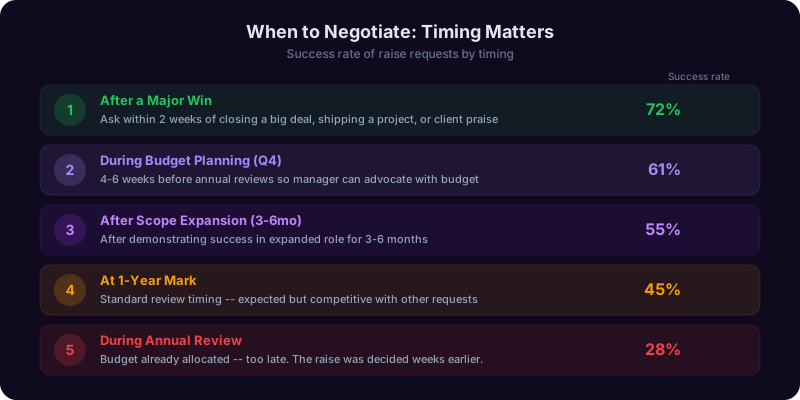
The worst time to ask for a raise is during your annual review. By then, the budget has already been allocated. The best times:
- After a major win: You just closed a big deal, shipped a critical project, or received glowing feedback from a client. The recency of your impact is fresh in your manager's mind. Ask within 2 weeks of the win.
- When you have taken on new responsibilities: If your role has expanded beyond your job description (and you have been performing well in the expanded role for at least 3-6 months), you have a strong case. See our guide on scope creep at work and learn how to write a cover letter that gets you to the offer stage in the first place for more on this.
- During budget planning season: Typically Q4 for calendar-year companies. Ask 4-6 weeks before reviews happen so your manager can advocate for you during budget allocation.
- After receiving a competing offer: This is high-risk, high-reward. Only use this if you are genuinely willing to leave. We cover this in Section 5.
- At the 1-year mark in a new role: If you were promised a salary review after your first year, hold them to it. Set a calendar reminder for 11 months.
Build Your Case: The Impact Document
Before you walk into the meeting, prepare a one-page impact document. This is not your resume. It is a summary of what you have delivered since your last compensation change. Include: Try our AI resume builder for step-by-step help.
- Revenue impact: "Led the launch of [product/feature] that generated $340,000 in new ARR in Q2."
- Cost savings: "Implemented [process change] that reduced operational costs by $85,000 annually."
- Scope expansion: "Took ownership of [new responsibility] in addition to my core role, equivalent to 0.5 FTE of additional work."
- Team impact: "Mentored 3 junior team members, two of whom were promoted within 12 months."
- Market data: "Current market rate for this role with my experience level is $X-$Y. My current compensation is $Z, which is [X%] below the midpoint."
The Meeting Script
You: "[Manager's name], I appreciate you making time for this conversation. I wanted to discuss my compensation. Over the past [timeframe], I have [biggest accomplishment with specific numbers]. I have also [second accomplishment]. Based on the scope of my current responsibilities and the market rate for this role, I would like to discuss adjusting my salary to [$Target Number]."
Then stop talking. The most common mistake in raise negotiations is filling the silence. Make your case, state your number, and wait for a response.
If they say "I need to check with HR/my manager":
You: "I completely understand. I have put together a summary of my contributions and market data to make the conversation easier on your end. [Hand over or email your impact document.] Could we set a follow-up meeting for [specific date, 1-2 weeks out] to discuss next steps?"
Following Up in Writing
After the meeting, send a follow-up email within 24 hours:
Subject: Follow-up: Compensation Discussion
Hi [Manager's Name],
Thank you for taking the time to discuss my compensation today. To summarize our conversation, I requested an adjustment to [$Amount] based on [brief recap of your key points]. You mentioned you would [what they said they would do, e.g., discuss with HR, review the budget].
I have attached the impact summary we discussed for your reference. I look forward to continuing the conversation on [date you agreed on].
Thank you,
[Your Name]
What to Do If They Say No
A "no" is rarely permanent. It usually means one of three things:
- "No, not right now" (budget constraints): Ask: "I understand. Can we agree on a specific date to revisit this? And can we define what milestones would make the case clear?" Get this in writing.
- "No, you have not demonstrated enough" (performance gap): Ask: "I appreciate the honesty. Can you tell me specifically what you need to see from me in the next 6 months to justify this adjustment?" Document their answer and hit every target.
- "No, and it is not going to change" (structural ceiling): This is your signal to start exploring external opportunities. Your market rate exists whether your current employer pays it or not. A Career Copilot session can help you assess your options.
The Counter-Offer: Templates and Strategies
You have the offer. You have done the research. Now it is time to counter. This section gives you the exact templates and the strategic thinking behind each one.
How Much to Counter: The 10-20% Rule
As a general rule, counter 10-20% above the initial offer. Here is the logic:
- Under 10%: The company may just say yes immediately, which means you probably could have asked for more. A counter of 5% or less is barely worth the conversation.
- 10-15%: This is the sweet spot for most roles. It signals that you have done your research, you value yourself appropriately, and you are being reasonable. Most companies will either meet you here or split the difference.
- 15-20%: Appropriate when the initial offer is clearly below market, when you have competing offers, or when you bring rare skills to the table. You need strong justification at this level.
- Over 20%: Use only when the offer is genuinely lowball (e.g., 25th percentile for your market) or when you have a competing offer at a significantly higher number. Countering more than 20% without strong justification can signal that you are not a fit.
Counter Offer Email Template #1: The Standard Counter
Subject: Re: Offer - [Role Title]
Hi [Name],
Thank you for the offer of [$X] for the [Role] position. I am excited about the opportunity to join [Company] and contribute to [specific thing you discussed in interviews].
After researching current market compensation for this role in [location], and considering my [X years of experience / specific skill / relevant credential], I would like to propose a base salary of [$X + 15-20%]. This aligns with the [60th-75th percentile / upper range] of market data for comparable roles.
I am very motivated to make this work and am open to discussing the full compensation package. Looking forward to your thoughts.
Best,
[Your Name]
Counter Offer Email Template #2: When You Have a Competing Offer
Subject: Re: Offer - [Role Title]
Hi [Name],
Thank you for the offer. I want to be upfront: [Company Name] is my first choice, and this role is exactly where I want to be.
I do want to share that I have received a competing offer at [$Competing Amount] for a similar role. I am not trying to create a bidding war. I am sharing this because I want to be transparent and give [Company] the opportunity to put together a package that makes the decision straightforward for me.
Would it be possible to adjust the base salary to [$Amount]? I am also open to discussing other forms of compensation such as a signing bonus or equity adjustment if base salary flexibility is limited.
I am excited about this opportunity and hope we can find a number that works for both of us.
Best,
[Your Name]
Counter Offer Email Template #3: Countering Beyond Salary
Subject: Re: Offer - [Role Title]
Hi [Name],
Thank you for the offer of [$X]. I appreciate the time the team has invested in this process, and I am genuinely excited about the role.
I understand that base salary may have limited flexibility, so I would like to propose a few adjustments to the overall package:
1. A signing bonus of [$5,000-$15,000] to bridge the gap between the offered base and my target range
2. An additional [5-10] days of PTO annually
3. A remote work arrangement of [X days per week]
4. An accelerated review at the 6-month mark with a defined path to [$Target Salary]I am flexible on the specifics and happy to discuss which of these would work best for [Company]. The goal is to find a package where I can focus entirely on delivering results from day one.
Best,
[Your Name]
When to Accept vs. Push Further
After your initial counter, the company will respond with one of four outcomes:
- They meet your number: Accept. Do not push further. You got what you asked for.
- They come up but not to your number: This is the most common outcome. If the new number is at or above your Target (not your Stretch), accept. If it is between your Floor and Target, you can push once more with a specific ask: "Could we split the difference at [$Midpoint]?"
- They hold firm on the original number: Ask about non-salary levers (signing bonus, equity, PTO, remote flexibility). If nothing moves, decide based on your Floor number.
- They increase non-salary comp instead: Calculate the total value. A $5,000 signing bonus + 5 extra PTO days + full remote has real dollar value. Evaluate the full package, not just base salary.
The Salary Copilot can help you evaluate whether a counter offer represents fair market value or whether you should push further based on your specific situation.
Negotiating Beyond Base Salary: The Full Compensation Toolkit
Base salary gets the most attention, but the biggest compensation gains often come from negotiating other parts of the package. Many companies have more flexibility on these items because they do not set permanent precedents the way base salary does.
Signing Bonuses: $5,000-$50,000+
A signing bonus is a one-time payment, usually paid within your first 1-3 months. Companies love signing bonuses because they do not increase your ongoing salary expense. Use them when:
- The company cannot meet your base salary target but wants to close the gap
- You are leaving unvested equity or a pending bonus at your current employer (this is called a "make-whole" bonus)
- You are relocating for the role
Typical ranges by level:
- Individual Contributor: $5,000-$15,000
- Senior IC / Manager: $10,000-$30,000
- Director+: $20,000-$50,000+
- Executive: $50,000-$200,000+
Script: "I understand the base salary has limited flexibility. Would it be possible to include a signing bonus of [$X] to bridge the gap? This would help offset [the bonus I am forfeiting at my current employer / relocation costs / the difference between the offered base and my target range]."
Equity: RSUs, Stock Options, and Startup Grants
Equity compensation varies dramatically by company type:
RSUs (Restricted Stock Units) at public companies: These are real shares of stock granted to you on a vesting schedule, typically over 4 years with a 1-year cliff. An RSU grant of $100,000 means you receive $25,000 worth of stock each year (at vesting price). RSUs are the most straightforward form of equity. Negotiate for a higher grant amount or a shorter vesting schedule.
Stock options at private companies: You receive the right to buy shares at a set price (the "strike price"). If the company goes public or gets acquired at a higher valuation, you profit on the difference. The key questions to ask:
- What is the current 409A valuation (fair market value)?
- How many total shares are outstanding (to calculate your percentage ownership)?
- What is the vesting schedule?
- What happens to your options if you leave before they vest?
- Is there an exercise window after departure (90 days is standard but brutal; some companies offer 5-10 years)?
Typical equity values by stage:
- Seed-stage startup: 0.25%-1.5% for early engineers, 0.05%-0.25% for later hires
- Series A-B: 0.1%-0.5% for senior roles
- Series C+: 0.02%-0.15% for senior roles
- Public companies: $50,000-$500,000+ in RSUs annually for senior roles
Remote Work and Flexible Schedule
The monetary value of remote work is significant and quantifiable:
- Commuting costs saved: The average American spends $8,466 per year on commuting (AAA, 2025). Full remote eliminates this.
- Time saved: The average round-trip commute is 55 minutes per day. Over a year, that is 230 hours - nearly six 40-hour work weeks.
- Geographic arbitrage: If the company is in San Francisco but you live in Austin, you may accept a 10-15% salary cut and still come out ahead on cost of living.
Script: "Would the team be open to a remote or hybrid arrangement? I have found that I do my best work with [X days per week at home], and I have [X years of remote experience] demonstrating my ability to deliver in a distributed environment."
Professional Development Budget: $1,000-$10,000
Many companies have professional development budgets that are underutilized. Ask for:
- Conference attendance: $2,000-$5,000 per conference (registration + travel)
- Certification programs: $500-$5,000 depending on the certification
- Executive coaching: $3,000-$15,000 per engagement (the Executive Coaching Copilot can help you identify which development areas to prioritize)
- Tuition reimbursement: Many companies offer $5,250 per year tax-free
Additional PTO: 5-10 Extra Days
Standard PTO in the US is 15-20 days. Extra PTO is one of the easiest things to negotiate because it costs the company nothing out of pocket. Five extra days off is worth approximately 2% of your salary in time value. At a $100,000 salary, that is $2,000 in value per year.
Script: "I currently receive [X] days of PTO. Would it be possible to match that at [X+5] days? This is important to me for maintaining the energy and focus I will need to deliver in this role."
Relocation Packages: $5,000-$50,000
If you are moving for the job, negotiate for:
- Moving expenses (full-service move: $5,000-$15,000)
- Temporary housing (1-3 months of furnished housing: $3,000-$8,000/month)
- House-hunting trips (2-3 trips: $2,000-$5,000)
- Lease break coverage if applicable
- Cost-of-living adjustment if moving to a more expensive market
What to Do When They Say "Final Offer"
The recruiter says: "This is our final offer." Your stomach drops. Is it really final? Sometimes yes. Often no. Here is how to tell the difference and what to do in each case.
Is It Really Final?
"Final offer" means different things in different contexts:
- When a recruiter says it: About 60% of the time, this is a negotiation tactic. Recruiters are trained to create urgency. If the company has invested weeks in interviewing you, they are unlikely to walk away over 5-10%. Test it politely.
- When the hiring manager says it: More likely to be genuine, especially if they specify budget constraints or explain why. Still worth a soft push on non-salary items.
- When HR/compensation team says it after multiple rounds: This is almost always real. Companies have pay bands, and if you have hit the top of the band, there is a structural ceiling that even the hiring manager cannot override.
- When it comes after your second or third counter: If you have already gone back and forth twice, the third number is usually genuinely final. Pushing further risks damaging the relationship.
How to Test Whether It Is Really Final
Use the "soft close" technique. Instead of pushing on the same item, shift to a different lever:
"I appreciate you working with me on this. I understand the base salary is firm at [$X]. Could we explore a signing bonus of [$Y] to bridge the gap? That way we can move forward without adjusting the base salary structure."
If they say yes to the alternative, the "final offer" was about base salary specifically, not total compensation. If they say no to everything, it is genuinely final.
The "Everything Else" Approach
When salary is truly locked, negotiate the peripherals. In order of typical flexibility:
- Start date: A later start date gives you a gap between jobs (free vacation) and may let you collect a bonus or vest more equity at your current employer. Worth $2,000-$20,000+ depending on what you are leaving behind.
- Title: A higher title costs the company nothing but affects your future earning potential. "Senior" in your title today means higher offers tomorrow.
- Review timeline: "Could we schedule a compensation review at 6 months instead of 12, with a defined path to [$Target]?" This is often the most valuable thing you can negotiate after a "final offer" because it shortens the timeline to your real number.
- Work arrangement: Remote days, flexible hours, compressed work week.
- Equipment/setup budget: Home office setup: $1,000-$3,000. This is a one-time cost that most managers can approve without HR involvement.
The Walking Away Framework
Sometimes the right answer is to walk away. Use this decision matrix:
- Walk away if: The final offer is below your Floor number AND you have other active opportunities. No job is worth starting resentful about your pay.
- Accept if: The total compensation (salary + bonus + equity + benefits + perks) meets your Target range, even if the base salary alone does not.
- Accept with a plan if: The offer is between your Floor and Target. Accept, but negotiate a 6-month review and start building your case for a raise from day one. Document everything.
- Request time if unsure: "I need 48 hours to make a decision this important. I want to say yes for the right reasons." A company that will not give you 48 hours is waving a red flag about their culture.
For more on evaluating when to accept versus walk away, the Career Copilot can help you weigh the full decision beyond just compensation - including growth potential, culture fit, and long-term career trajectory.
Scripts for Difficult Situations
Not every negotiation follows a clean path. Here are word-for-word scripts for the situations that make people freeze.
Responding to a Lowball Offer
A lowball offer is one that comes in at the 25th percentile or below for your market. It happens, and it does not necessarily mean the company is trying to take advantage of you. Sometimes it reflects internal pay bands, budget constraints, or simply a starting point for negotiation.
You: "Thank you for the offer. I am excited about this role and the team. I want to be straightforward: the offered salary of [$X] is significantly below the market range I am seeing for this role, which is [$Market Range]. I have [X years of experience] and [specific value-add]. I would need to see the base salary closer to [$Target] to move forward. Is there flexibility to revisit this number?"
Key principles: Do not be apologetic. Do not be hostile. State the gap factually and ask directly whether they can close it. If they cannot, you have your answer.
Using a Competing Offer Without Burning Bridges
Having a competing offer is powerful leverage, but using it clumsily can backfire. The goal is to inform, not threaten.
You: "I want to share something with you because I respect this process and want to be transparent. I have received another offer at [$Amount] for a [similar/comparable] role. I want to be clear: [Company Name] is where I want to be. But the compensation gap is meaningful, and I want to give you the opportunity to make this decision easy for me. Is there room to adjust the offer?"
Never bluff about a competing offer. If they call your bluff and you cannot produce it, you have destroyed your credibility. Only use this when you genuinely have another offer in hand.
Negotiating an Internal Promotion
Internal promotions often come with raises of 3-5%, which is insulting when the new role would command 15-25% more if filled externally. Here is how to address it:
You: "I am grateful for this promotion and excited to take on the [new role]. I want to discuss the compensation adjustment. The proposed [X%] increase would put me at [$Y], which is [$Z] below the market rate for someone being hired into this role externally. I have been performing at the [new role] level for [X months] already, and I have [specific accomplishments]. I would like to discuss bringing my compensation to [$Market Rate] to reflect the scope of the new position."
If they say the increase is the maximum for internal promotions, ask: "Is there a path to market rate within 6-12 months? Can we document specific milestones and a committed timeline?" Get it in writing.
Negotiating Startup Equity
Startup equity is where the most money is either made or lost, and most people negotiate it poorly because they do not understand what they are getting.
You: "I am excited about the equity component of this offer. Before I can evaluate it properly, I need to understand a few things: What is the current 409A valuation? How many fully diluted shares are outstanding? What is the vesting schedule, and is there an exercise window after departure? And can you share the terms of the most recent funding round so I can understand the liquidation preferences?"
These questions signal sophistication and protect you from common equity traps. A company that refuses to share this information is a company whose equity you should discount to near zero in your compensation calculation.
Key equity negotiation levers:
- Grant size (more shares or more options)
- Vesting schedule (3 years instead of 4, or monthly vesting instead of annual cliff)
- Exercise window (10 years instead of 90 days after departure)
- Acceleration on change of control (your equity vests faster if the company is acquired)
When You Are Currently Underpaid
If your current salary is below market and the new company asks what you currently earn (illegal to ask in 22 states as of 2026, but it still happens):
You: "I would prefer to focus on the value I will bring to this role rather than my current compensation, which does not reflect my market rate. Based on my research, the appropriate range for this position is [$X-$Y]."
In states where salary history questions are banned (California, New York, Illinois, Colorado, Washington, and others), you can simply say: "I believe that question is not permitted in [State]. I am happy to discuss my salary expectations for this role."
For help preparing for any of these difficult situations, the Interview Copilot can run through practice conversations so you are ready when the moment comes. If you are rethinking your career path entirely, the LinkedIn Copilot can help you optimize your profile to attract better offers, and the Resume Copilot can ensure your application materials reflect your true market value.
Frequently Asked Questions
Recommended Copilots
Recommended Copilots
Research market rates and build a personalized salary negotiation strategy
Try Free →Evaluate career moves, assess competing offers, and plan long-term trajectory
Try Free →Practice negotiation conversations and prepare for tough questions
Try Free →Ensure your resume reflects your true market value before applying
Try Free →Optimize your LinkedIn profile to attract higher-paying opportunities
Try Free →Develop leadership presence and communication skills for senior-level negotiations
Try Free →Set and negotiate rates for independent consulting and freelance work
Try Free →Related Articles
Get Answers From the Salary Copilot
Get personalized salary research, custom negotiation scripts, and real-time coaching for your specific role, industry, and experience level. The Salary Copilot has helped thousands of professionals negotiate higher compensation packages.