
The 2026 Student Loan Landscape
Student loan debt in the United States has reached $1.77 trillion across approximately 43.2 million borrowers. That makes it the second-largest category of consumer debt after mortgages, surpassing credit cards, auto loans, and every other form of borrowing. If you are reading this, there is a good chance you are one of those 43.2 million people trying to figure out the best way forward.
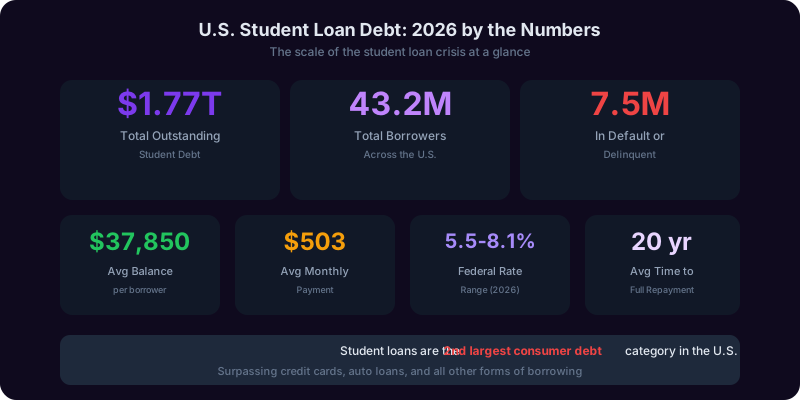
Here are the numbers that define the 2026 student loan landscape:
| Metric | 2026 Figure |
|---|---|
| Total outstanding student debt | $1.77 trillion |
| Number of borrowers | 43.2 million |
| Average individual balance | $37,850 |
| Median individual balance | $22,300 |
| Average monthly payment | $503 |
| Average interest rate (federal) | 5.50% - 8.05% |
| Borrowers in default or delinquent | ~7.5 million |
| Average time to full repayment | 20 years |
Recent Policy Changes You Need to Know
The federal student loan environment has shifted significantly over the past two years. Here is what matters for your repayment decisions right now:
- The SAVE Plan: The Saving on a Valuable Education plan, which replaced REPAYE in 2023, has been the subject of ongoing legal challenges. As of early 2026, the SAVE plan is operational but with modifications following court rulings. Borrowers enrolled in SAVE should verify their current status at StudentAid.gov, as payment calculations and forgiveness timelines have been adjusted.
- On-ramp period ended: The 12-month "on-ramp" that shielded borrowers from default consequences after the pandemic pause ended in September 2024. Missed payments now count against you for credit reporting, collections, and default.
- Interest capitalization rules: New regulations limit when unpaid interest can be added to your principal balance, which benefits borrowers on income-driven plans who have periods of low payments.
- Automatic IDR enrollment: Borrowers who are 75+ days delinquent can now be automatically enrolled in an income-driven repayment plan rather than being pushed toward default.
- PSLF expansion remains in effect: The expanded definitions of qualifying employers and payment types established in recent years continue to apply, making PSLF accessible to more borrowers.
The bottom line is that you have more repayment options than ever, but the differences between them can mean tens of thousands of dollars saved or lost. The rest of this guide breaks down every option with specific numbers so you can make the best decision for your situation. For more context on federal student aid programs and current interest rates, see the official federal student loan interest rate page.
Note: This guide covers federal student loans primarily. Private student loans have fewer repayment options and are not eligible for federal forgiveness programs. If you have a mix of both, the Student Loans Copilot can help you build a strategy that addresses each type.
Every Repayment Plan Compared: The Complete Table
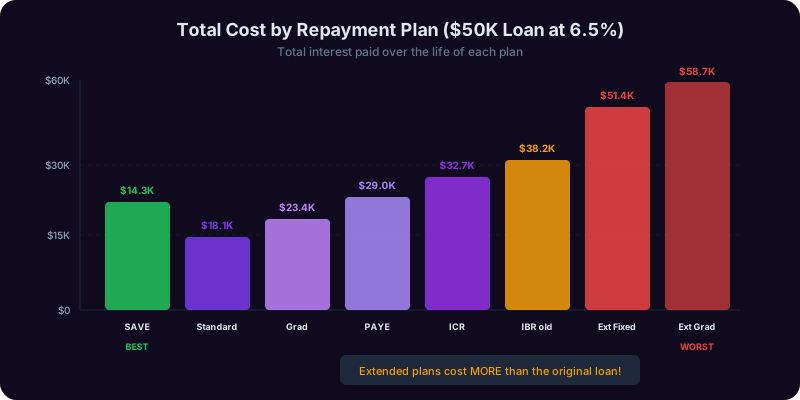
This is the comparison table most borrowers never see. We are using a $50,000 loan at 6.5% interest as the baseline so you can compare apples to apples across every federal repayment plan. For income-driven plans, we assume a starting salary of $55,000 with 3% annual raises.
| Plan | Monthly Payment (Start) | Monthly Payment (Year 10) | Total Paid Over Life | Total Interest | Forgiveness? | Timeline |
|---|---|---|---|---|---|---|
| Standard 10-Year | $568 | $568 | $68,136 | $18,136 | No | 10 years |
| Graduated | $336 | $767 | $73,440 | $23,440 | No | 10 years |
| Extended Fixed (25-yr) | $338 | $338 | $101,400 | $51,400 | No | 25 years |
| Extended Graduated (25-yr) | $254 | $580 | $108,720 | $58,720 | No | 25 years |
| SAVE | $198 | $271 | $64,300* | $14,300* | Yes | 20-25 years |
| PAYE | $287 | $393 | $78,960 | $28,960 | Yes | 20 years |
| IBR (new borrowers) | $287 | $393 | $78,960 | $28,960 | Yes | 20 years |
| IBR (pre-2014 borrowers) | $383 | $524 | $88,200 | $38,200 | Yes | 25 years |
| ICR | $441 | $568 | $82,680 | $32,680 | Yes | 25 years |
*SAVE plan totals reflect the plan's interest subsidy, which prevents your balance from growing when your payments do not cover accruing interest. Actual totals vary based on income trajectory and any forgiven balance.
What Jumps Out From This Table
- The Standard plan is not the cheapest in total cost. For this borrower profile, SAVE actually results in less total interest paid than the Standard plan, thanks to the interest subsidy and potential forgiveness. That is counterintuitive and why running your specific numbers matters.
- Extended plans are extraordinarily expensive. The Extended Fixed plan costs you $51,400 in interest alone - more than the original loan. The lower monthly payment is tempting, but you are essentially paying for the loan twice.
- Graduated plans front-load savings but back-load pain. Your payments start low but increase every two years. By year 8-10, you are paying significantly more than the Standard plan, and the total cost is $5,000-$40,000 higher.
- IDR plans only save money if you actually receive forgiveness. If your income rises enough that your IDR payments match or exceed the Standard payment, you will not have a balance left to forgive, but you will have paid more total interest over the longer repayment period.
The right plan depends entirely on your income trajectory, career plans, and whether you qualify for forgiveness programs. The Federal Student Aid Loan Simulator lets you model different scenarios with your actual loan data, and a Student Loans Copilot session can run your specific numbers across every plan in minutes.
Income-Driven Repayment: The Complete Breakdown
Income-driven repayment (IDR) plans are the most complex and most misunderstood part of student loan repayment. Over 13 million borrowers are enrolled in some form of IDR, but many are on the wrong plan for their situation - costing them thousands of dollars.
How IDR Payments Are Calculated
Every IDR plan uses the same basic formula, with different percentages:
Monthly Payment = (AGI - 150% to 225% of Federal Poverty Line) x Payment Percentage / 12
Here is what each variable means:
- AGI (Adjusted Gross Income): Your total income minus specific deductions (retirement contributions, HSA contributions, student loan interest deduction). This comes directly from your tax return - Line 11 of your 1040.
- Federal Poverty Line (FPL): For 2026, the FPL for a single person in the contiguous US is approximately $15,650. For a family of four, it is approximately $32,470.
- Discretionary income exemption: Each plan protects a different percentage of the FPL from your payment calculation. SAVE protects 225% of FPL ($35,213 for a single person). PAYE and IBR protect 150% of FPL ($23,475).
- Payment percentage: SAVE charges 5% of discretionary income for undergraduate loans and 10% for graduate loans. PAYE and new IBR charge 10%. Old IBR charges 15%. ICR charges 20%.
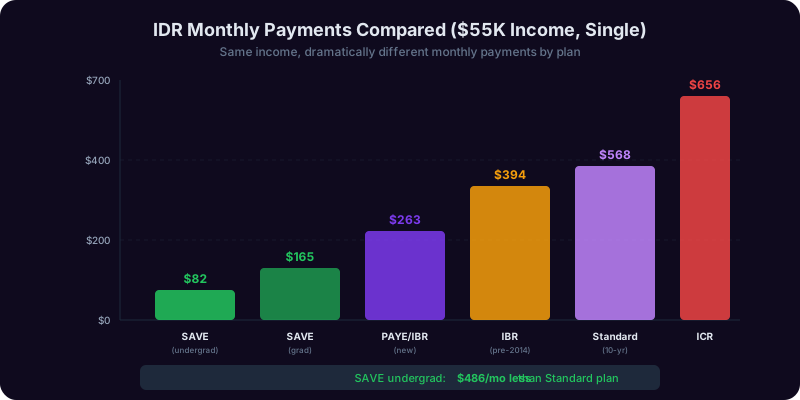
Concrete Example: $55,000 AGI, Single, No Dependents
| Plan | Income Protected | Discretionary Income | Payment % | Monthly Payment |
|---|---|---|---|---|
| SAVE (undergrad) | $35,213 | $19,787 | 5% | $82 |
| SAVE (grad) | $35,213 | $19,787 | 10% | $165 |
| PAYE / IBR (new) | $23,475 | $31,525 | 10% | $263 |
| IBR (pre-2014) | $23,475 | $31,525 | 15% | $394 |
| ICR | $15,650 | $39,350 | 20% | $656 |
Annual Recertification: The Trap Most Borrowers Fall Into
Every IDR plan requires you to recertify your income and family size annually. If you miss the recertification deadline, your payment jumps to the Standard plan amount, and any unpaid interest capitalizes - gets added to your principal balance. For a borrower with $50,000 in loans and $8,000 in accumulated unpaid interest, missing recertification means your balance instantly jumps to $58,000.
Set a calendar reminder 60 days before your recertification date. Log into StudentAid.gov and submit your recertification early. The process takes 5-10 minutes if you allow automatic tax return retrieval.
The Tax Bomb on Forgiveness - and the SAVE Exception
Under traditional IDR plans (PAYE, IBR, ICR), any balance forgiven after 20 or 25 years is treated as taxable income. On a $100,000 forgiven balance, you could owe $22,000-$37,000 in federal income taxes in a single year - the so-called "tax bomb." Try our AI tax filing assistant for step-by-step help.
However, there is a critical exception: through 2025, forgiven student loan balances are tax-free under the American Rescue Plan Act. Whether this exclusion will be extended beyond 2025 is uncertain as of this writing. Additionally, the SAVE plan was designed with provisions to minimize the tax impact of forgiveness, though the specifics depend on ongoing regulatory and legal developments.
PSLF forgiveness, by contrast, has always been tax-free and remains so regardless of legislative changes.
The Married Filing Separately Strategy
If you are married and on PAYE or IBR, your payment is based on your combined household AGI if you file taxes jointly. Filing separately means only your individual income counts for the IDR calculation. For a couple where one spouse earns significantly more, this can reduce the IDR payment by hundreds of dollars per month.
The trade-off: married filing separately means you lose several tax benefits, including the earned income tax credit, child and dependent care credit (reduced), and education credits. Run both scenarios through the Tax Copilot to see which filing status saves you more overall.
Important note for SAVE: Under the SAVE plan, spousal income is excluded from the payment calculation regardless of tax filing status for borrowers with separate loans. This was a major advantage of SAVE, though borrowers should confirm current rules apply given ongoing legal challenges.
For a deeper understanding of how your paycheck deductions interact with student loan repayment, read our guide on how to read your pay stub.

Get Answers From the Student Loans Copilot
Enter your loan balances, interest rates, income, and career plans. Get an instant comparison of every repayment strategy showing exactly how much each one saves you.
Public Service Loan Forgiveness (PSLF) - What Actually Qualifies
Public Service Loan Forgiveness is the single most valuable student loan benefit available. After 120 qualifying payments (10 years), your remaining federal loan balance is forgiven - completely tax-free. On a $100,000 balance with IDR payments of $300/month, that is roughly $64,000 in forgiven debt. But PSLF is also the program with the most rejected applications, historically over 90% - because borrowers make avoidable mistakes.
Qualifying Employers
PSLF requires you to work full-time (30+ hours per week) for a qualifying employer. Qualifying employers include:
- Federal, state, local, and tribal government agencies - this includes the military, public universities, public school systems, government hospitals, and law enforcement
- 501(c)(3) nonprofit organizations - hospitals, charities, religious organizations, and most nonprofits qualify
- Other nonprofits providing qualifying public services - even non-501(c)(3) organizations that provide emergency management, military service, public safety, public health, public education, public library services, or legal services for underserved populations
Employers that do NOT qualify: for-profit companies (regardless of their mission), labor unions, partisan political organizations, and for-profit government contractors.
Verify your employer: Use the PSLF Help Tool at StudentAid.gov to confirm your employer qualifies before counting on forgiveness. Enter your employer's name and EIN, and the tool will tell you whether they meet the criteria.
Qualifying Payments
Not every payment you make counts toward your 120. To qualify, a payment must be:
- Made on a qualifying repayment plan: Any IDR plan qualifies (SAVE, PAYE, IBR, ICR). The Standard 10-Year plan technically qualifies, but since it pays off your loan in exactly 10 years, there would be nothing left to forgive. Graduated and Extended plans do NOT qualify.
- Made on time and in full: Payments must be made within 15 days of the due date for the full amount due.
- Made while working full-time for a qualifying employer: Part-time work at two qualifying employers can count if your combined hours exceed 30 per week.
- Made on Direct Loans: Only Direct Loans qualify. FFEL and Perkins loans must be consolidated into a Direct Consolidation Loan first - and payments made before consolidation do NOT count.
Common PSLF Mistakes That Reset Your Count
These are the errors that cause the most PSLF rejections:
- Wrong loan type: Being on FFEL loans instead of Direct Loans. If you borrowed before 2010, check your loan type at StudentAid.gov. Consolidate to Direct Loans immediately if needed - every month you delay is a payment that will not count.
- Wrong repayment plan: Graduated or Extended plans do not qualify. Switching to an IDR plan after years on Graduated means those years do not count.
- Gaps in qualifying employment: If you switch to a non-qualifying employer for even one month, payments during that month do not count. Plan job transitions carefully.
- Not filing the Employment Certification Form (ECF): While not technically required annually, filing the ECF every year (and every time you change employers) is the single best thing you can do to protect yourself. It creates a contemporaneous record of your qualifying employment.
- Forbearance or deferment months: Months in forbearance or deferment do not count as qualifying payments, even if you are working for a qualifying employer. Avoid forbearance if at all possible.
The ECF Filing Strategy
File your Employment Certification Form (now called the PSLF Form) through the MOHELA servicer portal or at StudentAid.gov. Do this:
- When you first start working for a qualifying employer
- Every year, at the same time (many people file with their taxes)
- Every time you change employers
- Before you apply for forgiveness
Each time you file, MOHELA will update your qualifying payment count. This way, you will know immediately if something is wrong rather than discovering it after 10 years. Over 30% of PSLF denials are due to employment that did not qualify - filing the ECF annually catches this early.
TEPSLF: The Safety Net
Temporary Expanded Public Service Loan Forgiveness (TEPSLF) was created to help borrowers who were on the wrong repayment plan. If you made payments on a non-qualifying plan (like Graduated or Extended) but otherwise met all PSLF requirements, TEPSLF may count those payments. Funding is limited, so apply as soon as you believe you may qualify. Use the Student Loans Copilot to check your eligibility and walk through the application process.
Should You Refinance? The Math Behind the Decision
Refinancing replaces your existing loans with a new private loan at a lower interest rate. It can save you thousands - or it can be one of the most expensive mistakes you make. Here is how to decide.
When Refinancing Saves You Money
Refinancing makes sense when ALL of the following are true:
- Your current interest rate is above 6% and you can qualify for a rate below 5%
- You are NOT pursuing PSLF or IDR forgiveness - refinancing converts federal loans to private, permanently disqualifying you from all federal programs
- Your income is stable and sufficient to handle fixed payments without the safety net of IDR plans, forbearance, or deferment
- You have an emergency fund of at least 3-6 months of expenses (see our emergency fund guide)
- Your credit score is 680+ (ideally 720+) to qualify for the best rates - learn more in our credit score guide
Current Refinance Rates (May 2026)
| Lender Type | 5-Year Fixed | 10-Year Fixed | 15-Year Fixed | Variable (starts at) |
|---|---|---|---|---|
| Top-tier (740+ credit) | 4.49% | 5.09% | 5.49% | 4.19% |
| Mid-tier (700-739) | 5.29% | 5.89% | 6.29% | 4.99% |
| Lower-tier (680-699) | 6.29% | 6.89% | 7.29% | 5.99% |
Rates are approximate and vary by lender, loan amount, and term. Always compare at least 3-5 lenders. The CFPB student loan tools can help you understand your refinancing options and borrower rights.
Break-Even Calculator: A Worked Example
Let us run the numbers on a common scenario:
Current situation: $50,000 in federal loans at 6.5%, Standard 10-Year plan, monthly payment of $568, total interest over life of loan: $18,136
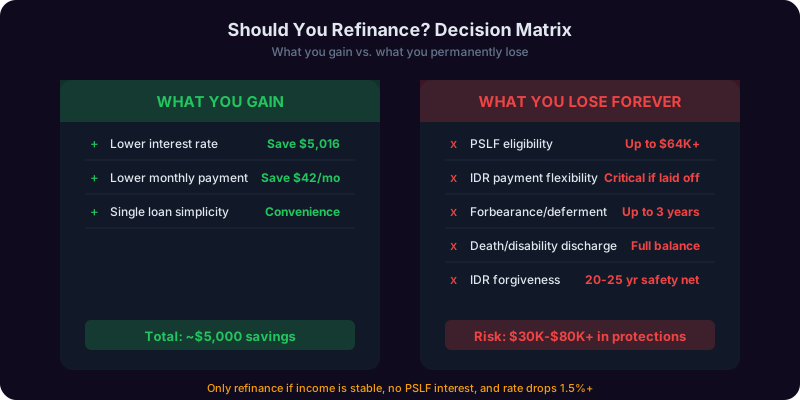
Refinance offer: $50,000 at 4.8%, 10-Year fixed, monthly payment of $526, total interest over life of loan: $13,120
Savings: $5,016 in interest over 10 years, or $42/month
Now factor in what you are giving up:
| Federal Protection Lost | Estimated Value |
|---|---|
| IDR payment flexibility | $0 if income stays stable; thousands if you lose your job |
| Forbearance/deferment | $0 unless you need it; up to $6,816/year if you do (12 months of skipped $568 payments) |
| PSLF eligibility | $0 if you never work in public service; up to $64,000+ if you do |
| Death/disability discharge | $50,000 (your estate would owe the private loan) |
| Tax-free forgiveness potential | $0-$50,000+ depending on IDR trajectory |
For borrowers with high, stable incomes in the private sector who have no interest in PSLF and will never need IDR - refinancing is often worth it. For everyone else, the math is much less clear.
When Refinancing Costs You
- You refinance and then lose your job. Private lenders offer limited forbearance (typically 3-6 months total). Federal loans offer up to 3 years of forbearance and indefinite access to $0 IDR payments.
- You refinance and then switch to public service. You have permanently lost PSLF eligibility. On $50,000 in loans, that could be a $30,000-$60,000 mistake.
- You refinance to a longer term. Going from a 10-year federal loan at 6.5% to a 15-year refinance at 5.0% lowers your payment from $568 to $395, but your total interest increases from $18,136 to $21,072. You pay more overall despite the lower rate.
- You refinance a variable rate near a rate floor. Variable rates that start at 4.19% can rise to 10%+ over the life of the loan if interest rates increase. Fixed rates are almost always the safer choice for terms longer than 5 years.
Need help running your specific refinance scenario? The Finance Copilot can calculate your break-even point and factor in the value of lost federal protections.
The Avalanche vs Snowball Debate Settled With Real Numbers
If you are paying extra on your student loans (above the minimum payment), you need a strategy for which loan to target first. The two main approaches are the avalanche method and the snowball method, and the debate between them is one of the most persistent in personal finance. Let us settle it with real numbers.
The Test Portfolio
We will use a realistic multi-loan portfolio totaling $50,000: Try our AI investment analysis tool for step-by-step help.
| Loan | Balance | Interest Rate | Minimum Payment |
|---|---|---|---|
| Loan A (freshman year) | $8,500 | 4.5% | $88 |
| Loan B (sophomore year) | $10,000 | 5.0% | $106 |
| Loan C (junior year) | $12,500 | 6.0% | $139 |
| Loan D (grad school) | $19,000 | 7.5% | $225 |
| Total | $50,000 | 6.1% weighted avg | $558/month |
Extra payment available: $300/month (total payment: $858/month)
Avalanche Method: Target Highest Interest Rate First
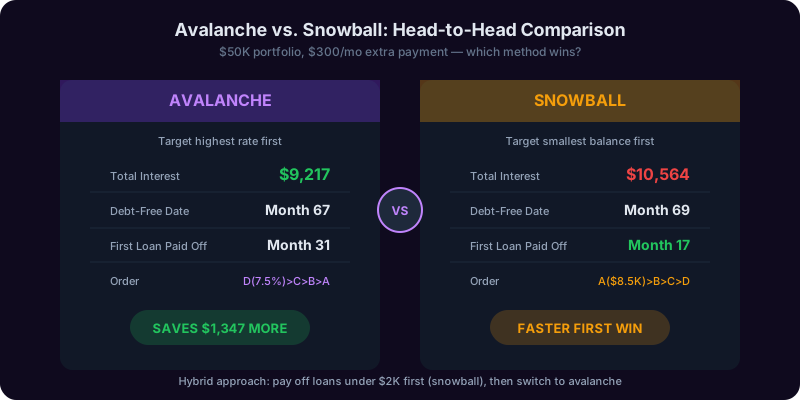
The avalanche method directs all extra payments to Loan D (7.5%) first, then Loan C (6.0%), then Loan B (5.0%), then Loan A (4.5%). This minimizes total interest paid because you are eliminating the most expensive debt first.
Results:
- Total time to pay off all loans: 5 years, 7 months
- Total interest paid: $9,217
- First loan fully paid off: Month 31 (Loan D)
Snowball Method: Target Smallest Balance First
The snowball method directs all extra payments to Loan A ($8,500) first, then Loan B ($10,000), then Loan C ($12,500), then Loan D ($19,000). The logic is psychological: quick wins motivate you to keep going.
Results:
- Total time to pay off all loans: 5 years, 9 months
- Total interest paid: $10,564
- First loan fully paid off: Month 17 (Loan A)
Head-to-Head Comparison
| Metric | Avalanche | Snowball | Difference |
|---|---|---|---|
| Total interest paid | $9,217 | $10,564 | $1,347 more (snowball) |
| Debt-free date | Month 67 | Month 69 | 2 months longer (snowball) |
| First loan eliminated | Month 31 | Month 17 | 14 months sooner (snowball) |
| Loans eliminated by Month 24 | 0 | 1 | Snowball wins on momentum |
The Verdict
The avalanche method saves $1,347 in this scenario. On larger portfolios with wider rate spreads, the savings can reach $3,000-$5,000. Mathematically, avalanche always wins.
But here is the thing: research from Harvard Business Review found that people who use the snowball method are more likely to actually pay off their debt. The quick wins create a psychological momentum that keeps people committed. A mathematically perfect plan you abandon in month 14 saves you nothing.
The Hybrid Approach: Best of Both
The optimal strategy for most people combines both methods:
- First, knock out any loan under $2,000. The quick win costs you almost nothing in extra interest but gives you one fewer payment to manage and an immediate morale boost.
- Then switch to avalanche. Target the highest interest rate for all remaining loans.
- If motivation drops, pick off the next smallest balance to regain momentum, then switch back to avalanche.
This hybrid approach typically costs less than $200 more than pure avalanche while maintaining the psychological benefits of snowball. It is the approach most financial planners actually recommend for real humans with real emotions about money.
You can model all three approaches with your actual loan balances using the Budgeting Copilot to see exactly how much each strategy saves in your specific situation. If you are also working a side hustle to accelerate payments, make sure you understand the tax implications of that extra income.
Tax Deductions and Credits for Student Loan Borrowers
Taxes and student loans intersect in several important ways. These deductions and credits will not eliminate your debt, but they can put $500-$2,000+ back in your pocket each year.
Student Loan Interest Deduction
You can deduct up to $2,500 of student loan interest paid during the year, directly reducing your taxable income. This is an "above-the-line" deduction, meaning you get it even if you do not itemize. See the IRS Topic 456 for the full rules on claiming this deduction.
Key details:
- Maximum deduction: $2,500
- Tax savings at 22% bracket: $550
- Tax savings at 24% bracket: $600
- Income phase-out (single): Modified AGI of $80,000-$95,000. Deduction starts decreasing at $80,000 and disappears entirely at $95,000.
- Income phase-out (married filing jointly): Modified AGI of $165,000-$195,000
- Married filing separately: Not eligible. This is one of the trade-offs of the MFS strategy for IDR plans.
- Applies to both federal and private loans
Your loan servicer will send you Form 1098-E by January 31 showing the interest you paid. If you paid less than $600 in interest, you may not receive the form, but you can still claim the deduction - check your account statements.
Employer Student Loan Repayment Programs
Under Section 127 of the tax code, employers can contribute up to $5,250 per year toward an employee's student loan payments tax-free. This means the payment is not counted as taxable income for the employee and is deductible as a business expense for the employer.
As of 2026, this provision has been extended through the latest budget legislation. Check with your employer's HR department - an increasing number of companies offer this benefit, and many employees do not know it exists.
If your employer contributes $5,250 annually, that is:
- $437.50 per month toward your loans
- $26,250 over 5 years
- Tax savings of $1,155-$1,260/year (depending on your bracket) compared to receiving the same amount as salary
State-Specific Deductions and Credits
Several states offer additional tax benefits for student loan borrowers beyond the federal deduction:
| State | Benefit | Maximum |
|---|---|---|
| Minnesota | Student loan interest credit | $500 credit |
| Indiana | Student loan interest deduction | $2,500 (mirrors federal) |
| Maine | Student loan tax credit (Opportunity Maine) | Up to actual payments made |
| Maryland | Student loan debt relief tax credit | $5,000 |
| South Carolina | Student loan interest deduction | $2,500 |
| Pennsylvania | Student loan forgiveness for eligible grads | Varies by program |
State programs change frequently. Verify current availability and eligibility requirements at your state's department of revenue website or by asking the Tax Copilot.
The Tax Impact of Loan Forgiveness
If you are on an IDR plan heading toward forgiveness, plan for the tax consequences now:
- PSLF forgiveness: Always tax-free. No action needed.
- IDR forgiveness (through 2025): Tax-free under the American Rescue Plan Act exclusion.
- IDR forgiveness (2026 and beyond): Uncertain. If the exclusion is not extended, forgiven balances will be taxed as ordinary income. On $80,000 forgiven, you could owe $17,600-$29,600 depending on your bracket.
If you are 10+ years from IDR forgiveness, start saving now. Even $50/month in a high-yield savings account for 15 years at 4.5% APY grows to approximately $12,700 - enough to cover the tax bill on up to $50,000 in forgiveness. Check our freelancer tax deductions guide for more tax-saving strategies if you have any self-employment income.
See our real-world walkthrough: first freelance tax season.
Building Your Personalized Repayment Strategy
Every borrower's optimal strategy is different. Use this decision tree to identify your starting point, then fine-tune based on your specific numbers.
The Student Loan Decision Tree
Question 1: Do you work for a qualifying PSLF employer (or plan to within the next 2-3 years)?
- Yes: Enroll in the IDR plan with the lowest payment (usually SAVE for undergrad loans, PAYE for grad loans). File your ECF immediately. Every dollar you pay above the IDR minimum is a dollar wasted - it would have been forgiven. Do not pay extra. Do not refinance. Focus your extra cash on investing, emergency fund, and retirement.
- No: Continue to Question 2.
Question 2: Is your total student loan balance more than your annual gross income?
- Yes: IDR with forgiveness is likely your best path even without PSLF. The interest on high-balance loans often means you will pay more under the Standard plan than under IDR even with the tax bomb on forgiveness. Run the specific numbers.
- No: Continue to Question 3.
Question 3: Is your income stable, above $75,000, and in the private sector?
- Yes and your credit score is 700+: Evaluate refinancing. If you can get a rate at least 1.5% lower than your current rate and you have a solid emergency fund, refinancing may save you thousands.
- No or unstable income: Stay on federal loans. The safety net of IDR, forbearance, and deferment is too valuable to give up. Continue to Question 4.
Question 4: Can you afford to pay more than the minimum each month?
- Yes: Use the hybrid avalanche/snowball method. Target high-interest loans first, but eliminate small balances quickly for momentum.
- No: Enroll in IDR (SAVE or PAYE) to lower your payment. Focus on increasing your income through career development, side income, or job changes. Even a $5,000 raise translates to significant extra loan payments.
Strategy by Income and Balance
| Scenario | Recommended Strategy | Expected Savings vs Standard |
|---|---|---|
| Income <$50K, Balance <$30K | SAVE plan, minimum payments, invest the difference | $3,000-$8,000 |
| Income <$50K, Balance >$50K | SAVE plan, pursue forgiveness (IDR or PSLF) | $15,000-$40,000+ |
| Income $50K-$80K, Balance <$30K | Standard or aggressive payoff (avalanche) | $2,000-$5,000 in interest |
| Income $50K-$80K, Balance $30K-$60K | IDR if pursuing forgiveness, otherwise avalanche with extra payments | Varies widely |
| Income $80K+, Balance <$50K | Refinance (if rate drops 1.5%+) or aggressive avalanche | $3,000-$7,000 |
| Income $80K+, Balance >$100K | PSLF if eligible; otherwise IDR with forgiveness or aggressive refinance | $20,000-$80,000+ |
How AI Can Help You Build Your Plan
The variables involved in student loan optimization - income trajectory, tax implications, forgiveness timelines, refinancing rates, opportunity cost of extra payments vs investing - make this one of the most complex personal finance decisions most people face. Here is how to use Copilotly's AI tools to get it right:
- Student Loans Copilot: Input your specific loan details, income, and career plans. Get a personalized comparison of every repayment strategy with projected savings, monthly payments, and payoff timelines.
- Finance Copilot: Model the trade-off between extra loan payments and investing. If your loan rate is 5% and the market averages 7-10%, should you invest the difference? The answer depends on your risk tolerance, tax situation, and timeline.
- Tax Copilot: Optimize your filing status, deductions, and credits for maximum student loan tax benefits. Especially important for married borrowers deciding between joint and separate filing.
- Budgeting Copilot: Find extra money in your budget to accelerate payments. Most people have $100-$300/month in spending they can redirect once they see where their money actually goes.
- Career Copilot: Explore PSLF-qualifying employers in your field, negotiate salary increases that accelerate payoff, or plan a career transition that changes your optimal repayment strategy.
The difference between the best and worst repayment strategy for a typical borrower is $15,000-$50,000. That is a down payment on a house, five years of retirement contributions, or a life-changing amount of financial breathing room. Take the time to get it right - and if the math feels overwhelming, let AI handle the number-crunching while you focus on the decisions that matter.
For a stronger financial foundation while tackling your loans, make sure to also read our guides on building an emergency fund, understanding your credit score, and how to start investing with just $100 - all essential pieces of the financial puzzle that interact directly with your student loan strategy.
Frequently Asked Questions
Recommended Copilots
Recommended Copilots
Get a personalized comparison of every repayment strategy based on your specific loan details and income
Try Free →Model trade-offs between extra loan payments, investing, and refinancing scenarios
Try Free →Optimize your filing status and deductions for maximum student loan tax benefits
Try Free →Find extra money in your budget to accelerate loan payments
Try Free →Explore PSLF-qualifying employers and salary negotiation to improve your repayment strategy
Try Free →Related Articles
Get Answers From the Student Loans Copilot
Enter your loan balances, interest rates, income, and career plans. Get an instant comparison of every repayment strategy showing exactly how much each one saves you.