
The Remote Work Landscape in 2026: What the Data Actually Says
The remote work debate in 2026 has become one of the biggest disconnects between what executives say and what the data shows. On one side, companies like Amazon, JPMorgan, and Dell have issued full return-to-office mandates, and according to FlexJobs' 2026 remote work report, roughly 77% of job postings now require some form of in-person presence. On the other side, 55% of workers say they want hybrid arrangements, 32% want fully remote, and only 13% actively prefer being in the office five days a week.
The result is massive talent market friction. Companies are mandating RTO. Workers are resisting, quietly quitting, or leaving entirely. And the data continues to show that the mandates are not backed by productivity evidence.
The Productivity Question Is Settled
A landmark Stanford study by Nicholas Bloom, published through the National Bureau of Economic Research, tracked 1,600 workers at a large technology company over two years. Hybrid workers (three days in office, two at home) showed no reduction in productivity compared to full-time office workers. Their performance reviews were identical. Their promotion rates were identical. And their quit rates were 35% lower, saving the company an estimated $11,000 per employee in turnover costs annually.
A 2025 meta-analysis of 148 studies on remote work productivity found that remote workers are on average 4.8% more productive than their in-office counterparts for individual tasks, and roughly equivalent for collaborative work when proper communication tools are in place. The productivity penalty executives cite comes almost exclusively from poorly managed remote transitions, not the arrangement itself.
Why Companies Are Mandating RTO Anyway
If the data supports remote work, why are companies forcing people back? The reasons are about real estate, control, and management philosophy rather than performance:
- Real estate costs: Many companies signed 10-15 year office leases before 2020 and are paying for space whether it is used or not.
- Management style: Many managers equate presence with productivity. They manage by observation, not by output.
- Quiet layoffs: Some RTO mandates are designed to reduce headcount without formal layoffs. Companies know that 10-20% of employees will quit rather than return, saving severance costs.
Understanding these motivations is critical for your negotiation. If your company's RTO mandate is about real estate, your counter-proposal needs to address occupancy metrics. If it is about management visibility, your proposal needs alternative accountability structures. If it is a quiet layoff, your strategy should shift to finding a new employer.
The Financial Value of Remote Work to You
Before you negotiate, quantify what remote work is worth in dollars:
- Commuting costs eliminated: The average American spends $8,466 per year on commuting according to AAA.
- Time recaptured: The average round-trip commute of 55.2 minutes per day adds up to 221 hours per year, equivalent to nearly 5.5 full work weeks.
- Food and wardrobe savings: Lunch out averages $15-20 per day versus $5-7 at home. Professional wardrobe costs drop by $1,000-2,000 per year.
- Total annual value: Full remote work is worth $12,000-$16,000 per year in direct savings and recovered time.
This reframes the negotiation. If a company offers $5,000 more to come into the office five days a week, you are actually losing $7,000-$11,000 in net value. The Career Copilot can help you calculate the exact financial impact based on your specific commute, salary, and cost of living.
Building a Business Case Your Manager Cannot Ignore
The number one mistake people make when asking for remote work is framing it as a personal preference. "I work better from home" is not a business case. It is a statement about your comfort. Managers do not approve comfort requests. They approve proposals that solve business problems. Your remote work request needs to be reframed as a cost reduction, productivity optimization, or retention strategy.
The Five Pillars of a Remote Work Business Case
1. Productivity evidence: Track your output for 30-60 days before making your proposal. Document deliverables completed, response times, and measurable metrics. Concrete example: "In Q1, I completed 47 client deliverables. Thirty-one of those were completed on my remote days, despite having fewer remote days than office days."
2. Cost savings for the company: According to Bureau of Labor Statistics data, the average employer saves $11,000 per year per remote employee in reduced real estate costs, lower absenteeism, and decreased turnover. A typical office desk costs $8,000-$14,000 per year in commercial real estate.
3. Retention value: Replacing an employee costs 50-200% of their annual salary. For a $100,000 employee, that is $50,000-$200,000 in recruiting, onboarding, and lost productivity. If remote work is the difference between you staying and leaving, frame it in these terms. Not as a threat. As a fact about the market.
4. Communication and accountability plan: This is the part most people skip, and it is the part managers care about most. Your proposal must answer: How will I stay visible? How will my manager know what I am working on? How will I be available for urgent requests?
5. Trial period with measurable success criteria: Asking for permanent remote work on day one is a big ask. Asking for a 90-day trial with defined success metrics is much easier to approve.
The One-Page Proposal Template
Put your business case on one page. Managers do not read five-page documents about work arrangements:
REMOTE WORK PROPOSAL: [Your Name]
Request: [Specific arrangement - e.g., 3 days remote, 2 days in office]
Business justification: [2-3 bullet points with data]
Communication plan: [Daily standups, weekly 1:1s, Slack availability, response time commitment]
Accountability metrics: [Specific deliverables, KPIs, deadlines]
Proposed trial period: [90 days with reviews at day 45 and day 90]
Success criteria: [3-5 measurable outcomes that would make the arrangement permanent]
This template shifts the conversation from "Can I please work from home?" to "Here is a low-risk business proposal with defined success metrics."
Common Objections and How to Pre-Empt Them
Anticipate your manager's objections and address them before they have to ask:
- "If I let you do it, everyone will want it." Pre-empt: "I am proposing this as a performance-based arrangement tied to specific metrics, not a blanket policy. If my metrics slip, the arrangement reverts."
- "We need you here for collaboration." Pre-empt: "My proposed in-office days are aligned with collaborative sessions. Remote days are reserved for deep focus work that does not require real-time collaboration."
- "Our culture requires in-person presence." Pre-empt: "I have proposed being in-office on specific days for team events and relationship-building. I believe strategic in-person time is more impactful than mandatory full-time presence."
For help building a personalized business case with industry-specific data, the Career Copilot can analyze your role and situation to generate the strongest possible proposal.
Scripts for the Manager Conversation: Word-for-Word
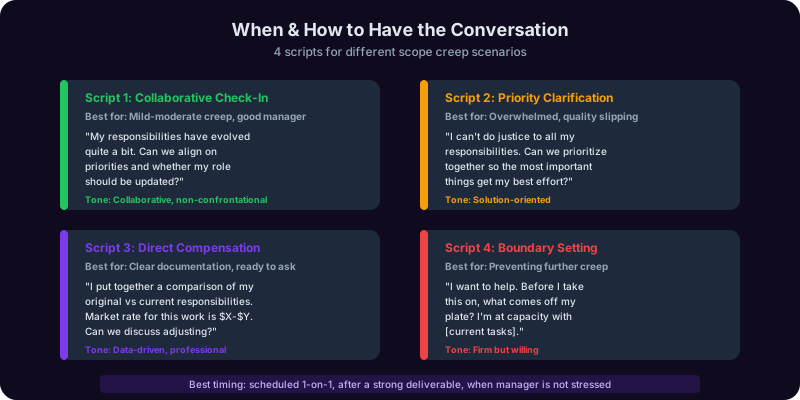
Having a strong business case is necessary but not sufficient. The way you deliver the request matters as much as the content. These scripts are designed for the three most common scenarios.
Script 1: Requesting Remote Work at Your Current Job
Timing matters. Ask after a win, not during a crisis. Schedule a dedicated 1:1 for this conversation.
You: "Thanks for making time for this. I wanted to discuss my work arrangement because I think there is an opportunity to improve both my productivity and my contribution to the team. Over the past [timeframe], I have [specific accomplishment with metrics]. I have noticed that my highest-output work consistently happens on days when I have uninterrupted focus time, and I would like to propose a hybrid arrangement where I work from home [X days per week] and come into the office on [specific days] for team collaboration and meetings. I have put together a one-page proposal with a communication plan, accountability metrics, and a 90-day trial structure. Can I walk you through it?"
When they say "Let me think about it":
You: "Absolutely. I will send you the proposal after this meeting. Could we set a follow-up for [specific date, 1-2 weeks out] to discuss?"
Script 2: Pushing Back on an RTO Mandate
This is the highest-stakes version. Frame it as alignment, not defiance.
You: "I understand the company's direction on returning to the office. I want to be transparent about where I stand so we can figure out the best path forward. Since I have been working remotely, my output has [specific metrics]. I have not missed a deadline and my performance reviews have been [rating]. I would like to propose a modified arrangement where I come in [X days per week] instead of five, with in-office days aligned to the meetings and sessions where in-person presence adds the most value. I am not asking for an exemption. I am asking for a performance-based alternative. Can we try this for 90 days?"
When they say "The policy applies to everyone":
You: "I hear you. Is there a formal process for requesting an exception or accommodation? If there is a path for individual arrangements based on performance, I would like to pursue it through the proper channels."
Script 3: Negotiating Remote Work Into a New Job Offer
This is the easiest negotiation because you have maximum leverage before accepting.
You: "I am very excited about this offer. Before I accept, I wanted to discuss the work arrangement. I have worked remotely for the past [X years] with a strong track record. I would like to structure a hybrid arrangement where I work from home [X days] and come in [X days] per week. Is there flexibility on the work arrangement?"
When they say the role is "in-office only":
You: "Would you be open to revisiting the arrangement after my first 90 days, once I have demonstrated my ability to deliver and built relationships with the team?"
What Not to Say
- Do not make it about you: "I hate commuting" is a valid feeling but a weak negotiation point. Frame everything around business outcomes.
- Do not threaten to quit: Unless you have another offer in hand. As we covered in our difficult conversations guide, effective scripts focus on shared outcomes, not ultimatums.
- Do not compare yourself to others: "But Sarah works from home" invites "Sarah's situation is different." Build your case on your own merits.
The Communication Copilot can help you rehearse these conversations, including practicing responses to pushback scenarios.

Get Answers From the Career Copilot
Ask a specialist AI copilot the question you just read about. Your first conversation needs no signup and no card.
Hybrid Compromise Frameworks: Finding the Middle Ground
The all-or-nothing approach to remote work rarely works. The most successful negotiations land on a hybrid arrangement that gives you most of what you want while giving your manager the visibility they need.
The 3-2 Model (Highest Approval Rate)
Three days remote, two days in office. This is the arrangement Stanford's research found produces the best outcomes: equivalent productivity to full-time office work with 35% lower attrition.
Structure your in-office days around: team meetings, 1:1s with your manager, client-facing presentations, and culture-building activities.
Structure your remote days around: deep focus work, writing and analysis, asynchronous collaboration across time zones, and professional development.
The Anchor Day Model
Designate one or two "anchor days" when the entire team is in the office, and let individuals choose the rest. This guarantees face-to-face overlap without mandating full-week presence.
"What if we designated Tuesday and Thursday as team anchor days when everyone is in the office for collaborative work, and allowed flexibility on the other three days? We could trial it for one quarter and measure team output, collaboration quality, and engagement scores."
The Results-Only Work Environment (ROWE)
ROWE focuses entirely on output rather than hours or location. Employees are evaluated on deliverables, not presence. Best for software engineers, writers, designers, analysts, and any role where output can be objectively measured.
"I would like to propose a results-based arrangement. Instead of tracking location or hours, I would be measured on [specific deliverables]. I would commit to being available during core hours of 10am-3pm for meetings and maintaining a 30-minute response time on Slack. If I hit those metrics, the where and when should not matter. If I miss them, we revisit."
The Seasonal or Project-Based Model
Some roles have natural rhythms. Accountants need more face time during audit season. Marketers may need collaboration during launches but can work remotely during execution phases.
"I have mapped out our calendar for the next two quarters. There are predictable periods that benefit from in-person collaboration and periods of deep individual work. I would like to propose full in-office during [high-collaboration periods] and remote during [deep work periods]."
Building the Communication Infrastructure
Every hybrid arrangement needs a communication backbone. Include these in your proposal:
- Daily async update: A 2-minute end-of-day Slack message summarizing accomplishments, progress, and blockers
- Weekly 1:1: A 30-minute check-in with a brief pre-meeting doc listing accomplishments and priorities
- Core hours commitment: Specific hours when you are guaranteed available, typically 10am-3pm
- Response time SLA: Slack messages within 30 minutes, emails within 2 hours during core hours
- Proactive status signaling: Slack status showing deep work, available, in a meeting, or at lunch
The Career Copilot can generate a customized communication framework for your specific role and company culture.
ADA Accommodations and Legal Protections for Remote Work
For employees with qualifying disabilities, remote work may not be a perk to negotiate. It may be a legally protected reasonable accommodation under the Americans with Disabilities Act (ADA). Understanding your rights gives you a different, and often stronger, negotiation position.
When Remote Work Is a Reasonable Accommodation
Under the ADA, employers with 15 or more employees must provide reasonable accommodations for qualified individuals with disabilities unless it would create "undue hardship." Since 2020, courts and the EEOC have increasingly recognized remote work as a reasonable accommodation. Remote work may qualify if you have:
- Chronic pain conditions that make commuting or extended desk sitting difficult (fibromyalgia, chronic back injuries)
- Autoimmune disorders where shared office environments create health risks (lupus, Crohn's disease, MS during flare-ups)
- Mental health conditions exacerbated by office environments (severe anxiety disorder, PTSD, agoraphobia)
- Mobility impairments where commuting creates significant barriers
- Immunocompromised conditions where shared spaces create medical risk
- Neurodevelopmental conditions where sensory aspects of offices significantly impair functioning (autism spectrum, ADHD in some cases)
How to Request an Accommodation
The ADA requires employers to engage in an "interactive process" with employees who request accommodations:
Step 1 - Written request to HR: "I am writing to request a reasonable accommodation under the ADA. I have a medical condition that significantly limits [specific life activity]. I am requesting the ability to work remotely [full-time or X days per week] as a reasonable accommodation. I am prepared to provide medical documentation and participate in the interactive process. Please let me know the next steps."
Step 2 - Medical documentation: Your healthcare provider confirms you have a qualifying disability and that remote work is medically necessary. The documentation does not need to disclose your specific diagnosis, only functional limitations.
Step 3 - Interactive process meeting: The employer must engage in dialogue about accommodations. Come prepared with your remote work proposal. The employer cannot deny the request without demonstrating undue hardship.
What "Undue Hardship" Actually Means
The legal bar for undue hardship is high. It means "significant difficulty or expense" relative to the employer's size and resources. For a company that already has remote work infrastructure, arguing that one additional remote employee creates a significant burden is very difficult. If the company allowed remote work during the pandemic, arguing it is now an undue hardship is an especially weak legal position.
Retaliation Protections
The ADA prohibits retaliation against employees who request accommodations. If you request remote work and subsequently receive negative reviews, reduced responsibilities, or termination, you may have a retaliation claim. Document everything. For more on workplace rights and protections, see our fired vs. laid off rights guide.
State and Local Protections
Many states have disability discrimination laws broader than the ADA. California's FEHA covers employers with as few as 5 employees and defines disability more broadly. Some cities and states are also passing specific remote work protection laws.
Important: the ADA accommodation route is for people with genuine qualifying disabilities. Using the process in bad faith undermines protections for people who genuinely need them. If you do have a qualifying condition, the law is on your side. The Career Copilot can help you understand whether your situation may qualify and how to approach the conversation with HR.
Finding Remote-Friendly Employers and Evaluating Remote Culture
Sometimes the best negotiation strategy is not convincing your current employer. It is finding one that already values remote work. If your company has issued a firm RTO mandate with no path to exception, your energy is better spent finding a company whose philosophy aligns with yours.
Where Remote Jobs Actually Are in 2026
Despite the RTO headlines, remote work is consolidating into specific industries and company types:
Remote-first companies were built for distributed work from the beginning. They have documentation cultures, async-first communication, and compensation policies for remote teams. Examples include GitLab, Zapier, Automattic, and Buffer.
Industries with highest remote adoption:
- Software and technology: 67% of roles offer remote or hybrid
- Financial services and fintech: 52% hybrid or remote
- Professional services (consulting, accounting, legal): 48%
- Media, marketing, and communications: 45%
Job boards specializing in remote work:
- FlexJobs: Curated, scam-free remote listings. Paid but worth it for active searchers.
- We Work Remotely: One of the oldest remote job boards, strong in tech and design.
- Remote.co: Focuses on companies with established remote cultures.
- LinkedIn (with remote filter): Be aware some companies post as "remote" but require in-office after onboarding.
Evaluating Remote Culture Before Accepting
A company that says "we support remote work" and one that actually has a functional remote culture are very different. Ask these questions during interviews:
- "What percentage of the team works remotely full-time?" Below 30% means remote workers are second-class citizens, excluded from spontaneous decisions and promotion conversations.
- "How do you handle meetings when some people are in-office and some remote?" Best answer: "Everyone joins from their own laptop." Worst answer: "We have a conference room with a speakerphone."
- "What tools do you use for async communication?" Strong remote cultures use Notion, Loom, and structured project management. If the answer is "mostly Slack and email," the infrastructure is not there.
- "How are remote employees evaluated for promotions?" No clear answer means remote workers will be disadvantaged.
Red Flags in "Remote-Friendly" Postings
- "Remote with occasional travel" that means monthly week-long HQ trips
- "Remote during probation, then hybrid" with no written guarantee
- Job listed as remote but the entire interview panel is in-office
- No mention of home office stipend or async culture in the job description
For help identifying truly remote-friendly employers and preparing for remote-specific interview questions, the Career Copilot can analyze job postings and help you develop targeted questions.
Negotiating Remote in New Offers, Existing Roles, and Backup Plans
The dynamics of negotiating remote work change significantly depending on whether you are talking to a prospective employer or your current one. Your leverage, timing, and fallback options are different in each scenario.
New Job Offer: Maximum Leverage
When negotiating an offer, you are at peak leverage. The company has invested weeks in hiring you and does not want to lose you over a work arrangement detail. Bring up remote work after receiving the offer but before accepting. As we covered in our salary negotiation guide, the pre-acceptance window is where all your power lives.
"I am thrilled about this offer. I wanted to discuss the work arrangement as part of the overall package. A hybrid setup with [X days remote] is an important factor in my decision. I have [X years of demonstrated success in distributed environments]. Can we include a hybrid arrangement in the offer terms?"
Getting it in writing: A verbal agreement about remote work is worthless if your manager changes or policy shifts. Ask for the arrangement to be included in your offer letter.
Existing Role: Performance Leverage
Your leverage comes from your track record, institutional knowledge, and replacement cost. Time your request after a major win, during your annual review, or when the team depends heavily on your contributions.
"Over the past year, I have [accomplishments]. I have demonstrated I can deliver regardless of where I am working. My proposal is [specific days and structure]. I see this as earned flexibility based on results, and I am willing to put measurable success criteria in place."
The Salary Trade-Off Question
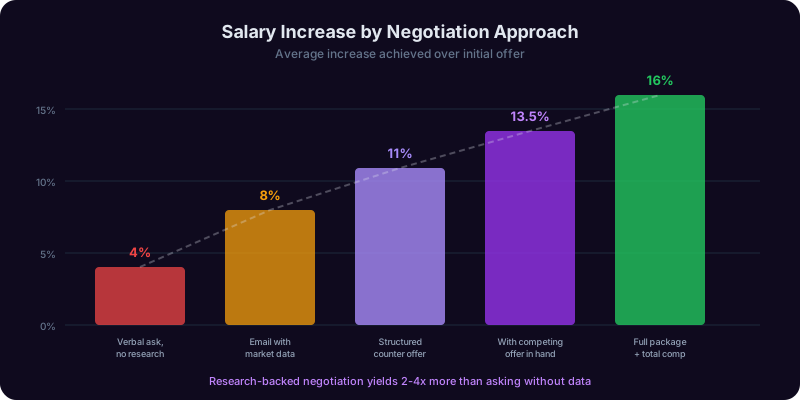
If remote work saves you $12,000-$16,000 per year, accepting a $5,000 pay cut for full remote is still a net gain. But never accept a pay cut without getting the arrangement in writing with a guaranteed review date.
When the Answer Is No: Backup Plans
Backup 1 - The incremental approach: If your full proposal was rejected, scale down. Instead of three remote days, propose one. Ask for "work from home Fridays" as an informal trial. Build the track record that justifies the formal arrangement later.
Backup 2 - Negotiate adjacent flexibility: Flexible hours (7am-3pm to avoid peak commute), compressed work week (four 10-hour days), or a core hours model (in-office 10am-3pm with flexible arrival and departure).
Backup 3 - Strategic job search: If flexibility is non-negotiable at your company and it is a priority for you, a job search is not giving up. Start passively by updating LinkedIn settings to signal remote interest. Target companies from Section 6 with established remote cultures. Our guide to quitting your job walks through the exit process when you are ready.
Backup 4 - Build your own remote career: Freelancing, consulting, and solo entrepreneurship let you build a career on your own terms. Our side hustle guide covers building income outside your day job, and AI tools now make it possible to run a one-person business that competes with larger teams.
When to Stop Negotiating
Clear signals your employer will not budge: your manager says yes but leadership overrides it, the company has made RTO a CEO-level commitment, your request was denied with instructions not to bring it up again, or colleagues who asked for remote work were put on performance improvement plans. When you see these signals, redirect your energy toward finding an employer whose values match yours.
How Copilotly Helps You Negotiate Remote Work at Every Stage
Negotiating remote work is a multi-step process that requires research, strategy, communication skills, and persistence. Copilotly's AI copilots are designed to support you at every point.
Stage 1: Research and Business Case Building
The Career Copilot helps you build the data-driven foundation for your proposal:
- Calculate the specific financial value of remote work for your situation
- Find industry-specific productivity data to support your case
- Identify the strongest business arguments for your company type
- Build the one-page proposal template with your actual data filled in
- Draft your accountability metrics and communication plan
Stage 2: Conversation Preparation and Role-Play
The Communication Copilot helps you prepare for the actual conversation. As we covered in our difficult conversations guide, AI role-play is one of the most effective preparation tools available:
- Customize scripts to match your specific situation, manager, and company culture
- Rehearse with AI playing your manager, including realistic pushback
- Refine your language to balance assertive and collaborative tones
- Prepare responses for the five most likely objections
Stage 3: Evaluating Alternatives
If your current employer will not accommodate remote work, the Career Copilot helps you evaluate options:
- Analyze job postings to identify truly remote-friendly companies
- Calculate total compensation value including the monetary worth of remote work
- Compare hybrid arrangements across potential employers
- Negotiate remote work into new offers with customized scripts
Stage 4: Ongoing Advocacy
Once you secure a remote or hybrid arrangement, you need to continually demonstrate it is working:
- Build weekly impact reports documenting remote productivity
- Create talking points connecting your output to your work arrangement
- Prepare for arrangement review meetings with fresh data
- Draft professional responses if the company tries to walk back flexibility
Sample Copilotly Prompts
Here are prompts you can use right now with the Career Copilot:
"I need to negotiate a hybrid work arrangement with my manager. I am a [role] at a [company type] in [industry]. The company has mandated [current policy]. I want [desired arrangement]. Help me build a one-page business case with productivity data, cost savings, and a 90-day trial proposal with success metrics."
"I received a job offer for a [role] at [company]. The offer says hybrid 3 days in office. I want to negotiate for 2 days in office or fully remote. Write me a script for the conversation with the recruiter that frames remote work as part of my total compensation negotiation."
"My company announced a full RTO mandate starting next month. I have been fully remote for 3 years with excellent performance reviews. I have a medical condition that makes daily commuting difficult. Help me draft an ADA accommodation request letter and prepare for the interactive process meeting with HR."
The Bottom Line
Remote work negotiation is not a single conversation. It is a campaign. The employees who successfully negotiate flexible arrangements in 2026 are the ones who build an evidence-based case, propose a structured trial, deliver exceptional results, and use every tool available to communicate their value. Whether you are fighting an RTO mandate, negotiating flexibility into a new offer, or exploring remote-first employers, Copilotly gives you the preparation edge that turns a wishful request into a professional proposal your manager can say yes to.
Frequently Asked Questions
Recommended Copilots
Related Articles
Get Answers From the Career Copilot
Ask a specialist AI copilot the question you just read about. Your first conversation needs no signup and no card.