
Career & Business
8 Word-for-Word Scripts for the Hard Conversations You Keep Avoiding
Around 70% of people are avoiding at least one hard conversation right now, and most go in unscripted when they finally have it. These eight word-for-word scripts cover raises, boundaries, coworker conflict, breakups, landlord disputes, and aging-parent money talks, each built on the NVC and DESC frameworks and rehearsable with AI before the real thing.
Why Difficult Conversations Fail (and How AI Changes the Equation)
According to a VitalSmarts research study, the average person is currently avoiding at least one difficult conversation. The cost is staggering. Employees who cannot speak up about workplace problems cost their organizations an estimated $7,500 per avoided conversation in wasted time, resentment, and workarounds. In personal relationships, avoided conversations metastasize into chronic resentment, passive aggression, and eventual blowups that are ten times harder to recover from than the original issue would have been.
The problem is not that people lack courage. It is that they lack preparation. Most people walk into difficult conversations with a vague sense of what they want to say, a racing heart, and zero structure. They either over-explain and dilute their message, get emotionally hijacked and say things they regret, or freeze entirely and walk away having said nothing meaningful.
What the Research Actually Says
Three decades of communication research have produced frameworks that dramatically improve outcomes in hard conversations. The two most validated are:
- Nonviolent Communication (NVC), developed by Marshall Rosenberg, which structures messages into four steps: observation, feeling, need, and request. NVC has been validated in clinical settings, school conflict resolution programs, and even international peace negotiations. A 2021 meta-analysis in Frontiers in Psychology found that NVC training reduced interpersonal conflict by 34% and increased empathic accuracy by 28%.
- The DESC model (Describe, Express, Specify, Consequences), widely used in assertiveness training and healthcare communication, which gives a repeatable four-step structure: describe the situation objectively, express how it affects you, specify what you want to change, and state the positive consequences of making that change.
The challenge has always been applying these frameworks in the heat of the moment. Reading about NVC is easy. Using it when your mother-in-law criticizes your parenting is hard. This is where AI becomes genuinely useful, not as a replacement for the conversation itself, but as a preparation tool.
How AI Helps You Prepare
AI conversation coaching works because it solves the three biggest preparation gaps:
- Script generation: AI can take your raw, emotional description of a situation and restructure it into an NVC or DESC format in seconds. Instead of figuring out how to phrase something diplomatically at 2am while angry, you tell the AI what happened and it gives you three versions to choose from.
- Role-play practice: You can rehearse the conversation with AI playing the other person. This is not theoretical. Research from Harvard Business Review shows that professionals who practiced difficult conversations with AI coaching tools before the real conversation reported 42% higher confidence and 31% better outcomes.
- Emotional regulation: By processing your feelings through the AI first, you offload the most reactive, least productive emotional energy before the real conversation. You still feel your feelings in the room. You just do not lead with the worst version of them.
The Relationship Copilot and Career Copilot are both designed to help you prepare for exactly these kinds of conversations. You describe the situation, and they help you build a structured, empathetic script you can actually use.
Asking for a Raise: Word-for-Word Scripts That Work
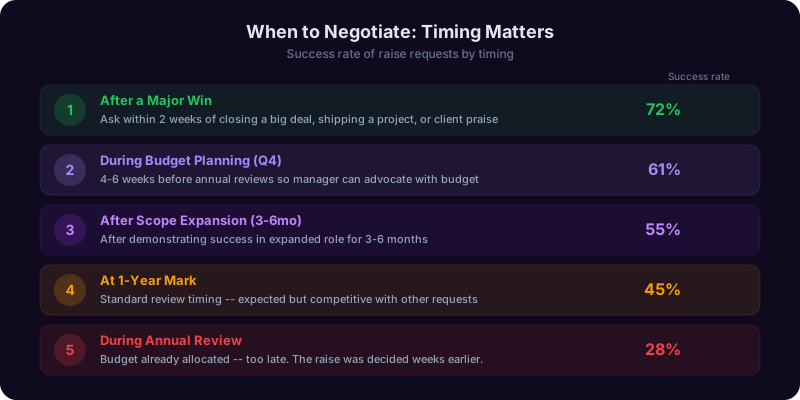
Asking for a raise is the most financially consequential difficult conversation most people will ever have. As we covered in our complete salary negotiation guide, a single successful raise negotiation can be worth over $600,000 in lifetime earnings when you account for compounding. Yet most people either avoid the conversation entirely or walk in without a script and fumble it.
The DESC Model Script for Asking for a Raise
The DESC model is particularly effective for raise conversations because it keeps the focus on objective performance and specific outcomes rather than emotional appeals.
Describe: "Over the past 12 months, I have taken on the client onboarding project in addition to my core responsibilities. I have onboarded 47 new accounts, which generated $380,000 in new annual revenue for the team."
Express: "I am proud of what I have contributed, and I want to make sure my compensation reflects the scope and impact of my current role."
Specify: "Based on market data from Glassdoor and Payscale for this role in our market, I am requesting an adjustment to $95,000, which is the midpoint for someone with my experience and performance level."
Consequences: "I am committed to this team and excited about what we are building. Aligning my compensation with my contributions would make it easy for me to stay focused and keep delivering at this level."
When Your Manager Says "Let Me Check With HR"
This is the most common response, and it is not a rejection. It is a deferral. Your goal is to maintain momentum by getting a specific follow-up date on the calendar.
You: "I completely understand. To help make the case, I have put together a one-page summary of my key contributions and the market data I referenced. I will send that to you after this meeting. Could we schedule a follow-up for two weeks from now to discuss where things stand?"
When They Say the Budget Is Frozen
You: "I appreciate the transparency. I understand budget constraints are real. Can we do two things? First, can we agree on a specific date to revisit this, ideally the start of next quarter? Second, can we put in writing the milestones that would make this a clear yes when the budget opens up? I want to make sure we are aligned on what success looks like so there is no ambiguity when the time comes."
When You Suspect You Are Being Underpaid Relative to Peers
This is one of the hardest variations because it introduces a fairness element that can feel accusatory. The NVC framework helps you raise the issue without triggering defensiveness.
You: "I want to bring up something that has been on my mind. When I look at market data for my role and compare it with the responsibilities I have taken on, I notice a gap between my current compensation and what the market suggests. I am not making assumptions about what anyone else on the team earns, but I want to make sure my pay reflects my contributions and experience. Can we review my compensation against the current market benchmarks together?"
Notice what this script does not do: it does not name specific coworkers, it does not accuse the company of unfairness, and it does not make demands. It states an observation, expresses a need, and makes a specific request. That is NVC in action.
For detailed salary research, counter-offer templates, and strategies for negotiating total compensation packages, see our salary negotiation scripts guide. The Salary Copilot can also help you build a personalized case based on your exact role, market, and experience level.
Setting Boundaries With Family and Friends: Scripts for Every Situation
Boundary-setting is where most communication frameworks get their hardest test. It is one thing to use the DESC model with a coworker you see eight hours a day. It is another to use it with a parent who raised you, a sibling you love, or a friend you have known for 20 years. The emotional stakes are higher, the history is deeper, and the other person often has decades of practice pushing past your limits.
The NVC Framework for Boundary Conversations
Nonviolent Communication was specifically designed for high-emotion, high-stakes interpersonal situations. The four-step structure works because it separates what happened from how you feel about it, which prevents the other person from arguing with your feelings.
Step 1 - Observation (not judgment): State what happened without interpretation. "When you commented on my weight at dinner" not "When you were rude about my body."
Step 2 - Feeling (not thought): Name the emotion. "I felt hurt and embarrassed" not "I felt like you were trying to humiliate me."
Step 3 - Need: State the underlying need. "I need to feel safe and accepted when I am with family."
Step 4 - Request (not demand): Make a specific, doable request. "Would you be willing to keep comments about my body off the table at family events?"
Script: A Parent Who Criticizes Your Life Choices
You: "Mom, I want to talk about something because our relationship matters to me. When you bring up that I should be further along in my career or ask when I am having kids, I feel pressured and like my current life is not enough. I need you to trust that I am making choices that work for me, even if they look different from what you imagined. What I am asking is that when we talk, we focus on what is happening in my life now rather than what you think should be happening next. Can we try that?"
Script: A Friend Who Consistently Cancels Plans
You: "Hey, I want to be honest about something because I value our friendship. The last four times we made plans, they got canceled the day of. I understand life is busy, and I am not trying to guilt you. But when it keeps happening, I start to feel like getting together is not a priority for you. What I need is reliability. If you are not sure you can commit, I would honestly rather hear that up front than have plans fall through. Can we make a deal where we only lock in plans you are confident about?"
Script: A Family Member Who Borrows Money Repeatedly
You: "I need to talk to you about the loans. I have lent you money three times this year, and I have not been paid back for any of it. I care about you, and I do not want money to damage our relationship. But continuing to lend when it is not repaid puts me in a difficult financial position and honestly makes me resentful, which is not fair to either of us. Going forward, I am not able to lend money. I am happy to help you look into other options, like a payment plan with your creditor or a financial assistance program. But the lending needs to stop. I hope you understand this is coming from a place of wanting to protect our relationship, not punish you."
When They React Badly
The hardest part of boundary-setting is not the script. It is what happens when the other person gets angry, guilt-trips you, or cries. Prepare for these responses:
- If they get angry: "I can see this is upsetting, and I am sorry it landed that way. I am not trying to attack you. I am trying to protect something I care about, which is our relationship. I would rather have an uncomfortable conversation now than let resentment build."
- If they guilt-trip: "I hear that this feels hurtful to you. That is not my intention. My boundary is not about controlling you. It is about what I need to be okay. I am asking you to respect that, even if you disagree with it."
- If they cry: Give them space. Say: "I can see this is bringing up a lot of emotion. I do not need to resolve everything right now. Let us take a break and come back to this when we have both had time to process."
The Relationship Copilot can help you rehearse boundary conversations with AI playing the role of the other person, including simulating defensive, guilt-tripping, or emotional reactions so you are not caught off guard in the real conversation.
Workplace Conflict: Scripts for Confronting Coworkers and Managers
Workplace conflict costs U.S. businesses an estimated $359 billion annually in lost productivity, according to CPP Global's workplace conflict study. The average employee spends 2.8 hours per week dealing with conflict, which adds up to roughly $12,000 in wasted salary per employee per year. Yet most workplace conflicts are not about bad people. They are about unclear expectations, poor communication, and unaddressed friction that compounds over time.
Script: A Coworker Who Takes Credit for Your Work
The DESC model works exceptionally well here because it keeps the conversation professional and focused on behavior rather than character.
Describe: "In last week's team meeting, the client engagement strategy I developed was presented as a team effort without mentioning my contribution. This has happened twice in the past month."
Express: "I want to be straightforward. When my contributions are not attributed, it affects my visibility and my ability to advance. It also makes me hesitant to share ideas openly."
Specify: "Going forward, when work I have led is presented, I would like the presentation to reflect who did the work. If it is collaborative, let us credit it as collaborative. If I led it, I need that acknowledged."
Consequences: "I think this will actually help the whole team. When people get proper credit, everyone is more motivated to contribute their best work. I want us both to succeed here."
Script: A Manager Who Micromanages
You: "I appreciate how invested you are in the quality of our team's output. I have noticed that we are checking in on project status three to four times per day, and I want to talk about whether we can adjust that. I find that I do my best work when I have blocks of uninterrupted focus time. What if I sent you a daily end-of-day status update and we kept our check-ins to our standing weekly one-on-one? That way you have full visibility without either of us spending time on ad hoc updates throughout the day. If something urgent comes up, I will flag it immediately. Does that feel workable?"
Script: Addressing a Coworker's Repeated Missed Deadlines Affecting Your Work
You: "I want to discuss the timeline on the Henderson project. The last three deliverables from your side came in between two and five days late, which pushed back my work on the client-facing materials. I am not trying to point fingers. I know you are carrying a heavy workload. But when the handoff is delayed, I end up working weekends to hit the client deadline, and that is not sustainable. Can we look at the timeline together and figure out what a realistic schedule looks like? If you need more lead time, I would rather adjust the plan now than keep hitting these crunches."
Script: Reporting Harassment or Discrimination to HR
This conversation requires precision. Document everything before the meeting, and use language that is factual and specific.
You: "I am here to report a pattern of behavior that I believe constitutes [harassment/discrimination]. I have documented specific incidents with dates and witnesses. On [date], [what happened]. On [date], [what happened]. On [date], [what happened]. I have raised this informally with [person] on [date], but the behavior has continued. I am requesting a formal investigation and documentation that this report was made. I also want to understand what protections are in place to prevent retaliation. Can you walk me through the process and timeline from here?"
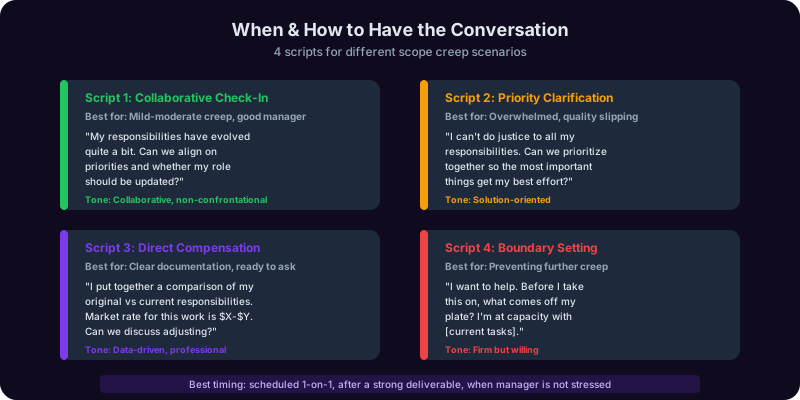
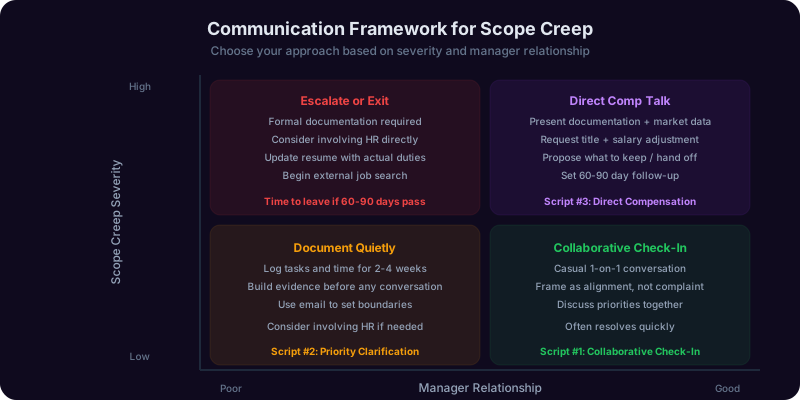
For serious workplace issues like harassment, discrimination, or wrongful termination, see our scope creep guide for boundary-setting at work and our fired vs. laid off rights guide for understanding your legal protections. The Career Copilot can help you assess whether a workplace conflict warrants escalation, documentation, or a strategic exit.
Breaking Bad News: Breakups, Resignations, and Hard Truths
Delivering bad news is a distinct communication skill that most people never learn formally. Whether you are ending a relationship, quitting a job, or telling a friend something they do not want to hear, the same principles apply: be direct, be compassionate, and do not dilute the message with excessive justification.
Script: Breaking Up With a Long-Term Partner
Breakup conversations fail when people try to soften the blow so much that the other person is confused about what is happening. Clarity is kindness in this context.
You: "I need to talk to you about something important, and I want to be honest because you deserve that. I have been thinking about our relationship for a while, and I have come to the decision that we need to end it. This is not about something you did wrong. It is about the fact that what I need from a relationship has changed, and I do not believe we can give each other what we both deserve. I care about you deeply, and that is exactly why I do not want to stay in something where I am not fully present. I know this is painful. I am not asking you to be okay with it right now. But I wanted to tell you face to face and be clear about where I stand."
What not to say:
- "I think we should take a break" (if you mean it is over, say it is over)
- "Maybe we can try again someday" (do not leave false hope)
- "You are perfect, I just..." (this invalidates your own reasons and confuses them)
- "I still love you but..." (true or not, it sends a mixed signal that makes processing harder)
Script: Quitting a Job You Hate
Even if the job was terrible, burning bridges is almost never worth it. For a comprehensive walkthrough, see our guide to quitting your job professionally. Here is the core conversation script:
You: "I wanted to let you know in person that I have decided to move on from my role here. My last day will be [date, typically two weeks out]. I want to be clear that this was not an easy decision. I have learned a lot here, and I appreciate the opportunities I have had. I am committed to making the transition as smooth as possible. I have already started documenting my current projects and am happy to help train whoever takes over."
Script: Telling a Friend Their Behavior Is Hurting Them
This is the conversation people avoid the most because it feels like crossing a line. But research on supportive confrontation shows that honest feedback from a trusted person is one of the most powerful catalysts for positive change.
You: "I want to say something to you that is hard for me to say, and I am only saying it because I care about you. I have noticed [specific behavior, not a label] happening more often, and I am worried about you. I am not judging you, and I am not trying to be your therapist. But as your friend, I would not be able to live with myself if I saw this and said nothing. What I want you to know is that whatever you are going through, I am here. And if you ever want to talk about it or need help finding support, I will show up for that. No pressure. I just needed you to know I see it and I care."
The 30-Second Silence Rule
After delivering bad news, most people panic and start over-explaining, backtracking, or trying to fix the other person's reaction. Do not. Deliver your message, then give the other person 30 seconds of silence to process. It will feel like an eternity. It is the most respectful thing you can do. Their reaction is not your responsibility to manage. Your responsibility is to be clear, honest, and present.
The Relationship Copilot can help you rehearse these conversations beforehand, including practicing how to respond to tears, anger, or questions you did not anticipate.
Confronting a Landlord: Scripts for Repairs, Deposits, and Disputes
Landlord-tenant conversations are uniquely difficult because there is a power imbalance baked into the relationship. Your landlord controls where you live. That dynamic makes many tenants reluctant to advocate for themselves, even when the law is clearly on their side. The key to these conversations is combining emotional composure with legal precision.
Script: Requesting Urgent Repairs
Most states require landlords to maintain habitable conditions under the implied warranty of habitability. When they fail to make repairs, you have legal standing, and your conversation should reflect that.
You: "I am contacting you about [specific issue, e.g., the broken heating system in unit 4B]. I reported this on [date] via [method], and as of today it has been [X] days without resolution. Under [your state]'s habitability requirements, heating is classified as an essential service that must be maintained. I need this repaired within 48 hours. If the repair cannot be completed in that timeframe, I need to understand what interim solution you can provide. I am documenting this conversation as a follow-up to my written notice on [date]. I want to resolve this directly with you, and I am confident we can. Can you give me a specific timeline for when the repair crew will be here?"
Script: Disputing an Unfair Security Deposit Deduction
Security deposit disputes are one of the most common landlord-tenant conflicts. For a detailed breakdown of your rights, see our security deposit guide. Here is the conversation script:
You: "I received the security deposit accounting and I would like to discuss several of the charges. You deducted $400 for carpet cleaning and $350 for wall repainting. I have photos from my move-in day showing the carpet had pre-existing stains, and I have my move-in checklist where we both noted scuff marks on the living room walls. Normal wear and tear is not a valid deduction under [state] law. I also have photos from the day I moved out showing the unit in the same condition as when I moved in. I am requesting the return of $750 within 14 days. I have all documentation ready to share. Can we resolve this between us?"
Script: Pushing Back on an Unreasonable Rent Increase
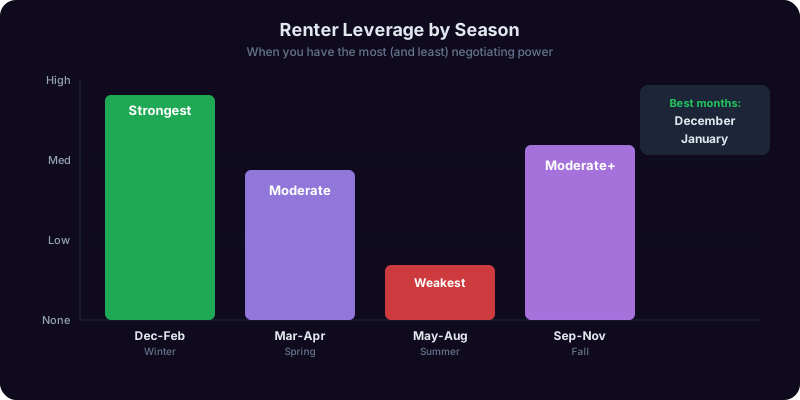
Even in markets without rent control, you have negotiating power, especially if you are a reliable tenant. For a deep dive into rent negotiation strategy, see our complete rent negotiation guide.
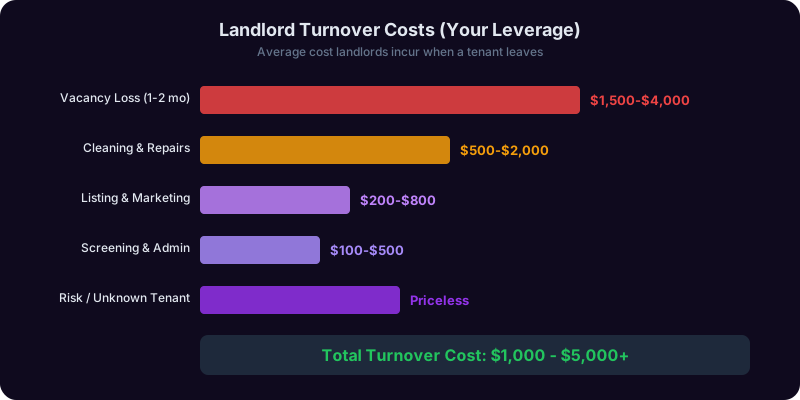
You: "I received the rent increase notice, and I would like to discuss it. You are proposing a [X%] increase, which would bring my rent from [$current] to [$proposed]. I have been in this unit for [X years], I have never been late on rent, and I take good care of the property. I checked comparable units in the area and the average rent for a similar unit is [$market rate]. I would like to propose that we cap the increase at [X%], bringing my rent to [$counter]. This keeps us both competitive with the market while reflecting the value of having a reliable, long-term tenant. Landlord turnover costs average $3,500 to $5,000 per vacancy when you factor in cleaning, repairs, marketing, and lost rent. I am hoping we can find a number that works for both of us."
When to Escalate
If direct conversation does not resolve the issue, escalate in this order:
- Written notice: Send a formal letter via certified mail restating your request and citing the relevant statute. Our demand letter guide walks you through the format.
- Local housing authority: File a complaint with your city or county housing department. Many have free mediation services.
- Small claims court: For security deposit disputes and habitability claims, small claims court is designed for tenants to represent themselves without a lawyer. Filing fees are typically $30 to $75.
The Tenant Rights Copilot can help you understand your specific state's landlord-tenant laws, draft formal notices, and determine whether your situation warrants legal action.
Medical Advocacy Scripts and Talking to Aging Parents About Finances
Two of the most emotionally loaded conversations adults face involve advocating for themselves in medical settings and having the money talk with aging parents. Both share a common thread: there is a power dynamic (doctor vs. patient, parent vs. adult child) that makes assertiveness feel inappropriate. But in both cases, silence has serious consequences.
Medical Advocacy: Scripts for Getting the Care You Deserve
Research published in JAMA Internal Medicine found that the average primary care visit lasts just 18 minutes, and patients are interrupted within 11 seconds of starting to describe their symptoms. If you do not advocate clearly and assertively, your concerns will be overlooked. Here are the scripts that work.
Script: When a doctor dismisses your symptoms
You: "I hear what you are saying, and I respect your expertise. But I need to tell you that this symptom has been affecting my daily life for [timeframe]. I would like you to document in my chart that I reported [symptom] and that the recommendation is [what they suggested or dismissed]. I would also like to discuss what diagnostic options are available so we can rule out [condition you are concerned about]. If you do not believe further testing is warranted, I would like that documented as well along with the clinical reasoning."
Asking a doctor to document their refusal to investigate is one of the most effective advocacy tools available to patients. It creates a medical-legal record and often prompts the physician to reconsider.
Script: When you disagree with a treatment plan
You: "I appreciate you explaining the treatment plan. Before I agree, I have some questions. What are the alternatives to this approach? What happens if we try a more conservative option first? What are the risks of this treatment versus the risks of waiting? I want to be an active participant in my care, and I need to understand my options fully before making a decision."
Talking to Aging Parents About Their Finances
This is the conversation adult children dread the most. A 2024 Fidelity survey found that 58% of families have never discussed end-of-life financial planning. The consequences of avoidance are severe: families discover too late that there is no will, no power of attorney, or no plan for long-term care costs that average $108,000 per year for a private nursing home room.
Script: Opening the conversation
You: "Mom and Dad, I want to talk about something that I know is uncomfortable, and I want to start by saying this is coming entirely from a place of love and wanting to make sure you are protected. I am not trying to control your money or make decisions for you. I just want to understand what plans are in place so that if something unexpected happens, I know how to help and I am not guessing. Can we set aside some time this weekend to walk through the basics together?"
Script: When a parent is resistant
You: "I understand this feels intrusive, and I am sorry it is uncomfortable. I am not asking because I doubt your ability to manage your own affairs. I am asking because I have seen friends go through a health crisis with their parents and have no idea where the important documents are, who the doctors are, or what their parents would have wanted. I do not want that for us. All I am asking for today is to know three things: where your important documents are, who your financial advisor and attorney are, and whether you have a healthcare directive. We do not have to go through everything at once. Can we start with just those three things?"
For help navigating end-of-life planning documents, see our power of attorney guide. The Health Copilot can help you prepare questions for medical appointments, and the Second Opinion Copilot can help you evaluate treatment options before making major decisions.
Using AI to Practice and Refine Your Scripts Before the Real Conversation
Having a script is the first step. But reading a script and delivering it under emotional pressure are two very different things. The gap between knowing what to say and being able to say it when your heart is racing is where most difficult conversations fall apart. This is where AI conversation coaching becomes a genuine tool rather than a gimmick.
The 5-Step AI Preparation Process
Based on the communication frameworks in this guide and the practical experience of thousands of Copilotly users, here is the most effective process for using AI to prepare for a difficult conversation:
- Brain dump (2 minutes): Tell the AI everything you are feeling, unfiltered. Do not worry about being fair, rational, or diplomatic. Get the raw emotion out. This is not the version you will deliver. It is the version you need to process first. Example: "I am furious at my boss because she took credit for my presentation in front of the VP and this is the third time it has happened and I am so angry I want to quit."
- Framework selection (1 minute): Ask the AI to restructure your raw feelings into either NVC format (for personal relationships) or DESC format (for professional settings). Review the rewritten version and adjust anything that does not sound like you.
- Script refinement (3-5 minutes): Go back and forth with the AI to fine-tune the language. Focus on three things: Does it sound like me? Does it say what I actually mean? Is there anything in here that could be misinterpreted or used against me?
- Objection mapping (5 minutes): Ask the AI: "What are the five most likely responses the other person will have?" Then prepare a one or two sentence reply for each. This is the single most valuable step because difficult conversations rarely go as planned. The people who handle them well are not smarter or braver. They have simply anticipated more scenarios.
- Role-play rehearsal (5-10 minutes): Ask the AI to play the other person and run through the conversation. Start with the most likely scenario, then practice the worst case. Pay attention to where you get stuck, defensive, or lose your composure. Those are the moments to rehearse again.
Sample AI Prompt for Conversation Preparation
Here is a prompt you can use with the Relationship Copilot or Career Copilot right now:
"I need to have a difficult conversation with [who]. The situation is [brief description]. I feel [emotions]. What I want to achieve is [outcome]. Please help me: (1) write a script using the [NVC/DESC] framework, (2) list the five most likely responses they will have, (3) give me a one-sentence reply for each response, and (4) role-play the conversation with me where you play [the other person] and respond realistically, including being defensive or emotional."
What AI Cannot Do
It is important to be honest about the limits. AI conversation coaching does not replace therapy. If the difficult conversation involves trauma, abuse, or deeply entrenched relational patterns, a licensed therapist is the right resource. For a research-based overview of when AI mental health tools are appropriate and when they are not, see our AI mental health support guide.
AI also cannot read the room in real time. It cannot tell you to pause because the other person is about to cry, or that your tone sounds aggressive even though your words are fine. The real conversation will require your emotional intelligence, not just your script. What AI gives you is a starting position that is 80% better than what most people walk in with, which is nothing.
Building a Conversation Toolkit
The most effective communicators are not naturally gifted. They have built a toolkit over time. Here is what yours should include:
- A saved NVC template: Observation, Feeling, Need, Request. Memorize the structure so you can deploy it in real time even without a script.
- A saved DESC template: Describe, Express, Specify, Consequences. Keep it in your phone's notes app for quick reference before any professional conversation.
- A "pre-game" routine: Ten minutes with an AI copilot before any high-stakes conversation. Brain dump, framework, script, objections, rehearse. This is not optional. This is preparation.
- A post-conversation debrief: After the conversation, spend five minutes reflecting on what went well, what surprised you, and what you would do differently. Tell the AI what happened and ask for feedback on your approach. This builds skill over time.
Difficult conversations are a skill, not a personality trait. Every script in this guide is a starting point. The more you practice with AI, the less you will need the script at all. The frameworks will become second nature, and the conversations that used to keep you up at night will start to feel manageable. That is the real payoff: not just surviving the next hard conversation, but building the confidence to have every hard conversation you have been avoiding.
Frequently asked questions
Can AI really help me prepare for a difficult conversation?
What is the NVC framework and how do I use it in real conversations?
What is the DESC model and when should I use it instead of NVC?
How do I handle it when the other person gets angry or cries during the conversation?
How far in advance should I prepare for a difficult conversation?
What if the conversation does not go the way I planned despite my preparation?
How do I bring up finances with aging parents who refuse to talk about it?
Is it ever better to avoid a difficult conversation entirely?
Get AI Conversation Coaching
Use the Relationship Copilot or Career Copilot to build structured scripts, rehearse with AI role-play, and walk into your next difficult conversation prepared. Describe the situation in plain language and get NVC or DESC-formatted scripts with objection mapping in minutes.
- Career & Professional CopilotGet structured coaching for workplace conversations including raise negotiations, conflict with managers, and resignation conversations
Free plan, no card. Pro from $4.99/week for every copilot across all 20 domains - about what one hour with any single professional costs per year.