
Career & Business
Paying an Agency $3,000 a Month? Build a $100 AI Marketing Stack Instead
Small businesses pay agencies $3,000 to $5,000 a month for work an AI stack now handles for under $100. This breakdown names every tool in the stack across content, SEO, social, email, ads, and analytics, then gives a 30-day roadmap for moving off your agency without your marketing going dark.
Why the Traditional Agency Model Is Broken for Small Businesses
The math has never worked. A small business generating $200,000 to $500,000 in annual revenue cannot justify spending $36,000 to $60,000 per year on a marketing agency. Yet that is exactly what agencies charge - $3,000 to $5,000 per month for a standard retainer that typically covers content creation, social media management, basic SEO, and monthly reporting. For businesses operating on 15-25% margins, that agency fee consumes anywhere from 30% to 80% of annual profit. It is not a growth investment at that point. It is a survival threat.
The problem is not that agencies deliver bad work. Many deliver excellent work. The problem is structural. Agencies carry overhead that small businesses subsidize: office space, account managers, project managers, junior staff learning on your account, and the margins that keep the agency profitable. According to HubSpot's annual marketing report, the average agency marks up actual production costs by 2.5x to 4x. When you pay $1,500 for a month of social media management, the actual content creation and scheduling might represent $400-$600 of labor. The rest covers coordination, overhead, and profit.
The specific pain points small businesses face with agencies:
- Long feedback loops: A simple social media post requires a brief, a draft, a review cycle, revisions, and approval. What should take 20 minutes takes 3-5 business days.
- Generic strategy: Agencies managing 15-30 clients simultaneously cannot develop deep expertise in your specific niche. Your bakery gets the same content framework as a plumbing company.
- Rigid contracts: Most agencies require 3-6 month commitments with 30-60 day cancellation windows. If the results are poor in month one, you are still paying for months two and three.
- Opaque reporting: Monthly reports emphasize vanity metrics (impressions, reach, follower count) over metrics that matter (qualified leads, cost per acquisition, revenue attribution).
- Scaling penalties: Need more content? More channels? More campaigns? Each expansion triggers a scope increase and a higher retainer, often disproportionate to the additional work involved.
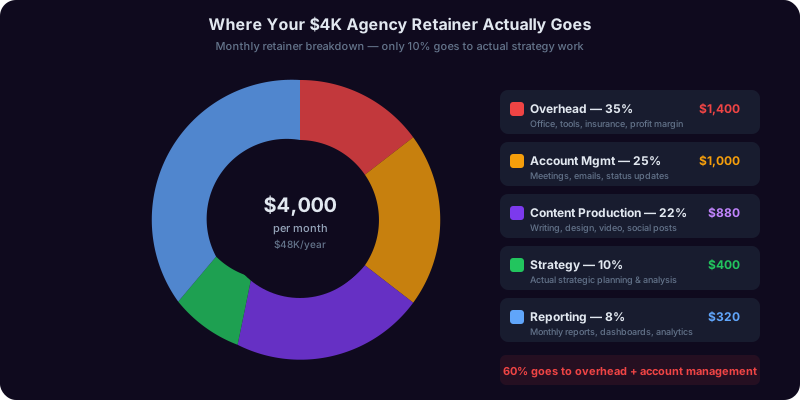
None of this means agencies are fraudulent or unnecessary. For large enterprises with complex, multi-channel campaigns spanning national or international markets, agencies provide coordination and expertise that are genuinely hard to replicate. But for a local service business, an e-commerce store doing $30,000 per month, or a B2B consultancy with 50 target accounts, the agency model is like hiring a moving company to rearrange your living room furniture.
What has changed in 2026 is the alternative. Two years ago, the choice was binary: hire an agency or do it yourself (poorly). AI copilots have created a third option that did not exist before - a small business owner or a single marketing hire can execute agency-quality work using AI tools that cost less than $100 per month combined. The Salesforce State of Marketing report found that 71% of small businesses using AI marketing tools reported performance equal to or better than their previous agency relationships, at an average of 94% lower cost.
This guide walks through the exact stack - tool by tool, function by function - showing you how to build a marketing operation that rivals what agencies deliver, for less than the cost of a single agency strategy session.
The Complete $100/Month AI Marketing Stack: Every Tool and Its Role
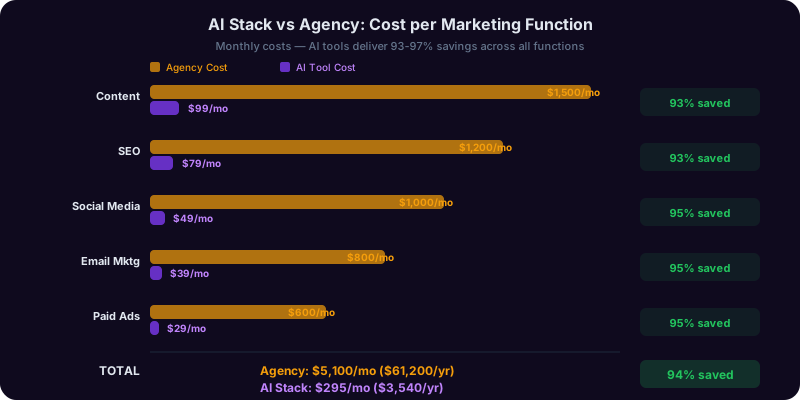
Before diving into individual functions, here is the full stack laid out so you can see how the pieces fit together. Each tool handles a specific marketing function, and together they cover everything a standard agency retainer includes - plus several things agencies charge extra for.
The complete AI marketing stack breakdown:
| Function | AI Tool/Copilot | Monthly Cost | Agency Equivalent Cost |
| Content strategy and blog writing | AI Marketing Copilot + writing assistant | $20-$30 | $800-$1,500 |
| SEO research and optimization | AI SEO tool + Marketing Copilot | $15-$25 | $500-$1,000 |
| Social media content and scheduling | AI social scheduler + Marketing Copilot | $15-$20 | $600-$1,200 |
| Email marketing and automation | AI email platform + Marketing Copilot | $15-$20 | $400-$800 |
| Ad copy and campaign optimization | AI Marketing Copilot | $10-$15 | $500-$1,000 |
| Analytics and reporting | AI analytics dashboard + Marketing Copilot | $10-$15 | $300-$500 |
| Total | $85-$125 | $3,100-$6,000 |
The center of this stack is an AI marketing copilot that serves as your strategic brain. Individual tools handle execution - scheduling posts, sending emails, tracking rankings - but the copilot handles the thinking: what content to create, which keywords to target, how to segment your email list, what angle to take in ad copy. This is the layer agencies charge the most for because it requires expertise, and it is the layer AI copilots have become remarkably good at delivering.
How these tools work together in practice:
- Monday morning: The Marketing Copilot reviews last week's performance data and suggests three content priorities for the week based on trending search queries in your niche, gaps in your content calendar, and underperforming pages that need updating.
- Content creation: You write a blog post using the copilot's outline and SEO guidance. The copilot optimizes the finished draft for search, suggests internal links, and generates meta descriptions.
- Distribution: The copilot repurposes the blog post into five social media posts (each tailored to the platform), an email newsletter segment, and two ad copy variations. Your scheduling tool queues them across the week.
- Optimization: The analytics layer tracks what drove traffic and conversions. The copilot interprets the data and adjusts next week's priorities accordingly.
This cycle - strategize, create, distribute, measure, adjust - is exactly what agencies execute. The difference is speed and cost. An agency runs this cycle on a monthly cadence with a 2-week lag on reporting. An AI stack runs it weekly with real-time data. And instead of waiting for your account manager to schedule a call to discuss next month's strategy, you ask your copilot a question and get an answer in 30 seconds.
Important caveat about the $100 figure: This covers the AI tools themselves. You still need the underlying platforms - a website, an email service provider, social media accounts, and potentially a small ad budget. These are costs you would have regardless of whether you use an agency or AI. The $100 replaces the agency labor and strategy cost, not the infrastructure cost. For a solopreneur context on building this kind of lean operation, see our guide on the solopreneur AI toolkit.
Content Strategy and SEO: The Foundation of Organic Growth
Content and SEO are the highest-value marketing functions for small businesses because they compound over time. A blog post that ranks on page one of Google generates traffic for months or years without additional spend. An agency charges $300-$1,500 per blog post and $500-$1,000 per month for SEO management. An AI marketing stack delivers the same output for under $50 per month - and often with faster turnaround.
AI-powered keyword research and content planning. Traditional keyword research involves expensive tools ($99-$249/month for Ahrefs or SEMrush alone), manual analysis of search volume and competition metrics, and the expertise to interpret what the data means for your specific business. An AI marketing copilot compresses this into a conversation. You describe your business, your target customers, and your goals. The copilot identifies keyword clusters you should target, maps them to buyer intent stages, and prioritizes them based on your domain authority and competitive landscape.
A practical keyword research workflow:
- Step 1 - Seed topic identification: Tell the copilot your three core services or products. It generates 30-50 related search queries your potential customers are typing into Google.
- Step 2 - Intent mapping: The copilot categorizes each query by intent: informational ("how to choose a wedding photographer"), commercial ("best wedding photographers in Austin"), or transactional ("wedding photography packages under $3,000"). You prioritize commercial and transactional queries for bottom-of-funnel content.
- Step 3 - Competition analysis: For each target keyword, the copilot analyzes the top 10 ranking pages and identifies gaps - topics they miss, questions they do not answer, data they do not include. These gaps become your competitive advantage.
- Step 4 - Content calendar: The copilot creates a 90-day publishing schedule with two to four pieces per month, each targeting a specific keyword cluster, with suggested word counts, header structures, and internal linking plans.
On-page SEO optimization with AI. After you write a draft, the Marketing Copilot reviews it against current SEO best practices. This includes checking title tag length and keyword placement, evaluating header hierarchy (H1, H2, H3 structure), analyzing keyword density without over-optimization, suggesting internal and external link opportunities, generating meta descriptions that drive click-through rates, recommending image alt text and schema markup, and identifying content gaps compared to competing pages. According to the U.S. Small Business Administration's online marketing guide, small businesses that publish consistent, SEO-optimized content see 3.5x more organic traffic than those that do not.
Content updating and refresh strategy. One of the most overlooked SEO tactics is updating existing content. Search engines reward freshness, and a page that ranked well 18 months ago may have slipped as competitors published newer content. An AI copilot can audit your existing content library, identify pages with declining traffic or rankings, and suggest specific updates: new statistics, additional sections, updated recommendations, and refreshed meta descriptions. This single tactic can recover 20-40% of lost organic traffic without creating anything new.
Technical SEO monitoring. While deep technical SEO still benefits from specialist tools, an AI copilot can handle the fundamentals that most small businesses neglect: checking for broken links, identifying pages with slow load times, flagging missing meta descriptions or duplicate title tags, and ensuring your site structure supports crawlability. These are the basics that agencies include in their monthly retainer and charge $500-$1,000 for - tasks that an AI copilot handles in minutes.
Real content ROI calculation
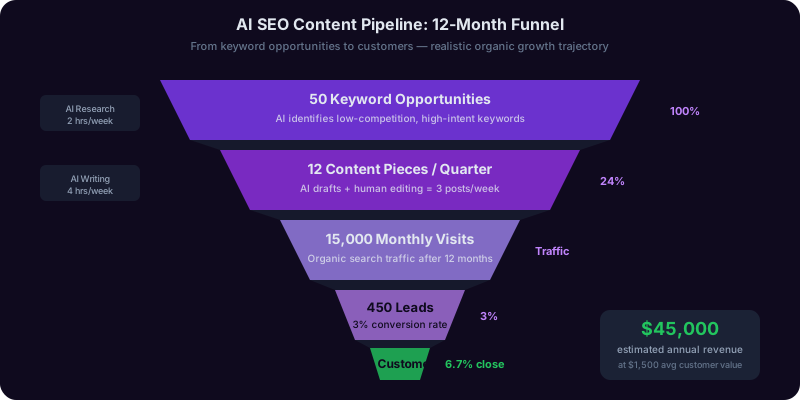
Consider a local accounting firm that publishes two blog posts per month using their AI marketing stack. Each post targets a specific search query like "small business tax deductions 2026" or "when to switch from sole proprietorship to LLC." After six months, those 12 posts generate an average of 2,500 organic visits per month. At a 2% conversion rate (email signup or consultation request), that is 50 new leads per month. If 10% of leads become clients at an average value of $2,000, that is $10,000 in monthly revenue from content that cost $50/month in AI tools plus a few hours of the owner's time. No agency retainer. No long-term contract. Just compounding organic growth.
Email Marketing and Ad Copy: Converting Attention into Revenue
Content and social media generate attention. Email marketing and advertising convert that attention into revenue. These are the functions where AI copilots deliver the most immediate, measurable ROI because the outputs - open rates, click rates, conversion rates, cost per acquisition - are directly trackable.
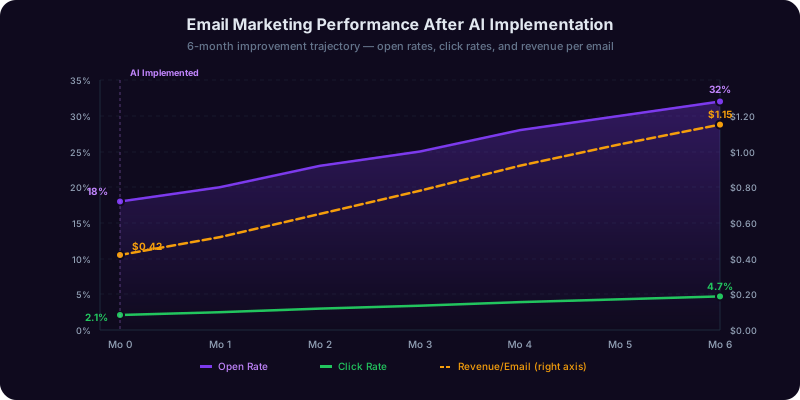
Email marketing with AI copilots. Email remains the most profitable marketing channel for small businesses. HubSpot's marketing data shows email generates $42 in revenue for every $1 spent, outperforming every other digital channel. Yet most small businesses treat email as an afterthought - sending occasional promotional blasts with no strategy, segmentation, or automation. An AI marketing copilot transforms email from a neglected channel into a systematic revenue engine.
The AI-powered email marketing system:
- Welcome sequence (5-7 emails): When someone joins your list, the copilot designs an automated sequence that introduces your brand, delivers immediate value, builds trust through social proof and expertise, and makes a soft offer. Each email is written in your brand voice with specific subject lines optimized for open rates.
- Nurture campaigns: For subscribers who are not ready to buy, the copilot creates monthly value-focused emails that keep your business top of mind. These might include industry insights, how-to content, case studies, or curated resources - all generated by the copilot based on what your audience engages with most.
- Promotional sequences: When you have a sale, new product, or special offer, the copilot drafts a 3-5 email promotional sequence with escalating urgency, different angles for different segments, and clear calls to action. It also generates A/B test variations for subject lines and preview text.
- Win-back campaigns: For subscribers who have not opened an email in 60-90 days, the copilot creates re-engagement sequences designed to either reactivate them or clean them from your list to improve deliverability.
Subject line optimization. The difference between a 15% and a 35% open rate often comes down to the subject line. AI copilots generate 5-10 subject line variations for each email, incorporating proven formulas: curiosity gaps, specific numbers, personalization tokens, urgency triggers, and benefit-first framing. Over time, the copilot learns which formulas perform best for your specific audience and adjusts its recommendations accordingly.
AI-powered ad copy and campaign management
Small businesses running Google Ads or Meta Ads face a steep learning curve. Poorly optimized campaigns waste hundreds of dollars per month on irrelevant clicks. Agencies charge $500-$1,000 per month for ad management on top of the ad spend itself. An AI marketing copilot handles the highest-value parts of ad management: writing compelling copy, identifying negative keywords, suggesting audience targeting, and interpreting performance data.
The AI ad copy workflow:
| Ad Component | AI Copilot Output | Impact |
| Headlines (Google Ads) | 15 headline variations per ad group, each under 30 characters, testing different value propositions | 20-40% improvement in click-through rate |
| Descriptions | 10 description variations per ad group with clear calls to action and benefit-focused language | 15-25% improvement in quality score |
| Negative keywords | Comprehensive negative keyword list to prevent wasted spend on irrelevant searches | 10-30% reduction in cost per click |
| Ad extensions | Sitelink, callout, and structured snippet suggestions tailored to your business | 15-20% improvement in ad rank |
| Landing page recommendations | Specific suggestions for headline, copy, and CTA alignment between ad and landing page | 25-50% improvement in conversion rate |
Budget optimization. For small businesses spending $500-$2,000 per month on ads, every dollar matters. The Marketing Copilot analyzes your campaign performance data and recommends budget reallocation: shifting spend from underperforming campaigns to those delivering the lowest cost per acquisition, pausing ads with high click rates but low conversion rates (a sign of targeting or landing page issues), and identifying dayparting opportunities where your ads perform significantly better at certain times. This level of optimization is exactly what agencies charge management fees to provide. For a broader perspective on how AI copilots can handle multiple business functions at this cost level, see our comparison of AI coaches versus human coaches.
Analytics and Measurement: Proving ROI Without a Data Team
The most common reason small businesses stick with expensive agencies is fear - fear that without professional guidance, they will waste money on marketing that does not work and not even know it. AI-powered analytics eliminate this fear by making performance measurement accessible to anyone who can ask a question in plain English.
The small business analytics problem. Google Analytics 4 is free but notoriously complex. Most small business owners have it installed but never look at it, or they glance at surface metrics (total visitors, page views) without understanding what the data means for their business. Agencies include analytics in their retainers, but the monthly reports they produce are often designed to justify the agency's fee rather than inform strategic decisions. Common agency report padding includes emphasizing impressions over conversions, comparing month-over-month instead of year-over-year (which hides seasonal patterns), and reporting on vanity metrics like social media follower count that have no correlation with revenue.
What AI copilots do differently with analytics. An AI marketing copilot interprets your analytics data through the lens of business outcomes, not marketing activity. Instead of telling you that your website had 12,000 visitors last month, it tells you that 340 of those visitors came from organic search for commercial-intent keywords, 45 filled out your contact form, and based on your historical close rate, those 45 leads should generate approximately $18,000 in revenue. That is actionable information. That is what you are actually paying an agency $300-$500 per month to tell you, and the copilot delivers it instantly.
Key metrics your AI analytics stack should track:
| Metric | What It Tells You | Action Threshold |
| Customer acquisition cost (CAC) | How much you spend to acquire each new customer across all channels | If CAC exceeds 25% of customer lifetime value, reduce spend or improve conversion |
| Channel-specific conversion rate | Which marketing channels actually drive revenue, not just traffic | If a channel converts below 1%, investigate or reallocate budget |
| Content ROI | Revenue attributable to each piece of content relative to creation cost | Double down on content types with ROI above 5:1 |
| Email revenue per subscriber | Monthly revenue generated per email subscriber | Below $0.50/subscriber/month indicates list quality or engagement issues |
| Ad spend efficiency (ROAS) | Revenue generated per dollar of ad spend | Below 3:1 ROAS for most small businesses signals campaign optimization needed |
| Organic traffic growth rate | Month-over-month change in search engine traffic | Flat or declining for 3+ months indicates content or technical SEO issues |
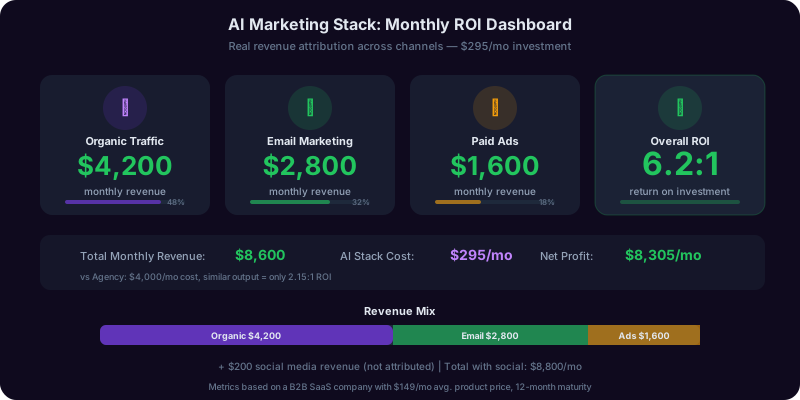
Weekly performance reviews with AI. Instead of monthly agency reports, an AI marketing copilot enables weekly 15-minute performance reviews. You ask the copilot to summarize this week's marketing performance, and it delivers a concise brief: what worked, what did not, what needs immediate attention, and what to prioritize next week. This rapid feedback loop is one of the biggest advantages of the AI stack over the agency model. Agencies operate on monthly cycles because humans need time to compile and analyze data. AI copilots operate in real time.
Attribution modeling for small businesses. Understanding which marketing touchpoints contribute to a sale is one of the most complex problems in marketing. Enterprise companies spend millions on attribution software. Small businesses typically have no attribution at all - they know they got a new customer but cannot trace the path from first touch to purchase. An AI copilot can build a simple attribution model using your existing data: UTM parameters in your URLs, Google Analytics event tracking, email engagement history, and ad platform conversion data. It will not match the precision of enterprise attribution tools, but it gives you a working model that is infinitely better than guessing. For broader guidance on how AI tools can assist with data-driven business decisions, see our guide to AI-powered professional second opinions.
Competitive benchmarking. Agencies often provide competitive analysis as part of their retainer, monitoring what your competitors are doing on social media, what keywords they rank for, and what ads they run. An AI copilot does this on demand. Ask it to analyze a competitor's content strategy, identify keywords they rank for that you do not, or evaluate their social media posting frequency and engagement rates. This intelligence informs your own strategy without the $200-$400 per month agencies typically charge for competitive monitoring services.
The 30-Day Implementation Roadmap: From Agency to AI Stack
Transitioning from an agency (or from doing nothing) to an AI marketing stack does not require a dramatic overnight switch. The most successful transitions follow a phased approach that builds competence and confidence at each stage before expanding. Here is the exact 30-day roadmap that small businesses are using to make this transition smoothly.
Week 1: Foundation and audit.
- Day 1-2: Set up your AI marketing copilot. Start by giving it comprehensive context about your business: what you sell, who your ideal customers are, your current marketing activities, your top three competitors, and your monthly revenue goals. The more context you provide upfront, the more relevant every subsequent interaction will be.
- Day 3-4: Run a complete marketing audit. Ask the copilot to evaluate your website's SEO health, review your last 30 days of social media performance, and assess your email marketing metrics. This audit establishes your baseline so you can measure improvement.
- Day 5-7: Develop your content strategy. Based on the audit, the copilot creates a 90-day content calendar prioritized by impact. Identify the first four blog posts or content pieces you will create. Set up your SEO tracking for target keywords.
Week 2: Content engine activation.
- Day 8-10: Create your first AI-assisted blog post. Use the copilot's outline, add your expertise and voice, then let the copilot optimize for SEO. Publish and promote across your active social channels.
- Day 11-12: Set up your email marketing automation. Use the copilot to write a 5-email welcome sequence for new subscribers. If you already have a list, draft a re-engagement campaign for inactive subscribers.
- Day 13-14: Batch-create two weeks of social media content using the copilot. Schedule everything through your scheduling tool so social media runs on autopilot while you focus on other functions.
Week 3: Paid advertising and optimization.
- Day 15-17: If you run paid ads, use the copilot to audit your current campaigns. Have it review your ad copy, negative keyword lists, audience targeting, and landing page alignment. Implement its top three recommendations.
- Day 18-19: If you are new to paid advertising, use the copilot to create your first campaign from scratch. Start with a small daily budget ($10-$20) on Google Ads targeting your highest-intent keywords. The copilot generates all ad copy, suggests bid strategies, and creates a negative keyword list.
- Day 20-21: Create your second blog post. By now the process should feel faster and more natural. Use learnings from the first post's performance to improve your approach.
Week 4: Measurement and refinement.
- Day 22-24: Run your first AI-powered weekly performance review. The copilot analyzes all channels - organic search, social media, email, and paid ads - and provides an integrated view of what is working and what is not. Adjust your strategy based on data rather than gut feeling.
- Day 25-27: Optimize your email sequences based on open rate and click rate data. The copilot A/B tests subject lines and suggests content adjustments for underperforming emails.
- Day 28-30: Review the full month. Compare your baseline metrics from Week 1 to current performance. Document what worked, what did not, and what you want to improve next month. The copilot generates a monthly report that focuses on business outcomes, not vanity metrics.
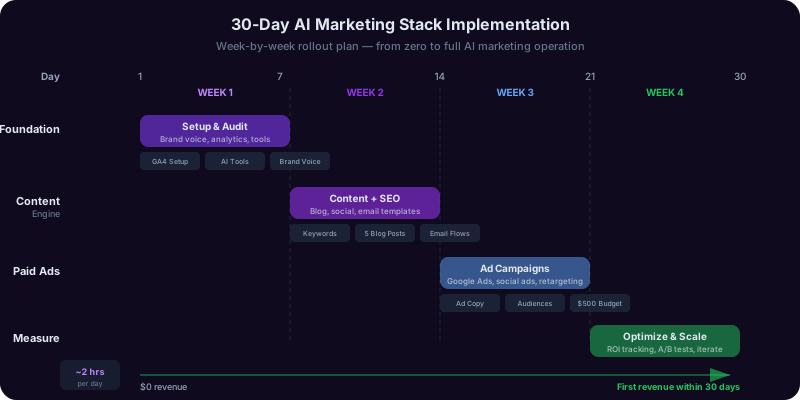
What to expect after 30 days. You will not have agency-level results in 30 days. Organic content takes 3-6 months to rank. Email lists take time to build. Ad campaigns need data before they can be optimized effectively. What you will have after 30 days is a functioning marketing system that runs for under $100 per month, a clear strategy based on data rather than guesswork, and the confidence to execute without agency hand-holding. By month three, most small businesses using this approach see organic traffic growth of 30-50%, email list growth of 15-25%, and paid ad efficiency improvements of 20-40%.
When to consider bringing the agency back. There are scenarios where professional marketing help still makes sense. If you are launching a major rebrand, entering a completely new market, or running a campaign with a budget exceeding $10,000 per month, the strategic guidance of an experienced marketing professional can be worth the investment. The difference is that with your AI stack in place, you can engage an agency for specific projects at defined scope and budget rather than an ongoing retainer. You might hire a consultant for a $3,000 brand strategy project and then execute the strategy yourself using your AI tools. This project-based approach gives you expert input when it matters most while keeping your monthly costs minimal.
Common Pitfalls and Best Practices for AI Marketing Success
AI marketing tools are powerful, but they are not magic. Small businesses that get the best results avoid specific pitfalls and follow practices that maximize the value of their AI stack. Here are the most common mistakes and how to avoid them, drawn from patterns across thousands of small businesses that have made this transition.
Pitfall 1: Treating AI output as final copy. The fastest way to make your marketing feel generic is to publish AI-generated content without adding your expertise, experience, and voice. AI copilots produce excellent first drafts, well-structured outlines, and data-driven recommendations. But your unique perspective, real customer stories, and industry-specific insights are what differentiate your content from every other business using the same tools. The best practice is to use the copilot for structure and optimization while providing the substance yourself. A blog post should be 60-70% your original thinking and 30-40% AI-assisted refinement.
Pitfall 2: Trying to be everywhere at once. Just because AI makes it faster to create content does not mean you should blast it across every platform. Focus beats volume. A business that publishes two excellent blog posts per month and maintains one strong social media channel will outperform a business that publishes eight mediocre posts across five platforms. The SBA's guidance on small business marketing emphasizes quality over quantity, and that applies even more when AI makes quantity easy.
Pitfall 3: Ignoring brand voice consistency. Each time you start a conversation with your AI copilot, make sure it understands your brand voice. Share examples of content you have written that you like. Specify whether your tone is formal, conversational, technical, or casual. Without this guidance, AI-generated content defaults to a competent but generic tone that sounds like every other AI-assisted business. The businesses that maintain a distinctive voice in the age of AI will have a significant competitive advantage.
Best practices that drive results:
| Practice | Why It Matters | How to Implement |
| Weekly performance reviews | Catches problems early and enables rapid iteration | Block 15 minutes every Friday to review channel metrics with your copilot |
| Content batching | Reduces context-switching and improves quality | Create all social media content for the week in one 30-minute session |
| Systematic A/B testing | Replaces guesswork with data-driven decisions | Test one variable per email campaign (subject line, CTA, send time) |
| Monthly content audits | Ensures existing content stays relevant and maintains rankings | Ask copilot to identify top 5 pages with declining traffic each month |
| Customer feedback integration | Grounds AI recommendations in real customer language | Feed customer reviews and support tickets to copilot for content ideas |
| Competitive monitoring | Identifies opportunities and threats early | Monthly copilot analysis of top 3 competitors' content and ad activity |
Pitfall 4: Not tracking ROI rigorously. Because the AI stack is cheap, some businesses stop measuring whether their marketing actually works. This is a mistake. Track customer acquisition cost, revenue by channel, and content ROI monthly. The copilot makes this easy - ask it to calculate your marketing ROI each month and flag any channels where performance is declining. Without measurement, you cannot optimize, and without optimization, even cheap marketing is wasted money.
Pitfall 5: Neglecting the human elements that AI cannot replace. AI copilots cannot attend a networking event, build a genuine relationship with a referral partner, or sit across the table from a hesitant prospect and answer their real concerns. The best AI marketing stacks handle the scalable, repeatable marketing functions (content, SEO, email, ads) and free up the business owner to focus on the high-touch, relationship-driven activities that still require a human presence. Do not let AI efficiency become an excuse to hide behind a screen. The most successful small businesses combine AI-driven digital marketing with intentional, in-person relationship building.
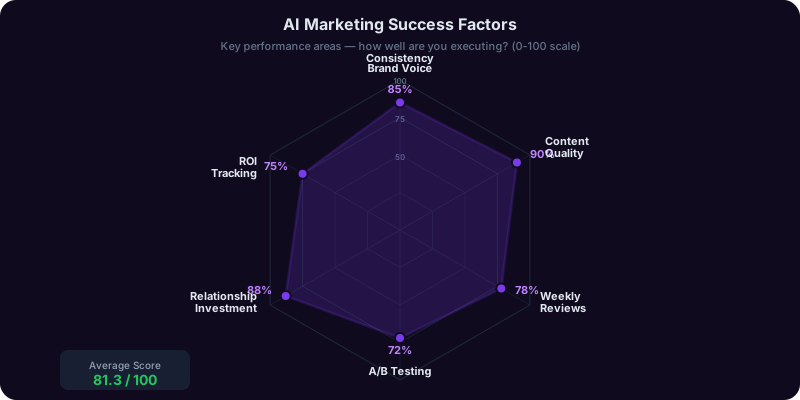
The compounding advantage. The small businesses that implement these practices see their AI marketing stack become more effective over time. The copilot learns your brand voice. Your content library grows and generates compounding organic traffic. Your email list expands and becomes more responsive. Your ad campaigns accumulate data that improves targeting and reduces cost per acquisition. After 12 months, a business running a disciplined AI marketing stack typically outperforms one that spent 10x more on agency services, because the AI-driven approach enables faster iteration, tighter feedback loops, and more consistent execution. That is the real competitive advantage - not the technology itself, but the discipline and velocity it enables.
Frequently asked questions
Can AI marketing tools really replace a full-service marketing agency for my small business?
How much time do I need to spend per week managing an AI marketing stack?
What is the biggest risk of switching from an agency to an AI marketing stack?
Do I need any marketing experience to use an AI marketing stack effectively?
How long does it take to see measurable results from an AI marketing stack?
What happens if the AI generates inaccurate information about my industry or products?
Should I tell my customers that I use AI for marketing content?
How do I ensure my AI marketing content does not sound generic or identical to my competitors?
Build Your AI Marketing Stack Today
Stop overpaying agencies for work AI copilots handle better and faster. Get personalized marketing strategy, content optimization, and campaign planning for your small business - all for a fraction of the cost.
- Marketing & Growth CopilotGet AI-powered content strategy, SEO optimization, ad copy generation, and campaign planning for your small business marketing
- Career & Professional CopilotBuild your professional brand and optimize LinkedIn presence to complement your AI marketing stack
- Finance & Money CopilotTrack marketing ROI, manage advertising budgets, and forecast revenue impact of your marketing investments
Free plan, no card. Pro from $4.99/week for every copilot across all 20 domains - about what one hour with any single professional costs per year.
Social Media Marketing: From Time Sink to Revenue Driver
Social media is where small businesses waste the most time and money relative to results. The average small business owner spends 6-10 hours per week on social media and generates minimal measurable revenue from it. Agencies charge $600-$1,200 per month for social media management and typically deliver a calendar of generic posts that could belong to any business in your industry. AI copilots transform social media from a scattershot time sink into a focused, data-driven revenue channel.
Platform selection and focus. The first and most valuable thing an AI marketing copilot does for social media is tell you where not to spend time. Most small businesses try to maintain a presence on five or six platforms simultaneously and do all of them poorly. The copilot analyzes your business type, target audience demographics, and content strengths to recommend one or two platforms where you can actually build traction. A B2B consulting firm should focus almost exclusively on LinkedIn. A local restaurant should focus on Instagram and Google Business Profile. A home services company should prioritize Google Business Profile and Facebook. Spreading effort across platforms where your customers do not spend time is the single biggest social media mistake small businesses make.
AI-driven content creation workflow for social media:
Social media analytics that matter. Agencies send you monthly reports filled with impressions and reach numbers that look impressive but mean nothing for revenue. An AI copilot tracks the metrics that actually predict business impact: click-through rate to your website, direct messages from potential customers, profile visits that convert to website visits, and attribution from social media touchpoints to actual sales. When you ask your copilot "which social media posts drove the most website traffic this month," you get an actionable answer in seconds - not a 15-page PDF in two weeks.
Community management with AI assistance. Responding to comments and messages is where most small business owners either spend too much time or ignore their audience entirely. An AI copilot drafts response templates for common questions, flags messages that require urgent attention (complaints, purchase inquiries, partnership opportunities), and helps you maintain a consistent brand voice across all interactions. A plumber who gets 15 Facebook messages per week asking about pricing and availability can set up templated responses through the copilot that are personalized enough to feel human but fast enough to respond within minutes instead of hours.
Repurposing engine. The highest-leverage social media strategy is repurposing content you have already created. A single blog post can become a LinkedIn article, a Twitter thread, five Instagram carousel slides, a Facebook post, and a short video script. The Marketing Copilot handles this transformation automatically, adapting tone, length, and format for each platform while maintaining the core message. This is how small businesses maintain an active social media presence without creating everything from scratch - and it is exactly the service agencies charge $600-$1,200 per month to perform manually.