
Money & Finance
Do Your RMDs Start at 73 or 75? It Depends on Your Birth Year
Born 1951-1959, your RMDs start at 73; born 1960 or later, you wait until 75, and getting the year wrong now triggers a 25% excise tax instead of the old 50%. This guide decodes the SECURE 2.0 birth-year matrix, the April 1 first-year trap that can double one year's taxable income, the new Uniform Lifetime Table divisors, and the QCD and aggregation moves that shrink the bill.
SECURE 2.0 RMD Age Changes: Why You Might Owe 2026 RMDs (or Not)
Tax disclaimer: This article is educational only and does not constitute tax, legal, or investment advice. Required minimum distribution (RMD) rules interact with Social Security claiming, Medicare IRMAA brackets, Roth conversions, and estate planning in ways that depend on your specific facts. Confirm any numbers with a CPA, enrolled agent, or fiduciary financial planner before filing or distributing.
For 40 years RMDs were simple: at age 70½ you started pulling taxable money out of your traditional IRAs and pre-tax 401(k)s, like it or not. Then the original SECURE Act of 2019 bumped the age to 72. Then SECURE 2.0 (enacted December 2022) bumped it again to 73 for most current retirees, and scheduled another bump to 75 starting in 2033. The result is a three-tier birth-year matrix that confuses even seasoned CPAs.
If you turn 73 in 2026 you almost certainly owe an RMD this year. If you turn 73 in 2026 but were born before July 1, 1949 your start age was already 70½ under the old rules and you've been taking RMDs for years. If you were born in 1960 or later your first RMD is still a decade or more away. And if you were born in the narrow 1951–1959 window your RMD age is 73 but the calculation year depends on which side of your birthday you started the year on.
The penalty for getting it wrong used to be a brutal 50% excise tax on the amount you should have withdrawn. SECURE 2.0 dropped that to 25%, and to 10% if you self-correct within a two-year window. That is still painful enough to justify reading this guide carefully. In 2026 the IRS is also rolling out updated Uniform Lifetime Table divisors that slightly extend life expectancy assumptions, lowering RMDs by roughly 5–7% across most ages.
This guide walks the matrix birth year by birth year, shows you how to compute the dollar amount with the 2026 divisor, explains the April 1 first-year trick that can either save you money or stack two RMDs into one tax year, covers QCDs as the single best tax-management lever, and shows where Copilotly's Finance Copilot automates all of it.
What changed in SECURE 2.0 beyond the age bump. The law also indexed the QCD limit to inflation (it was stuck at $100,000 for 17 years), eliminated lifetime RMDs from Roth 401(k) accounts effective 2024, created a one-time $54,000 split-interest QCD to a charitable remainder trust or charitable gift annuity, halved the missed-RMD penalty from 50% to 25% with a further reduction to 10% on timely correction, and clarified post-death distribution rules for inherited IRAs. Taken together these are the most retiree-friendly RMD changes in a generation. They are also the most complex, because the old rules continue to apply to people who already started under them. There is no "reset" — if you began RMDs at 70½ or 72 you stay on that schedule, and you cannot retroactively elect the new age.
Who this guide is for. If you were born between 1951 and 1959, this is your primary reference for 2026. If you were born in 1960 or later, use this guide to plan the Roth conversion runway before your age-75 trigger. If you inherited an IRA, you live under a different rule set — see our companion guide on the 10-year rule. If you are still working past 73 and not a 5% owner of the business, you may qualify for the still-working exception covered in section 8.
The Birth-Year Matrix: Age 70½, 73, or 75
The single most important table for any pre-retiree or retiree in 2026 is the SECURE 2.0 birth-year matrix. Get this wrong and you either pay a penalty or pay tax a year early.
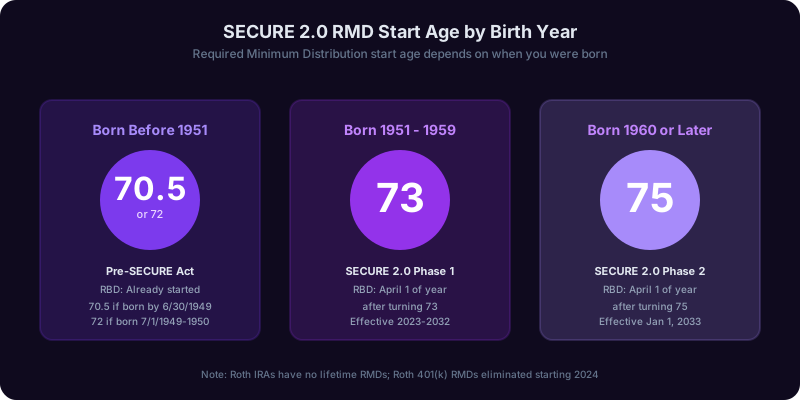
| Birth year | RMD start age | First RMD year | RBD (April 1) |
|---|---|---|---|
| Before 7/1/1949 | 70½ | Already taking | Past |
| 7/1/1949–12/31/1950 | 72 | Already taking | Past |
| 1951 | 73 | 2024 | April 1, 2025 |
| 1952 | 73 | 2025 | April 1, 2026 |
| 1953 | 73 | 2026 | April 1, 2027 |
| 1954–1959 | 73 | Year you turn 73 | April 1 next year |
| 1960 or later | 75 | Year you turn 75 | April 1 next year |
Notice the gap. Someone born December 31, 1959 starts RMDs at 73 (2032). Someone born January 1, 1960 starts at 75 (2035). One day of birthdate difference equals a three-year RMD deferral and likely six figures of additional Roth conversion runway. Congress did this deliberately to phase in the change, but it created a cliff that anyone born in late 1959 should plan around.
The middle bracket — born 1951 through 1959 — is where almost all 2026 RMD activity sits. If you are in that cohort, your first RMD is either already done, due this calendar year, or due next year. The next two sections show how to nail the timing and the dollar amount.
First-RMD Year: The April 1 Trick (and Trap)
Every other RMD in your life is due by December 31. Your first RMD is special: you can defer it until April 1 of the year after you turn 73 (or 75). That deferral date is called the Required Beginning Date, or RBD. It sounds like a gift but it is a trap as often as a gift.
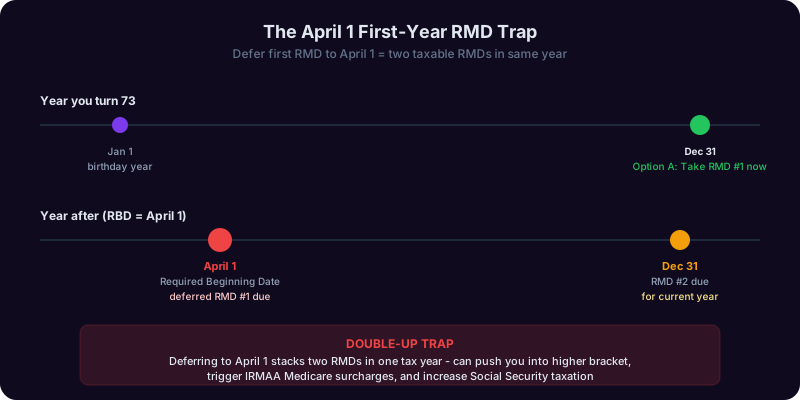
The trap: if you defer your first-year RMD to April 1 of year two, you still owe your year-two RMD by December 31 of year two. That means two RMDs in the same calendar year, stacked on top of each other and probably on top of a year of Roth conversions or capital gains harvesting. The combined income spike can push you into a higher marginal bracket, trigger the 3.8% Net Investment Income Tax, raise your Medicare IRMAA premium two years later, and reduce the deductible portion of medical expenses.
Here is a concrete example. Maria was born in 1953 and turns 73 in 2026. Her IRA balance on December 31, 2025 was $1,200,000. Her 2026 RMD is roughly $1,200,000 ÷ 26.5 = $45,283. She has three choices:
- Take the RMD in 2026. Simple, smooth income, no stacking.
- Defer to April 1, 2027. She also owes her 2027 RMD by December 31, 2027 — roughly $46,500 on a slightly grown balance. That is $91,783 of taxable IRA income in 2027.
- Split the deferral. Take part in 2026, part by April 1, 2027. This rarely helps because the calendar-year tax treatment is identical to option 2.
Option 2 makes sense in narrow cases: you retired mid-2026 with high W-2 wages and expect 2027 to be a lower-income year; or you live in a state that won't tax the IRA in 2027 (moving to Florida or Texas); or you are doing a large Roth conversion in 2026 and want to keep the bracket clean.
For everyone else, option 1 wins. Take your first RMD in the year you turn 73 (or 75) and avoid the stacking trap. Copilotly's Finance Copilot models all three options against your projected tax brackets and Medicare premiums so you can see the actual after-tax cost of each path before you commit.
One more nuance: the April 1 RBD is also the trigger for spousal beneficiary timing under the SECURE Act 10-year rule. If you die after your RBD, your beneficiary's distribution clock works differently than if you die before. That makes the RBD a planning hinge even beyond your own tax bill.
Tax-bracket math behind the choice. A married couple filing jointly in 2026 hits the 24% federal bracket at $206,700 taxable income. Add Medicare IRMAA tier 2 at $212,000 AGI (single) or $424,000 (joint) and the cost of stacking gets concrete. Maria's projected 2027 taxable income before any RMD is $135,000 (Social Security + pension + dividends). Adding a single $45,000 RMD keeps her in the 22% bracket comfortably. Stacking two RMDs ($91,800) pushes her to $226,800 — into the 24% bracket and into IRMAA tier 2 for 2029 Medicare premiums. The stacking penalty is roughly $2,000 of marginal federal tax plus $1,800 of additional annual Medicare premium — nearly $4,000 of avoidable cost from a single deferral decision. Multiply that across higher-balance accounts and the trap is obvious.
Calculating Your RMD: Uniform Lifetime Table 2026 Update
The RMD formula is brutally simple. Take your December 31 prior-year balance, divide by the Uniform Lifetime Table divisor for your age this year, and you have the minimum dollar amount you must withdraw. The IRS published an updated Uniform Lifetime Table effective January 1, 2022 (Regulation 1.401(a)(9)-9) that slightly extended life expectancy assumptions. Those divisors remain in force for 2026.
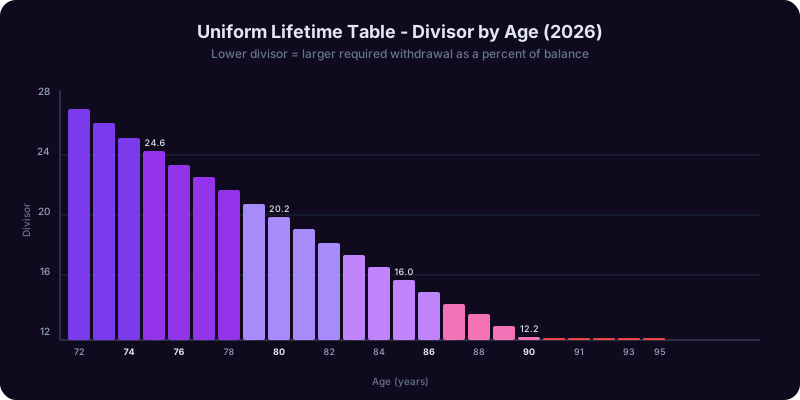
| Age in 2026 | Divisor | RMD % | RMD on $1,000,000 |
|---|---|---|---|
| 73 | 26.5 | 3.77% | $37,736 |
| 75 | 24.6 | 4.07% | $40,650 |
| 80 | 20.2 | 4.95% | $49,505 |
| 85 | 16.0 | 6.25% | $62,500 |
| 90 | 12.2 | 8.20% | $81,967 |
| 95 | 8.9 | 11.24% | $112,360 |
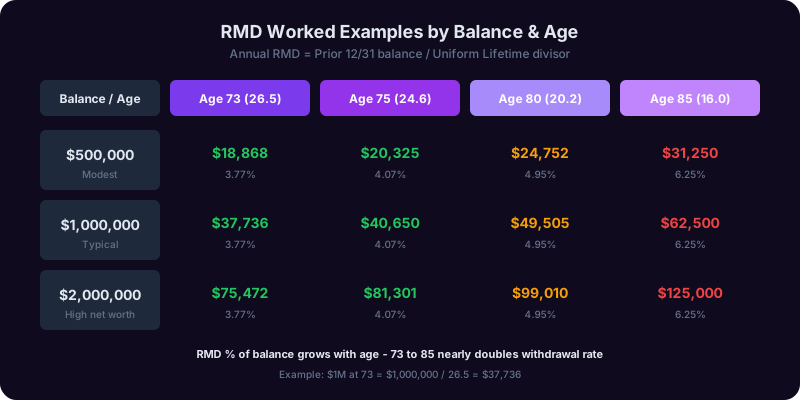
Worked examples for a 73-year-old in 2026 (divisor 26.5):
- $500,000 balance → $500,000 ÷ 26.5 = $18,868 RMD
- $1,000,000 balance → $1,000,000 ÷ 26.5 = $37,736 RMD
- $2,000,000 balance → $2,000,000 ÷ 26.5 = $75,472 RMD
The joint-and-survivor exception. If your sole beneficiary is a spouse more than 10 years younger than you, you use the Joint Life and Last Survivor Expectancy Table instead of the Uniform Lifetime Table. The divisors are larger, so your RMD is smaller. A 75-year-old married to a 60-year-old uses a divisor of roughly 27.0 instead of 24.6 — a 9% lower RMD every year for life.
The balance you divide is always the prior-year December 31 fair market value, including pending dividends and accrued interest. Your custodian (Fidelity, Schwab, Vanguard) reports this on Form 5498 and almost always pre-calculates your RMD on the January statement. Verify it — custodian errors happen, especially after rollovers or account transfers.
The 25% Excise Tax Penalty (Reduced from 50%) and the Correction Window
For decades the penalty for missing an RMD was a savage 50% excise tax on the shortfall, on top of the income tax you'd eventually owe anyway. SECURE 2.0 cut that to 25%, and added a self-correction safe harbor that drops it to 10%.
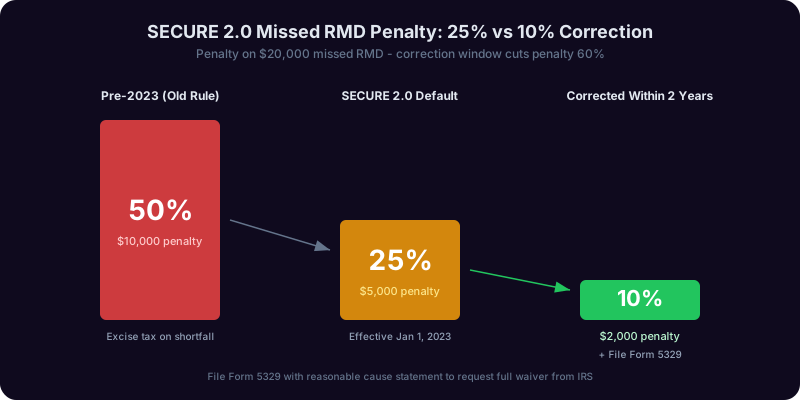
The 10% safe harbor. If you withdraw the missed amount and file an amended return within the correction window — generally the earlier of (a) the date the IRS mails you a notice of deficiency or (b) the end of the second taxable year after the year of the missed RMD — the excise tax drops from 25% to 10%. You report and pay it on Form 5329.
Example. Robert was supposed to take a $40,000 RMD in 2024 but forgot. He realized the mistake in March 2026, well within the two-year window. He:
- Withdraws the $40,000 from his IRA immediately.
- Files Form 5329 with his 2024 amended return.
- Pays $4,000 excise tax (10% of $40,000) plus the regular income tax on the $40,000 withdrawal.
Without the safe harbor he would have owed $10,000 in excise tax. Without SECURE 2.0 at all, $20,000.
The reasonable cause waiver. Even outside the safe harbor, the IRS routinely waives the excise tax if you can show the shortfall was due to reasonable error and you took prompt corrective action. File Form 5329, write "RC" (reasonable cause) in the margin, attach a brief letter explaining what happened (custodian error, medical emergency, recent death of spouse), and document the corrective withdrawal. Practitioners report a waiver grant rate above 90% on first-time honest mistakes.
What does not work. You cannot fix a missed RMD by taking a larger RMD next year — the shortfall remains a shortfall in the year it was due. You cannot use a Roth conversion to satisfy a missed RMD (see section 9). You cannot offset the penalty with charitable deductions or losses.
The practical lesson: set automatic RMD distributions with your custodian the moment you turn 73. Fidelity, Schwab, and Vanguard all offer automated RMD plans that calculate the amount each January and distribute it on whatever schedule you choose. Copilotly's Finance Copilot adds a second layer of safety by independently calculating the expected RMD, comparing it to the custodian's number, and pinging you in November if no distribution has been recorded that year.
Common missed-RMD scenarios that qualify for waiver. The IRS reasonable-cause waiver is routinely granted for: death or serious illness of the account owner or spouse in the fourth quarter; custodian error (the custodian failed to process a scheduled distribution); first-year confusion (newly turned 73 didn't realize the year-one rule); reliance on incorrect professional advice; and natural-disaster disruption (FEMA-declared zones get automatic relief). The waiver is not granted for: simple forgetfulness with no documentation, willful avoidance, repeated prior offenses, or shortfalls noticed only after IRS contact. The lesson: document everything in real time. If you discover a missed RMD, write down when you noticed, what triggered the discovery, and the corrective steps in date order. That timeline becomes your reasonable-cause attachment.
How custodians help — and where they fail. Major custodians calculate your RMD on the January statement and offer automated distribution plans (monthly, quarterly, annual). They do not aggregate across custodians, do not know about your 401(k) at a former employer, and do not know whether you intend QCDs. Treat the custodian number as a useful checkpoint, not a complete plan.
QCDs: Qualified Charitable Distributions Strategy
If you give to charity and you take RMDs, the Qualified Charitable Distribution (QCD) is the single most powerful tax tool available to you. A QCD is a direct transfer from your IRA custodian to a qualified 501(c)(3) charity. The amount counts toward your RMD but is excluded from your adjusted gross income entirely. You get the deduction value without itemizing.
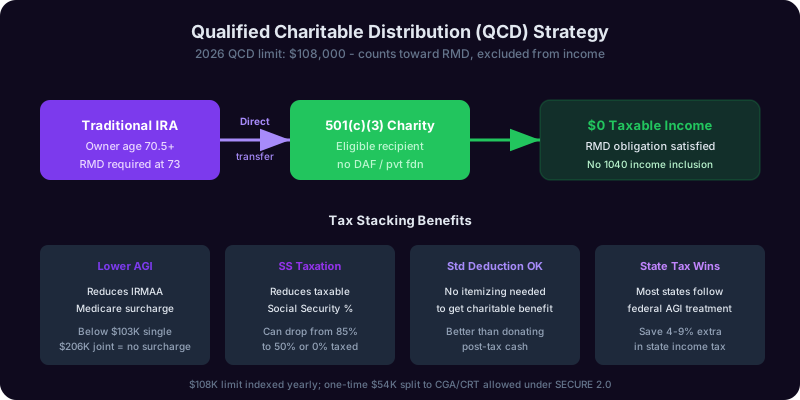
2026 QCD limits (indexed annually under SECURE 2.0):
| Provision | 2026 limit |
|---|---|
| Standard QCD annual limit per person | $108,000 |
| One-time split-interest QCD (CRT/CGA) | $54,000 (lifetime) |
| Minimum age to use QCD | 70½ |
Why QCDs beat itemized charitable deductions. An ordinary charitable contribution is a below-the-line deduction. It only helps if you itemize, and even then it doesn't reduce your AGI. AGI drives:
- Medicare Part B & D IRMAA surcharges (look-back two years)
- The taxable portion of Social Security benefits
- The 3.8% Net Investment Income Tax threshold
- State tax (most states use federal AGI as the starting point)
- Senior property tax circuit breakers and rent rebates
A QCD reduces AGI directly. The same $50,000 going to charity via QCD versus check can save $1,200–$3,000 in IRMAA alone for high-balance retirees.
Mechanics. You instruct your IRA custodian to write a check payable to the charity (not to you). The charity provides a contemporaneous written acknowledgment. On your 1040 you report the gross IRA distribution on line 4a and the taxable portion on line 4b with "QCD" written next to it. The QCD portion is the difference.
Restrictions. QCDs come only from IRAs, not 401(k)s — you may need to roll a 401(k) to an IRA first if QCDs are central to your plan. Donor-advised funds and private foundations do not qualify. The charity must be a public 501(c)(3). The QCD must be from a pre-tax IRA; Roth IRA QCDs work mechanically but waste the benefit (Roth distributions are already tax-free).
Copilotly's Finance Copilot schedules QCDs to satisfy your RMD before December 31, tracks the cumulative annual total against the $108,000 cap, and generates the IRS-compliant acknowledgment-letter checklist for each charity.
Aggregation Rules: Which Accounts You Can Combine
If you own more than one retirement account — and most Americans entering RMD age do — you need to know which accounts you can aggregate and which you cannot. Getting aggregation wrong is one of the most common ways high-net-worth retirees rack up the excise tax.
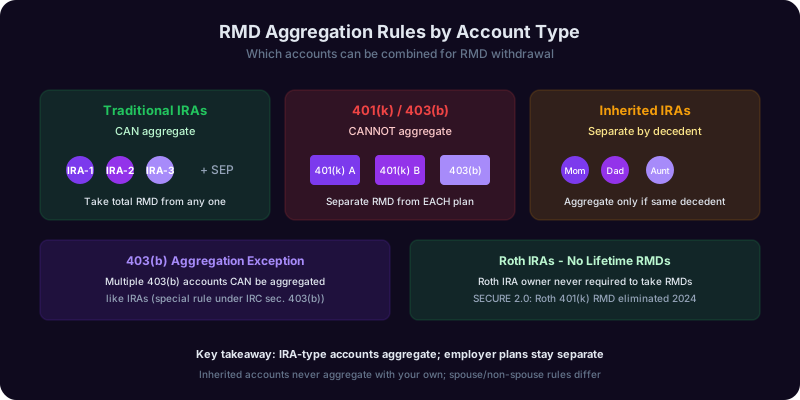
| Account type | Aggregate? | Notes |
|---|---|---|
| Traditional IRAs (multiple) | Yes | Calculate each, take total from any one or any combination |
| SEP & SIMPLE IRAs | Yes (with each other and with traditional IRAs) | Treated as IRAs for RMD purposes |
| 403(b) accounts (multiple) | Yes (only with other 403(b)s) | Separate universe from IRAs |
| 401(k) plans (multiple) | No | Each plan's RMD must come from that plan |
| Inherited IRAs | Only with other inherited IRAs from same decedent | Never aggregate with your own IRAs |
| Roth IRA (yours) | N/A — no lifetime RMD | SECURE 2.0 eliminated Roth 401(k) RMDs starting 2024 |
The big trap. If you have a 401(k) at a former employer and a traditional IRA, you cannot take the 401(k)'s RMD from the IRA. You must take it from the 401(k) itself. Many retirees with old 401(k)s left at former employers miss this and trigger the penalty. The fix is usually to roll old 401(k)s into a single IRA at retirement, which both simplifies RMDs and opens QCD eligibility.
Inherited IRA wrinkle. If you inherited an IRA from your spouse and rolled it into your own name, normal aggregation applies. If you kept it as an inherited IRA (you might if the original owner was younger than you, to defer your own RMDs), it lives in its own world. Inherited IRAs from different decedents can never be aggregated with each other. Multiple inherited IRAs from the same decedent can be aggregated.
Spousal coordination. Spouses cannot aggregate with each other — even if filing jointly. Each spouse's RMD comes from that spouse's accounts. This sounds obvious but advisors see clients who think a single $50,000 IRA distribution can cover both spouses' RMDs. It cannot.
Copilotly's Finance Copilot maps every retirement account to its correct aggregation bucket, calculates the per-bucket RMD, and generates a single-page yearly action sheet showing exactly which account each dollar must come from.
Still Working at 75+ Exception
If you are still working at RMD age and you participate in your current employer's qualified retirement plan, you may be able to defer RMDs from that single plan until April 1 of the year after you retire. This is the still-working exception, and it can be enormously valuable for late-career professionals, business owners, and tradespeople who keep earning into their late 70s.
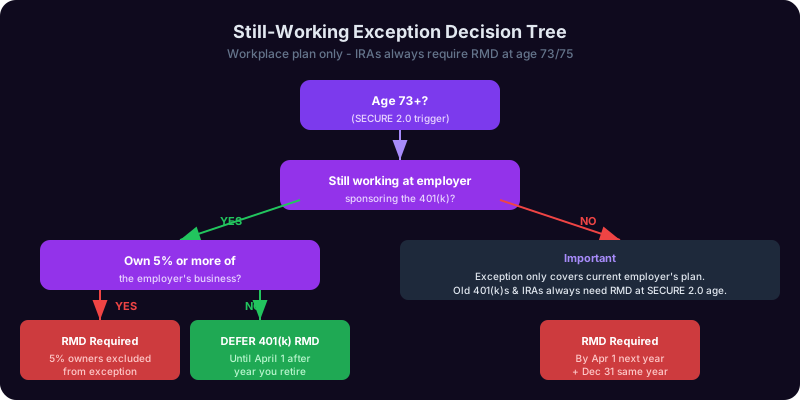
The five conditions. All of these must be true:
- You are still employed (not just a contractor) by the plan sponsor.
- The plan is a qualified plan: 401(k), 403(b), 457(b) governmental, or profit-sharing — not an IRA, SEP, or SIMPLE.
- The plan document permits the exception (most do, but check).
- You are not a 5% owner of the sponsoring business.
- The exception applies only to that specific plan — not to old 401(k)s at former employers, not to your IRAs.
The 5% owner kill-switch. If you own more than 5% of the business sponsoring the plan (directly, through a spouse, or via attribution rules to children/parents/grandparents), the exception does not apply. Period. You owe RMDs from your own business's plan starting at age 73 or 75 even if you are working 60 hours a week. This is why owner-employees often roll their 401(k) to an IRA before RMD age and shift retirement saving to a defined-benefit plan or after-tax bucket.
Example: late-career consultant. Patricia is a 76-year-old senior consultant at a 500-person firm, still earning $220,000. Her 401(k) at the firm holds $1.4M. Her old rollover IRA holds $900K.
- The $1.4M 401(k) is exempt from RMDs while she works. No RMD due on it.
- The $900K IRA is subject to RMDs. At age 76 the divisor is 23.7 → RMD ≈ $37,975.
- When she retires (say at 78), her 401(k) RMDs begin with an April 1 RBD the year after retirement.
The strategy trap. Retirees often roll old IRAs into their current 401(k) to qualify the IRA balance for the still-working exception. This is called a reverse rollover. It works mechanically, defers RMDs on a large balance, and is fully legal — but it locks the money into the 401(k)'s investment menu and forfeits future QCD eligibility on that money. Run the numbers both ways before doing it.
Copilotly's Finance Copilot models the still-working exception alongside reverse-rollover scenarios and compares the present value of deferred RMDs against the lost QCD and investment flexibility.
Edge cases worth knowing. The still-working exception applies even if you reduce hours, so long as you remain a common-law employee. It does not apply to contractors or 1099 consultants — the W-2 relationship is essential. Phased retirement counts; sabbaticals usually count; unpaid leaves can disqualify you depending on plan rules. If you change employers after age 73, the new employer's plan can still qualify under the exception, but balances rolled in from the old employer's plan may need separate RMD treatment for the year of the change. Plan administrators handle this differently and you should get the answer in writing before relying on it.
Spousal attribution under the 5% owner test. Family attribution rules under IRC Section 318 sweep in stock owned by your spouse, children, grandchildren, and parents. If your spouse owns 4% of the business and you own 2%, you are deemed to own 6% and the exception disappears for both of you. This catches a lot of mom-and-pop business owners off guard. The fix is either to take RMDs as required or to restructure ownership well before RMD age — a conversation for your CPA and estate attorney.
Roth Conversion + RMD Interaction
Roth conversions are the most powerful long-term tax tool for retirees, but they collide with RMDs in ways that catch even experienced planners off guard. The single most important rule:
Your RMD must come out of the IRA first, before any dollar of Roth conversion. The RMD itself cannot be converted.
This is Treasury Regulation 1.408A-4 Q&A-6. The RMD is treated as the first money out of the IRA each year. Any conversion in the same year is treated as occurring after the RMD has been satisfied. You cannot recharacterize the RMD as a conversion; you cannot retroactively roll the RMD back; the RMD is taxable and stays in your brokerage or checking account.
The right order in a year you owe RMDs:
- January–June: Satisfy your RMD (or schedule it with the custodian). Verify the dollar amount against your prior-year December 31 balance.
- July–October: Project your full-year taxable income, including the RMD, Social Security, dividends, capital gains, and any wages.
- October–December: Execute the Roth conversion sized to fill the gap between projected income and your target bracket ceiling (typically the top of the 22% or 24% bracket, or below the next IRMAA tier).
The pre-RMD window is gold. The five-to-ten years between retirement and your RMD start age is the highest-leverage Roth conversion period of your life. Wages have stopped, Social Security may be delayed, the standard deduction shelters the first $30K+ for couples, and RMDs aren't yet inflating your bracket. Every dollar you convert in this window shrinks the IRA balance that will eventually be subject to RMDs — permanently reducing future taxable income, IRMAA exposure, and Social Security taxability.
The 1960-cohort opportunity. If you were born in 1960 or later, your RMDs don't start until 75. That gives many retirees a 10–15 year Roth conversion runway after stopping work. A million-dollar IRA converted over 12 years in $80K–$120K annual slices, executed in the 22%/24% brackets, can swap a six-figure lifetime tax bill for a five-figure one and leave heirs a fully tax-free Roth subject only to the 10-year withdrawal rule.
What about the five-year clock? Each Roth conversion starts its own five-year clock for penalty-free withdrawal of converted principal. At RMD age you are already past 59½, so the 10% early-withdrawal penalty doesn't apply, but the five-year rule still matters for earnings on conversions. In practice this rarely binds for retirees converting modest annual amounts.
The conversion-to-IRMAA dance. Roth conversions add to your AGI in the conversion year and that AGI determines your Medicare IRMAA premium two years later. A 2026 conversion of $100,000 on top of a $90,000 RMD plus $50,000 of Social Security can push a single filer into IRMAA tier 3 ($394 extra Part B per month plus Part D surcharges — roughly $5,400 of additional 2028 Medicare cost). Always size conversions against the next IRMAA tier ceiling, not just the next tax bracket. The IRMAA cliffs are sharper than the tax brackets and frequently dominate the year's planning.
How Copilotly's Finance Copilot Calculates Your RMDs
Tax disclaimer: Copilotly's Finance Copilot is a planning and education tool. It does not replace a CPA, enrolled agent, or fiduciary financial planner. Outputs should be reviewed with a qualified professional before filing returns or executing distributions. Tax law changes; Copilotly updates rules continuously but cannot guarantee real-time accuracy for every state and edge case.
RMDs sit at the intersection of five other planning problems: Social Security claiming, Medicare IRMAA, Roth conversions, charitable giving, and estate distribution. Modeling them in isolation almost always leaves money on the table. Copilotly's Finance Copilot was built to model them together.
What it does:
- Calculates your RMD across every IRA, 401(k), 403(b), and inherited account, applying the correct aggregation rules and the 2026 Uniform Lifetime Table (or Joint Life table for spouses 10+ years younger).
- Models the April 1 RBD decision against projected two-year income to flag stacking risk, IRMAA tier changes, and bracket overflow.
- Schedules QCDs to satisfy the RMD before December 31, tracks the cumulative $108,000 annual cap, and prepares acknowledgment-letter templates per charity.
- Integrates with a Roth conversion ladder, automatically taking the RMD first and then sizing conversions to fill your target bracket without crossing the next IRMAA threshold.
- Maps the still-working exception — including the 5% owner test, attribution rules, and reverse-rollover trade-offs.
- Monitors for missed RMDs in November and generates Form 5329 + reasonable-cause letter drafts for the 10% safe harbor if needed.
A typical session: You link your Fidelity, Schwab, and Vanguard accounts (read-only via Plaid), enter your birthdate and Social Security claiming year, and upload last year's 1040. The copilot returns a one-page 2026 distribution plan: dollar amount per account, target distribution dates, suggested QCD amount, suggested Roth conversion amount, and projected impact on 2028 IRMAA premium (using the two-year lookback).
What it costs. The Finance Copilot is free to start. Premium scenarios — multi-year tax projections, estate distribution modeling, advisor sharing — are part of the Copilotly Pro tier. For a typical pre-RMD household sitting on $1M–$3M in tax-deferred accounts, the Roth-conversion lift identified in the first session usually exceeds a year of Pro fees by 10x or more.
If you are turning 73 in 2026, born in the 1951–1959 cohort, or planning ahead for a 75-trigger after 1960, the next 90 days are the highest-leverage planning window of your retirement. Don't spend December guessing at divisors. Run the Copilot once, lock in your distribution plan, and put the year on autopilot.
Frequently asked questions
What if I have multiple IRAs at different custodians?
Can I delay my first RMD to April 1 without penalty?
Do Roth 401(k)s have RMDs in 2026?
How do RMDs interact with Social Security taxation?
Can I take more than my RMD?
Are RMDs subject to state income tax?
What happens to RMDs when I die?
How does Copilotly handle the 2026 RMD calculation?
Get help with this from the Finance & Money Copilot
Link your retirement accounts in 60 seconds and Copilotly's Finance Copilot calculates your 2026 RMD across every IRA and 401(k), schedules QCDs to cut your AGI, sizes Roth conversions to fill the gap, and flags IRMAA tier risk two years ahead. Free to start, no credit card required.
Free plan, no card. Pro from $4.99/week for every copilot across all 20 domains - about what one hour with any single professional costs per year.
Not a financial advisorThis is financial information, not financial advice. Consult a licensed financial professional.