
Business & Strategy
You and Your Co-Founder Are in Conflict
Business partnerships break down. Here is how to protect yourself and your company.
Free plan, no card. Or read the whole plan below first.
What is happening
You and your co-founder - someone you may have known for years, or even built a company with from scratch - are no longer aligned. Maybe it started as a disagreement about company direction, spending priorities, or hiring decisions. Maybe one of you stopped pulling their weight, or is drawing a salary the company can't sustain. Maybe trust has completely eroded after discovering dishonesty, misuse of company funds, or a unilateral decision that blindsided you. Whatever the trigger, the working relationship has deteriorated to the point where the status quo is not sustainable for either of you or the business.
Co-founder conflict is one of the top causes of startup failure. When founders can't function effectively together, it paralyzes decision-making, creates a toxic environment for employees, and signals instability to investors and customers. But the stakes are not just operational - they are financial and legal. Equity ownership, intellectual property, company debt, and fiduciary responsibilities are all on the line. How you handle the conflict in the next few weeks will determine whether the company survives, whether you walk away with something of value, and whether you end up in costly litigation.
This usually looks like
- Fundamental disagreement over company direction, business model, or growth strategy
- One co-founder is not performing or contributing equally and resists accountability
- Discovered financial misconduct, undisclosed conflicts of interest, or misuse of company funds
- One co-founder wants to exit but is demanding an unreasonable buyout price
- Personal relationship deterioration that has spilled over into business decision-making
- Investor or board pressure that has created a wedge between founders
What it costs
$5,000-$50,000+ depending on whether the matter settles in negotiation or proceeds to litigation; mediation typically costs $2,000-$8,000 split between parties
Typical timeline
Negotiated separations: 4-12 weeks; mediated resolutions: 6-10 weeks; litigation: 12-36 months
How these usually end
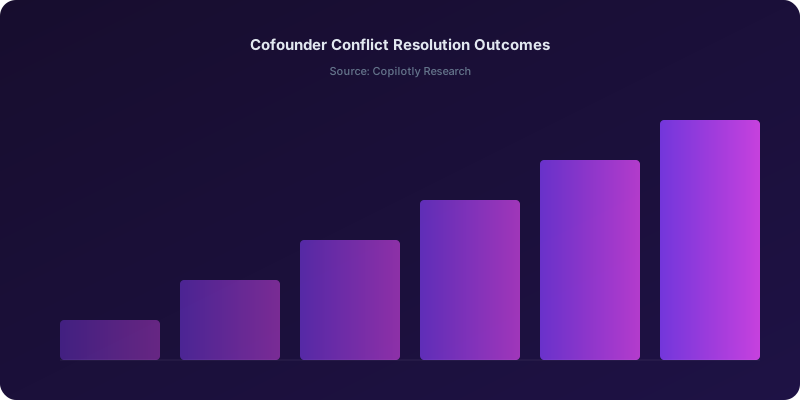
Approximately 80% of co-founder disputes that reach formal mediation settle without litigation; fewer than 10% of disputes result in a court judgment
The law involved
Delaware General Corporation Law (for C-corps), your state's LLC Act, Uniform Partnership Act, common law fiduciary duty principles, and any arbitration clause in your founding agreement
What to do, in order
- 01
Secure Your Access and Document Everything First
Immediately, before any confrontation
Before you have a formal conversation with your co-founder, quietly take stock of what you control and what you could lose. Ensure you have access to all critical accounts: banking, code repositories, cloud infrastructure, customer databases, domain registrars, and any platforms the business depends on. Do not lock your co-founder out yet - that is premature and potentially a breach of your fiduciary duty - but verify your own access is intact. Simultaneously, begin documenting the conflict: dates of incidents, specific statements made, decisions taken unilaterally, evidence of any financial irregularities. Written records matter enormously if this proceeds to legal dispute.
How a copilot helpsThe legal copilot can generate a documentation checklist specific to your company structure (LLC, C-corp, partnership) covering what records to secure and how to preserve evidence without triggering a legal dispute prematurely.
- 02
Review Your Founding Documents and Shareholder Agreement
Day 1-3
Pull out your shareholder agreement, operating agreement (if an LLC), or partnership agreement. Look specifically for: vesting schedules and cliff dates, buyout provisions and valuation methods, drag-along and tag-along rights, deadlock resolution mechanisms, causes for removal of a co-founder, and any non-compete or non-solicitation clauses. Many early-stage companies have weak or missing agreements - if yours is one of them, that changes your options significantly. You need to understand exactly what the legal framework says before you can negotiate anything.
How a copilot helpsThe legal copilot can walk you through your founding documents section by section, flag the clauses most relevant to your situation, and help you understand what rights and remedies you actually have under the agreement you signed.
- 03
Attempt a Direct, Structured Conversation
Days 3-7
If the relationship has not completely broken down, a structured one-on-one conversation is your first and least expensive option. Come prepared with a written agenda, specific examples of the issues, and a clear proposal for what resolution looks like to you. This is not a venting session - it is a business negotiation. Avoid ultimatums in the first conversation, focus on business outcomes rather than personal grievances, and listen to understand what the other party actually wants. Many co-founder conflicts resolve when both parties realize they actually want different things and can structure a clean separation by mutual agreement.
How a copilot helpsThe business strategist copilot can help you prepare for this conversation, including scripting key talking points, anticipating your co-founder's likely positions, and structuring a proposal that creates a viable path forward for both parties.
- 04
Engage a Mediator If Direct Conversation Fails
Week 2-3
If direct conversation breaks down or is too charged, a professional mediator - ideally one with experience in business disputes - can facilitate a resolution without the cost and damage of litigation. Mediation is confidential, typically costs $2,000-$8,000 total, and can resolve disputes in one to three sessions. It is far cheaper than arbitration or litigation, and a mediated agreement tends to be more durable because both parties shaped it. Many operating agreements require mediation before arbitration - check yours. Even if not required, proposing mediation signals good faith and can prevent the situation from escalating.
How a copilot helpsThe legal copilot can explain the mediation process, help you identify what a fair resolution might look like before you walk into the room, and assist you in evaluating any settlement proposal the mediator surfaces.
- 05
Hire a Business Attorney - Not a General Practitioner
Week 2-4, or sooner if there is misconduct
If the conflict is serious - equity is at stake, there are allegations of misconduct, or you are contemplating a buyout or forced separation - you need an attorney who specializes in business disputes or corporate law, not a general practitioner or a family friend who handles wills. Your attorney's job is to advise you on your legal rights, review any separation agreement before you sign it, and represent your interests if the dispute escalates. Do not sign any agreement, amendment, or buyout term sheet without legal review. The cost of an hour of attorney time is trivial compared to the cost of signing away equity you were entitled to.
How a copilot helpsThe legal copilot can help you prepare for your first attorney meeting - summarizing the key facts, the relevant documents, and the specific questions you need answered - so you use your billable hours efficiently.
- 06
Negotiate a Buyout or Separation Agreement
Week 3-8
If one co-founder will leave the company, the central question is valuation: what is the departing founder's equity worth, and who pays whom? Common valuation approaches include book value, a multiple of revenue or EBITDA, a discounted cash flow model, or a third-party independent appraisal. The buyout can be structured as a lump sum, an installment plan, or a revenue-sharing arrangement. The separation agreement should also address: IP ownership, non-compete terms, references, ongoing advisory arrangements if any, and release of claims. Both parties should have independent legal counsel before signing.
How a copilot helpsThe business strategist copilot can help you build a defensible valuation model for the company, model different buyout structures and their financial impact, and identify what terms matter most in a separation agreement.
- 07
Protect Employees, Customers, and Investors Throughout the Process
Throughout the process
Co-founder conflict becomes a company-wide crisis when it leaks to employees, customers, or investors prematurely. Keep the circle of knowledge tight while you are in active negotiation. Do not disparage your co-founder to staff. If you have investors or a board, you may have a fiduciary obligation to inform them - consult your attorney on timing. Once resolution is reached, craft a clear, neutral communication plan for internal and external stakeholders. How you frame the transition to employees and customers will significantly affect whether the business retains trust through the disruption.
How a copilot helpsThe marketing copilot can help you draft internal and external communications that announce a leadership change professionally and honestly, without creating alarm or inviting speculation about what actually happened.
- 08
Restructure Governance to Prevent Future Deadlocks
After resolution, within 30 days
Once the immediate conflict is resolved, use it as a forcing function to fix the structural problems that allowed it to escalate. If you are now the sole founder or have remaining co-founders, update your operating or shareholder agreement with clearer decision-making authority, defined vesting schedules, explicit buyout mechanisms tied to a valuation formula, and a board or advisory structure that can break deadlocks. Companies that survive a co-founder split and put proper governance in place often emerge stronger - with clearer roles and a more resilient structure than they had before.
How a copilot helpsThe legal copilot can help you identify the governance gaps that contributed to the conflict and outline the specific provisions your updated agreement should include to protect the company going forward.
Questions worth asking
These are the ones that change the outcome. Most people do not know to ask them.
Does our founding agreement have a buyout clause, and how is the company valued under it?
The valuation method baked into your agreement - whether book value, a revenue multiple, or a third-party appraisal - determines what a departing co-founder is owed. If there is no clause, you are negotiating from scratch, which typically means a longer and more expensive process.
The legal copilot can review your operating or shareholder agreement and extract the exact buyout terms, highlight any ambiguities, and explain what each party is entitled to under the existing language.
What equity has actually vested for each co-founder, and what happens to unvested shares if someone leaves?
Vesting schedules are designed precisely for this situation. If your co-founder leaves before their equity has fully vested, the unvested shares may revert to the company - but only if your agreement was set up correctly. Many early-stage companies have no vesting at all, which means a co-founder who leaves day one walks away with a full equity stake.
The legal copilot can walk you through your vesting schedule, calculate how much equity has vested for each founder as of today, and explain what provisions - if any - allow you to claw back unvested shares.
Who owns the intellectual property, and is it properly assigned to the company?
In many early-stage companies, IP created by the founders - code, designs, trade secrets, patents - was never formally assigned to the company entity. If a co-founder leaves and the IP assignment was never executed, they may have a colorable claim to IP critical to the business.
The legal copilot can help you audit whether IP assignment agreements exist, identify gaps, and understand what steps you can take to protect the company's ownership of its core assets during and after the separation.
What are my fiduciary duties to the company and to other shareholders during this conflict?
As a director or officer of the company, you owe fiduciary duties of care and loyalty - even during a conflict with your co-founder. Actions that harm the company (locking co-founders out of systems, diverting business opportunities, or destroying records) can expose you to personal liability even if you believe you are the wronged party.
The legal copilot can explain your specific duties based on your role (director, officer, managing member) and your state's corporate law, and flag actions you should avoid during the dispute to stay on the right side of your legal obligations.
If we cannot agree, what are my options for forcing a resolution?
When co-founders cannot reach a voluntary agreement, you may have options depending on your structure: invoking a deadlock resolution clause, calling a vote if there is a board, seeking judicial dissolution of the company, or filing a lawsuit for breach of fiduciary duty. Each option has different costs, timelines, and risks. Understanding the full menu of options is essential to negotiating effectively.
The legal copilot can map out the dispute resolution mechanisms available under your specific agreement and state law, explain the realistic cost and timeline of each, and help you evaluate which path gives you the best outcome given your goals.
Understanding Your Legal Position Before You Act
The first thing most founders get wrong in a co-founder dispute is acting on instinct before understanding their legal position. Locking a co-founder out of Slack or the bank account, unilaterally hiring or firing employees, or making major company decisions without proper authority can all constitute breaches of fiduciary duty - even if you believe you are the wronged party. Before you take any significant action, you need to understand what your founding documents actually say and what your legal obligations are.
Your operating agreement (for an LLC) or shareholder agreement (for a corporation) is the governing document for your dispute. It should address decision-making authority, voting thresholds for major decisions, what triggers a buyout, how the company is valued, and what happens if founders deadlock. If your agreement has these provisions, your dispute has a roadmap. If it does not - which is common in early-stage companies that used a template or skipped the process entirely - you are operating under your state's default business law, which may not reflect what either party intended. The SBA's guide to resolving business disputes outlines the formal options available to business partners under U.S. law, including arbitration and mediation processes.
A legal copilot can help you read your founding documents with fresh eyes, extract the provisions that govern your dispute, and identify where the agreement is silent or ambiguous. This is the foundation for every conversation, negotiation, or legal proceeding that follows. Going in blind is how founders give away rights they did not realize they had. If your company is also dealing with external legal pressure during the dispute, see our scenario on receiving a cease-and-desist. Founders building the right legal structure from the start should explore our scenario on choosing between LLC and corporation.
How to Negotiate a Fair Buyout
The most common resolution to a co-founder conflict is a buyout - one founder purchases the other's equity stake and continues operating the business. The central challenge is agreeing on what that equity is worth. Both parties typically have an incentive to skew the valuation in their favor: the departing founder wants a higher number, the remaining founder wants a lower one. Without a pre-agreed valuation formula in your founding documents, reaching agreement often requires a neutral third-party valuation or significant negotiation.
Common valuation approaches include a multiple of trailing revenue or EBITDA, a discounted cash flow analysis, book value (which is often far below market value for technology companies), or a third-party appraisal by a certified business valuator. The right method depends on your company's stage, revenue, and industry. A pre-revenue startup is valued very differently than a company generating $2 million in annual recurring revenue. Getting the methodology right matters as much as the number itself.
Structuring the payment is equally important. A lump sum buyout preserves a clean break but requires the remaining co-founder to have access to capital - whether from company funds, outside investment, or personal resources. Installment payments spread the cost but create an ongoing relationship between parties that may want a clean separation. Revenue-sharing arrangements tie the buyout price to future performance, which can align interests but creates complexity. The business strategist copilot can help you model each structure and understand the financial implications before you sit down to negotiate.
Do not forget the non-financial terms. A separation agreement should also address: what the departing founder will say publicly about the split, whether they retain any advisory role, non-compete and non-solicitation terms (which are enforceable in some states and not others), vesting of any unvested equity, and a mutual release of claims. These provisions are often as important as the dollar amount - and are frequently the ones founders neglect until after they have already agreed on price.
Protecting the Company While the Dispute Is Active
One of the most underappreciated risks in a co-founder dispute is the damage done to the company itself while the founders are focused on fighting each other. Employees notice when leadership is dysfunctional - key hires leave, productivity drops, and a toxic undercurrent spreads through the organization. Customers and partners who sense instability may reduce their exposure or quietly begin evaluating alternatives. Investors who hear about the dispute secondhand, without context, may conclude the company is uninvestable.
Managing information flow during an active dispute requires discipline. Keep the circle of knowledge tight - typically just the two founders, their respective attorneys, and any mediator or board member whose involvement is required by your agreement. Avoid venting to employees, even informally. Document decisions carefully so that the company continues to make defensible, process-appropriate choices during the dispute. If you have a board or investors, consult your attorney about whether and when you are obligated to inform them - there is often a legal answer to this question, not just a strategic one.
Once a resolution is reached, communication planning becomes critical. How you frame a co-founder's departure to employees, customers, and the press determines whether the company retains confidence or enters a period of destabilizing speculation. A marketing copilot can help you draft internal announcements and external communications that acknowledge the change honestly and project stability, without inviting questions you are not prepared to answer.
When Separating Is Actually the Right Answer
Many founders - especially those who have been through years of building something together - resist accepting that separation is the best outcome. They keep trying to patch the relationship, restructure responsibilities, or find a compromise that allows both people to stay. Sometimes that works. Often it does not. Prolonged conflict with a co-founder is not a neutral situation - every week of dysfunction has a cost in lost focus, employee morale, and strategic momentum. At some point, a clean separation is less harmful to the company than continued coexistence.
The right moment to pivot from resolution to separation is when the core values or strategic vision of the two founders are genuinely incompatible - not just different communication styles or work preferences, but fundamental disagreements about what the company is and what it should become. It is also appropriate when trust has been so severely damaged - through dishonesty, financial misconduct, or repeated broken commitments - that rebuilding it would require more energy than the company can spare. A company with one committed, aligned founder often outperforms a company with two founders who can barely be in the same room. Research cited by the SBA's small business blog suggests that companies that resolve founder disputes within 90 days are significantly more likely to survive the following 24 months than those where the conflict continues unresolved.
Approaching separation as a business negotiation rather than a personal conflict is the most important reframe available to you. The question is not who was right or who is the better person - it is how to structure an exit that allows the company to survive and both parties to move on with their equity and reputation intact. A business strategist copilot can help you think through what a fair and viable separation looks like given your specific company stage, cap table, and financial position, while a legal copilot can help you understand the legal architecture required to execute it cleanly. Founders navigating this transition should also review our guide on startup governance mistakes and explore resources for startup founders using AI advisory tools.

How to Rebuild the Company After a Co-Founder Split
Companies do survive co-founder splits - some of the most successful businesses in history went through a founder departure at a critical juncture and came out stronger. But recovery is not automatic. The period immediately after a separation is when the remaining founder or founders need to be most intentional about stabilizing the organization, addressing the gaps left by the departed co-founder, and communicating a clear vision for what comes next.
Start with the organizational gaps. If the departing co-founder owned a functional area - engineering, sales, finance - identify who is covering those responsibilities in the interim and what the plan is to fill the role properly. Do not assume the remaining team will absorb the work indefinitely without burnout or resentment. Be honest internally about the transition plan and its timeline. Employees who understand what is happening and what the plan is will perform far better than employees left to speculate.
Use the disruption as an opportunity to revisit your governance structure. Update your operating or shareholder agreement with clearer provisions for future leadership transitions, decision-making authority, and dispute resolution. Consider formalizing an advisory board or establishing an independent board member who can provide oversight and break deadlocks if they arise again. The structural vulnerabilities that enabled the conflict to escalate rarely disappear on their own - they need to be addressed deliberately. A business strategist copilot can help you design a governance structure that is appropriate for your company's current stage and resilient enough to prevent the next conflict from reaching the same level of crisis.
When to get a professional
Including the cases where you probably do not need one. That half matters as much as the other.
Definitely get one
- Equity worth more than $25,000 is in dispute
- There is evidence of financial misconduct, fraud, or embezzlement by your co-founder
- Your co-founder has locked you out of company accounts or assets
- You have outside investors or a board who may have independent legal interests
- You are being asked to sign any agreement, release, or term sheet
Probably worth it
- Direct negotiation has broken down and you cannot reach an agreement
- Your founding agreement is silent on buyout mechanisms or dispute resolution
- The company has significant revenue, contracts, or intellectual property
- There are employees whose interests could be affected by the leadership dispute
- The conflict involves allegations of breach of fiduciary duty on either side
Probably not needed
- The conflict is minor and both parties are aligned on wanting to resolve it quickly
- You have a clear, detailed operating agreement with a straightforward buyout formula
- The company is pre-revenue and has minimal assets to divide
- Both parties agree on company value and the terms of separation
- A trusted mutual advisor or mediator is already facilitating a resolution
Common questions
Can my co-founder sell their equity stake to a third party without my consent?
What happens to a co-founder's unvested equity when they leave?
Can I remove my co-founder from the company even if they refuse to leave?
Do I have to pay my co-founder if they leave voluntarily?
How do I protect the company's intellectual property if my co-founder leaves on bad terms?
Should I talk to a therapist or coach as well as a lawyer?
Get help with this from the Business & Strategy Copilot
Describe your situation and get specific, actionable guidance - not the generic hedging a general-purpose chatbot gives you on business & strategy questions.
Free plan, no card. Pro from $4.99/week for every copilot across all 20 domains - about what one hour with any single professional costs per year.