
Marketing & Growth
Launching Your First Product Online
A great product means nothing if nobody knows about it. Here is your launch plan.
Free plan, no card. Or read the whole plan below first.
What is happening
You have built something - a physical product, a software tool, a digital download, a course - and now you need to get it in front of the right people. You may have a rough idea of your target customer, a product listing or landing page, and a lot of anxiety about whether anyone will actually buy. The gap between 'product ready' and 'product selling' is where most first-time founders get stuck.
First impressions in a market are hard to undo. Launching without a clear strategy often means spending money on ads that don't convert, building an audience in the wrong channel, or pricing the product incorrectly and having to walk it back publicly. A structured pre-launch and launch process dramatically increases the probability of early sales, genuine word of mouth, and the data you need to optimize. Getting this right the first time saves months of wasted effort.
This usually looks like
- You finished building a product and realized you have no marketing plan
- You launched on your own and got zero sales in the first two weeks
- You are preparing a launch and want to do it right the first time
- You have a small budget and need to know where to spend it for maximum impact
- You are choosing between launching on Amazon, Etsy, Shopify, or your own site
- You want to build an email list before launch but do not know how to start
What it costs
Marketing consultants for launch strategy typically charge $150-$500/hour; full-service launch agencies charge $5,000-$50,000+ for managed campaigns
Typical timeline
A well-prepared product launch takes 6-12 weeks of pre-launch preparation; the active launch window is typically 7-14 days
How these usually end
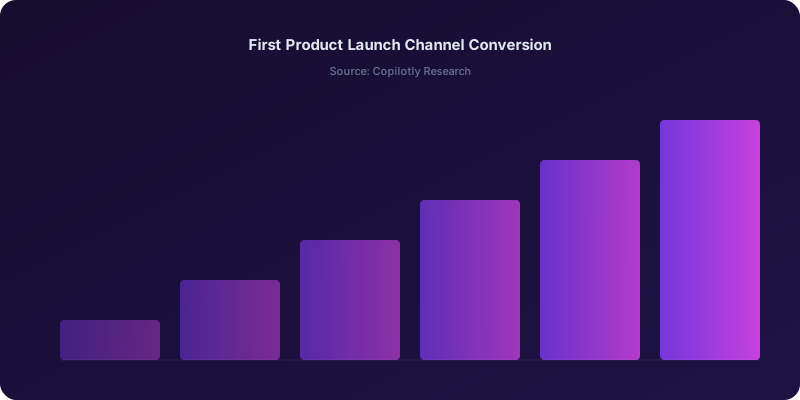
Products with a structured pre-launch email list of 500+ subscribers convert at 3-8% on launch day vs. under 0.5% for cold traffic launches
The law involved
FTC endorsement guidelines require clear disclosure of paid or incentivized reviews; platform policies (Amazon, Etsy) have specific rules about review solicitation and prohibited incentives
What to do, in order
- 01
Define Your Positioning Before You Write a Single Piece of Copy
Week 1
Positioning answers one question: why should your specific customer choose you over every alternative, including doing nothing? Most first-time product launches fail not because the product is bad but because the positioning is fuzzy. You need to identify your target customer precisely (not 'women aged 25-45' but 'first-time dog owners in urban apartments who feel guilty about leaving their dog alone all day'), the single biggest problem you solve, and why your solution is better than the alternatives they are already using. Everything - your name, your tagline, your ad copy, your pricing - flows from this.
How a copilot helpsThe marketing copilot can run you through a positioning workshop, helping you define your ICP (ideal customer profile), your unique value proposition, and the key message hierarchy that will inform all your launch copy.
- 02
Research Your Market and Validate Demand Before Going All-In
Week 1-2
Before spending on ads or production, confirm that real people want what you are selling at a price that makes sense. Search for your product on Google, Amazon, and Reddit. Look at existing competitors: are they thriving or struggling? Read 1-star reviews of similar products - these tell you exactly what the market wants that no one is delivering. If possible, pre-sell to 5-10 customers before manufacturing at scale. A presale or waitlist is the most honest validation signal that exists.
How a copilot helpsThe marketing copilot can help you structure a competitive analysis, identify market gaps from review mining, and draft a pre-launch validation survey or presale landing page.
- 03
Build Your Pre-Launch Audience and Email List
Weeks 2-5
The businesses that have the most successful product launches spend weeks or months building an audience before they sell anything. Your goal is to collect email addresses from people who have expressed genuine interest in your product category. A simple landing page with a compelling offer (early access, a launch discount, a free resource related to your product) and a lead capture form can collect hundreds of leads before you spend a dollar on ads. An email list of 500 genuinely interested people will outperform a cold ad audience of 50,000.
How a copilot helpsThe marketing copilot can write your pre-launch landing page copy, design your lead magnet strategy, and draft the email welcome sequence that turns subscribers into buyers on launch day.
- 04
Choose Your Launch Channels Strategically - Not All of Them
Week 3-4
Every marketing channel requires time and expertise to work. Spreading yourself across Instagram, TikTok, Pinterest, Google Ads, Facebook Ads, and SEO simultaneously means doing all of them poorly. Instead, identify where your specific target customer actually spends time online, and go deep on one or two channels. For consumer products targeting under-35s, TikTok and Instagram Reels often outperform everything else. For B2B software, LinkedIn and Google Search tend to be more effective. For niche hobby products, Reddit communities and YouTube reviews drive disproportionate volume.
How a copilot helpsThe marketing copilot can analyze your product category and target audience to recommend the highest-probability launch channels, and help you build a 30-day content calendar for each one.
- 05
Create Your Core Launch Content Package
Weeks 3-6
You need a minimal content package before launch day: a product page with clear benefits (not just features), high-quality product photos or a demo video, at least three pieces of educational or entertaining content for your chosen social channels, and an email launch sequence (pre-launch teaser, launch day announcement, post-launch follow-up). Do not wait for perfect - good content shipped on time beats excellent content shipped after momentum is gone. First-person founder stories and behind-the-scenes content often perform better than polished brand content for early-stage launches.
How a copilot helpsThe marketing copilot can draft your product page copy, write your launch email sequence, and generate content ideas and outlines for your social channels that are tailored to your specific product and audience.
- 06
Set Your Pricing With Psychology and Margin in Mind
Week 4
Pricing is one of the highest-leverage decisions you will make. Underpricing signals low quality and attracts price-sensitive customers who churn fastest. Overpricing without sufficient social proof kills conversion. Research what comparable products sell for, then assess whether you want to compete on price, go premium, or create a tiered offering. Odd pricing ($47 vs. $50, $97 vs. $100) consistently outperforms round numbers. If you have multiple product options, the middle tier almost always gets the most sales - this is the decoy effect, and it is real and reliable.
How a copilot helpsThe marketing copilot can help you analyze competitor pricing, build a pricing model that accounts for your costs and margins, and structure tiered offerings that use proven psychological pricing principles.
- 07
Execute Your Launch Week With a Daily Plan
Launch week
Launch day is not a single event - it is a week-long push. Day 1: send your launch email to your list, post across all channels, and reach out personally to anyone who signed up for early access. Days 2-3: follow up with non-openers, post testimonials or early reviews if you have them, and run a limited-time offer to create urgency. Day 4-5: respond to every comment and question publicly - this builds social proof in real time. Day 6-7: send a 'last chance' message to your list if you are running a launch offer. Document everything: what drove traffic, what converted, and what did not.
How a copilot helpsThe marketing copilot can build you a day-by-day launch week execution plan with specific messaging for each touchpoint, and draft the urgency-based emails and social posts for your final launch push.
- 08
Analyze Your First 30 Days and Iterate Ruthlessly
Days 31-60
After the initial launch excitement fades, the real work begins. Pull data from every channel: where did traffic come from, what was the conversion rate on your product page, what was your email open rate, what was your cost per acquisition if you ran ads, and what was your average order value. Most first launches surface at least one major insight - a message that resonated unexpectedly, a channel that dramatically outperformed, or a pricing structure that confused customers. Act on these insights within 30 days before testing another round of marketing.
How a copilot helpsThe marketing copilot can help you interpret your analytics, identify the key levers to pull for your next growth phase, and build a 60-day post-launch optimization plan based on real data from your launch.
Questions worth asking
These are the ones that change the outcome. Most people do not know to ask them.
Who, specifically, is my ideal first customer - and where do they already spend time online?
Vague target audiences produce vague marketing that converts no one. The more precisely you can describe your ideal buyer - their job, their daily frustrations, the content they consume, the influencers they follow, the communities they participate in - the more precisely you can reach them. Your first 100 customers should be people you could describe in a single detailed paragraph. These early adopters also become your source of testimonials, referrals, and the product feedback that shapes your next iteration.
The marketing copilot can guide you through building a detailed ideal customer profile (ICP), including demographic, psychographic, and behavioral characteristics, and then map those characteristics to specific online channels and communities.
What is the single most compelling reason someone should buy my product today rather than waiting?
Every purchase decision has friction: skepticism, inertia, competing priorities, and a limited budget. Your launch messaging needs to overcome all of these with a clear, specific benefit and a reason to act now. 'Buy our widget' is not a reason. 'Eliminate the 45 minutes you spend every morning on X' is a reason. A launch offer, limited inventory, or founding member pricing creates urgency that overcomes inertia. Without a compelling reason to buy now, potential customers will bookmark your page and forget about it.
The marketing copilot can help you craft a core value proposition statement and a launch offer structure that creates genuine urgency without feeling manipulative or desperate.
Do I have any social proof - testimonials, beta users, case studies, or press coverage - that I can use on launch day?
Social proof is the single most powerful conversion tool available to a new product. People do not want to be the first to try something. Even 3-5 authentic testimonials from beta users dramatically increase conversion rates compared to zero testimonials. If you have not yet gotten your product into the hands of even a handful of people willing to share their experience, that is the highest-priority task before your launch. User-generated content, authentic reviews, and media mentions all serve this function.
The marketing copilot can help you design a beta program that generates usable testimonials, draft the outreach emails to recruit beta users, and structure your product page to present social proof in the most conversion-effective way.
What is my plan for customers who do not buy on launch day?
Most people who visit your product page on launch day will not buy. They may like the product but need more time, more social proof, or a reminder. Your post-launch email sequence - the automated emails that go to people who visited but did not purchase, or who joined your list but have not ordered - is where most of your revenue actually comes from after launch week. Abandoned cart sequences, educational nurture emails, and re-engagement campaigns recover a significant portion of would-be customers.
The marketing copilot can design your post-launch nurture sequence, including abandoned cart emails, educational follow-ups, and re-engagement campaigns that convert fence-sitters into buyers over the 30-90 days after launch.
How will I get my first 10 reviews or testimonials quickly?
New products without reviews are at a massive disadvantage on every platform - Amazon, Etsy, Shopify, app stores, and even your own site. The first 10 reviews are the hardest to get and the most impactful. A structured outreach plan to early customers, incentivized review programs (where permitted), and proactive follow-up with buyers dramatically accelerates review acquisition. The alternative - waiting passively for reviews to accumulate - can take months and will suppress your conversion rate and search ranking during your most critical growth window.
The marketing copilot can help you design a compliant review generation strategy for your specific platform, draft the follow-up email sequences to solicit reviews, and advise on what incentives are permitted under platform policies and FTC guidelines.
Positioning: The Foundation Everything Else Is Built On
Most first-time product launches fail at the messaging level, not the product level. Founders who are close to their product often write copy that describes features rather than benefits, addresses no specific customer, and fails to articulate why someone should choose this product over everything else available to them. Positioning fixes this by forcing you to answer the hardest question in marketing: what does your product do for a specific person that no one else does as well?
Effective positioning has four components. First, the target customer - not a demographic, but a specific person with a specific problem in a specific context. Second, the category - what type of product is this, and what alternatives are you being compared against? Third, the key benefit - the one thing you do better than any alternative, stated in customer language. Fourth, the reason to believe - the evidence that your claim is true (unique ingredients, a patent, a case study, a founder credential).
The most powerful positioning exercise for a first-time founder is the 'positioning statement' format: 'For [specific target customer] who [has this specific problem], [Product Name] is a [category] that [delivers this specific benefit] unlike [main alternative] because [reason to believe].' Writing this statement - and rewriting it until every word is precise - will reveal exactly what your marketing needs to communicate. The marketing copilot can walk you through this exercise and pressure-test your positioning before you write a word of launch copy. The FTC's endorsement guidelines are also essential reading before launch, as they govern how you must disclose paid endorsements and incentivized reviews across all marketing channels.
One common mistake: positioning to too broad an audience because it feels safer. 'Designed for everyone' means designed for no one. The founders who niche down aggressively - even uncomfortably so - almost always find that their conversion rates are higher, their word-of-mouth is stronger, and their customer acquisition cost is lower. You can always expand your audience after you have proven the model with your core segment. Before you launch, also read our guide on the complete product launch checklist for 2026 and explore what to do when things go wrong in our scenario for handling bad online reviews.
Building Your Pre-Launch Audience: The Highest-ROI Activity You Can Do
The single biggest difference between a product launch that generates $500 and one that generates $50,000 is almost always the size and quality of the pre-launch audience. An email subscriber who opted in to hear about your product is worth roughly 100x a cold website visitor. Building this list before you launch is the highest-ROI marketing activity available to you, and most first-time founders skip it entirely because they are impatient to start selling.
A pre-launch landing page - a simple one-page site that describes your product's benefit and collects email addresses in exchange for early access or a launch discount - is the core tool. The page does not need to be beautiful. It needs to answer three questions: what is this, who is it for, and why should I care right now? A strong headline, three to five benefit bullets, a single image or short video, and an email capture form are all you need. Tools like Carrd, Unbounce, or Shopify's landing page builder can get this live in a day.
Drive traffic to your pre-launch page through organic social posts in relevant communities (Reddit, Facebook groups, Discord servers), targeted paid social ads with a small budget ($5-$20/day on Instagram or TikTok), direct outreach to people who fit your target profile, and content marketing on YouTube or TikTok that addresses the problem your product solves. Every email address you collect before launch day is a warm lead on the day you open your store. The marketing copilot can write your pre-launch page copy and design your list-building ad strategy.
What do you offer in exchange for the email address? Early bird pricing is the most effective offer for most consumer products - a genuine discount available only to pre-launch subscribers. Access to a beta or founding member program works well for software. A free downloadable resource (guide, template, checklist) related to your product category can work if it is genuinely valuable and tightly connected to the product. Avoid vague offers like 'subscribe for updates' - the offer needs to feel worth something.
Choosing the Right Launch Channels for Your Product
One of the most common first-launch mistakes is spreading budget and effort across every possible marketing channel simultaneously. The result is mediocre execution everywhere and results nowhere. The better approach is to identify the one or two channels where your specific target customer is most active and most receptive, go deep on those, and resist the temptation to add channels until you have proven the model.
For physical consumer products targeting younger buyers, short-form video on TikTok and Instagram Reels is currently the highest-potential organic channel. Products that can be demonstrated visually - before/after transformations, satisfying processes, surprising reveals - perform exceptionally well in this format. Seeding product to micro-influencers (10,000-100,000 followers) in your niche often delivers better ROI than macro-influencers because their audiences are more engaged and their rates are accessible for bootstrapped launches.
For software products (SaaS, apps, tools), content marketing and SEO build durable long-term traffic, but they are slow. For a launch, consider Product Hunt (for a tech-forward audience), AppSumo (for lifetime deal buyers), or LinkedIn thought leadership if your buyer is a business professional. A well-executed Product Hunt launch can generate hundreds of signups in a single day if you prepare properly - briefing your network to vote and comment, writing a compelling tagline, and timing your launch for Tuesday through Thursday when traffic is highest.
For niche hobby or specialty products, community marketing is often the most effective channel. Reddit communities, Facebook groups, Discord servers, and Slack communities for your specific niche contain your most fanatical potential customers. Authentic participation - not spam - in these communities before and during your launch generates extraordinary word-of-mouth. The marketing copilot can identify the specific communities and influencers in your product niche and help you develop a community launch strategy that does not feel like advertising.
Paid advertising (Google Ads, Facebook Ads, TikTok Ads) can accelerate any launch, but it requires budget, expertise, and a product page that is already converting organically. Running paid traffic to a page that is not converting is an expensive way to confirm a problem you should have caught earlier. If you are new to paid advertising, start with a small daily budget ($10-$25/day) and learn the platform mechanics before scaling spend.
Launch Day and Launch Week: How to Execute Without Burning Out
Launch day is both the most exciting and most exhausting day of building a product. Everything you have prepared arrives at a single point, and the pressure to perform can be overwhelming. The antidote is preparation: knowing exactly what you will post, email, and message at each point during launch week so that you are executing a plan rather than improvising under pressure.
Your launch day sequence should start with your email list - this is your highest-conversion audience and they should hear from you first. Send a clear, personal launch announcement that leads with the benefit, includes a single clear call-to-action (the purchase link), and creates appropriate urgency (limited launch pricing, limited inventory, or a launch offer deadline). Follow your email with posts on every social channel you have prepared content for. If you have personal relationships with people in your target market, send individual direct messages - these convert at dramatically higher rates than broadcast messages.
For days 2-7, plan a daily touchpoint on each channel. This does not mean a daily sales pitch - it means daily value. Share a customer story (even if it is just a beta user quote), answer a common objection publicly, post a piece of educational content related to your product category, or show behind-the-scenes content about your product. Every piece of content during launch week should include a clear way to purchase, but the content itself should stand on its own as interesting or useful. The marketing copilot can write your full launch week content calendar so you are not creating under pressure.
Respond to every comment, question, and message during launch week. This is not optional - it is one of the highest-ROI activities of the entire launch. Public replies to questions serve as social proof for everyone else who had the same question but did not ask. Speed of response signals that there is a real, attentive person behind the product, which is a significant trust signal for first-time buyers. Treat every interaction during launch week as an opportunity to convert a fence-sitter into a buyer.
Post-Launch: Turning Your First Sales Into a Repeatable System
The week after launch is the most important learning period in your product's life. You now have real data: what drove traffic, what converted, what the most common questions and objections were, and which customers are most satisfied. This data is worth more than any marketing advice, because it is specific to your product and your market. Your job is to extract the insights and build them into a repeatable system before momentum fades.
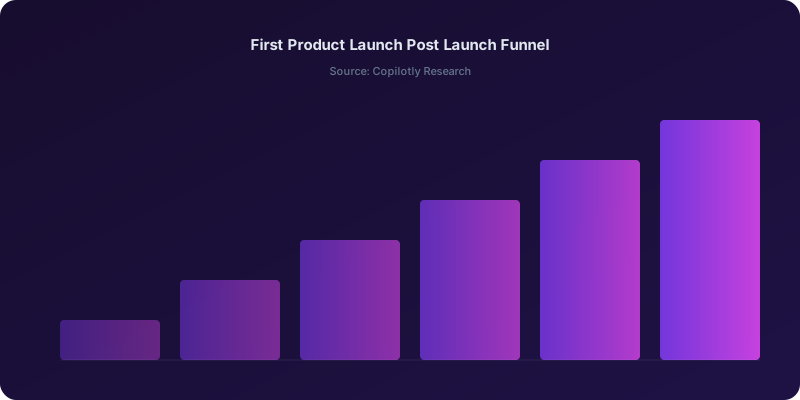
Start with your conversion funnel. Look at the traffic-to-purchase conversion rate for each channel. A healthy conversion rate for a product page ranges from 2-5% for cold traffic to 5-15% for warm (email or referral) traffic. If your rates are lower, the bottleneck is usually the product page - unclear benefits, insufficient social proof, confusing pricing, or a checkout process with too much friction. Fix the biggest bottleneck first before adding more traffic. The SBA's small business marketing guide provides a strong primer on building a repeatable customer acquisition system for new businesses.
Next, look at your customer acquisition cost (CAC) for any paid channels. Divide your total ad spend by the number of customers acquired. Compare this to your average order value and your estimated customer lifetime value. If your CAC is higher than your gross margin on the first order, you need to either reduce CAC (better creative, better targeting) or increase average order value (bundles, upsells, subscriptions). The marketing copilot can help you analyze your launch data and identify the specific optimizations that will have the biggest impact on your next growth phase. Also explore the task for analyzing your product launch performance and our resources tailored to entrepreneurs.
Finally, build your retention and referral system. Your launch customers are your most valuable marketing asset. They have already bought, which means they have overcome the biggest barrier. A well-timed follow-up email sequence - onboarding content, usage tips, a request for a review or testimonial, and eventually a referral offer - turns a one-time buyer into a repeat customer and a word-of-mouth advocate. Referral programs (offer existing customers a discount or reward for sending a friend who buys) can reduce your CAC to near zero once you have a base of satisfied customers. The marketing copilot can design your retention and referral program to maximize lifetime value from your launch cohort.
When to get a professional
Including the cases where you probably do not need one. That half matters as much as the other.
Definitely get one
- You are launching a product in a regulated industry (supplements, medical devices, financial products, children's products) that has specific compliance requirements
- You are planning a crowdfunding campaign on Kickstarter or Indiegogo and need to manage backer expectations and fulfillment legally
- You are allocating more than $10,000 to paid advertising and have no prior experience with ad platforms
- You need to negotiate with distributors, retailers, or wholesale buyers and are unfamiliar with commercial contracts
- You are launching internationally and need to navigate customs, duties, and international payment processing
Probably worth it
- You have a decent email list and social following but have never run a structured product launch and want a campaign strategist
- You are planning an influencer marketing campaign and need to vet creators, negotiate rates, and structure contracts
- Your product involves complex technical setup (subscription billing, memberships, international shipping) that is beyond your technical skill
- You want to run PR outreach to media outlets and do not know how to pitch journalists or build a press list
- You have a launch budget over $5,000 and want expert guidance on allocating it across channels
Probably not needed
- Your initial goal is just 10-50 sales and you are willing to learn as you go
- You are a solo founder with a very small budget who can start with organic content and build from there
- You are launching to an existing audience you have already built through a newsletter, social media, or community
- You have a clear, simple product with an obvious buyer and a straightforward purchase decision
- You are launching a digital product (ebook, template, course) with minimal fulfillment complexity
Common questions
How long does it take to properly prepare for a product launch?
How much should I budget for my first product launch?
Should I launch on Amazon, my own Shopify store, or another marketplace?
What is the most important thing to do in the first 24 hours of launch?
How do I get my first reviews as a brand-new product with no customers?
What if my launch does not go as planned and I get very few sales?
Get help with this from the Marketing & Growth Copilot
Describe your situation and get specific, actionable guidance - not the generic hedging a general-purpose chatbot gives you on marketing & growth questions.
Free plan, no card. Pro from $4.99/week for every copilot across all 20 domains - about what one hour with any single professional costs per year.