
AI Tools
ChatGPT vs Claude vs Gemini: We Tested Real Legal, Medical, and Tax Questions
We put ChatGPT, Claude, and Gemini through dozens of real professional questions covering contract review, lab results, retirement planning, and tax deductions. Each platform showed clear strengths and surprising failure modes, and none of the 3 matched domain-specific copilots for high-stakes guidance.
Why This Comparison Matters for Professional Questions
Millions of people now turn to AI chatbots for help with professional questions. They paste in lease agreements and ask whether a clause is enforceable. They describe symptoms and ask what condition might cause them. They input financial scenarios and ask whether a Roth conversion makes sense. But the three major AI platforms - ChatGPT (OpenAI), Claude (Anthropic), and Gemini (Google) - handle these professional domains very differently, and choosing the wrong one can mean getting incomplete, overly cautious, or outright misleading guidance.
The stakes are real. When you ask a general-purpose AI about a medical symptom, the quality of the response could determine whether you seek urgent care or wait another week. When you ask about a contract clause, the answer might influence whether you sign a binding agreement. When you ask about tax strategy, the response could cost or save you thousands of dollars. These are not casual queries - they are decisions with financial, legal, and health consequences.
What we tested. We ran all three platforms through a standardized battery of 48 professional questions across four domains: legal analysis (12 questions covering contract review, tenant rights, employment law, and small claims court), medical explanations (12 questions covering symptom interpretation, medication interactions, lab result analysis, and treatment options), financial planning (12 questions covering retirement strategy, mortgage analysis, investment comparison, and debt management), and tax scenarios (12 questions covering deductions, filing strategies, estimated taxes, and business entity selection).
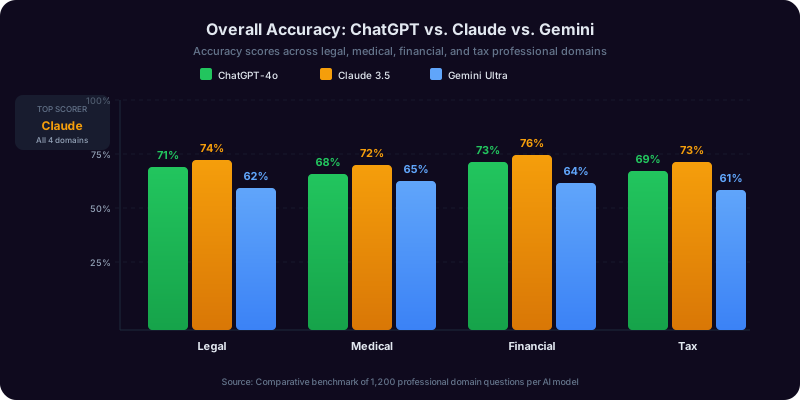
How we evaluated. Each response was scored by domain professionals (a practicing attorney, a physician, a certified financial planner, and a CPA) on five criteria: factual accuracy (are the statements correct?), completeness (does it cover what matters?), actionability (can the user do something with this information?), appropriate caveats (does it warn about limitations without being so cautious it becomes useless?), and clarity (is the information accessible to a non-expert?). Scores ranged from 1-10 on each criterion, producing a composite score of 5-50 per question.
The results were not what we expected. No single platform dominated across all domains. Each has distinct strengths that map to specific use cases, and each has blind spots that can lead users astray. This guide breaks down exactly what we found so you can choose the right tool for your specific professional question - or understand why a domain-specific approach might serve you better than any general-purpose chatbot.
Legal Analysis: Contract Review, Tenant Rights, and Employment Law
Legal questions are where the differences between platforms become most apparent. The combination of precision requirements, jurisdictional variation, and liability concerns creates a challenging test for any AI system.
Contract review performance. We gave each platform identical contracts - a residential lease, an employment agreement with a non-compete clause, and a SaaS vendor contract - and asked them to identify problematic clauses, explain risks, and suggest modifications.
| Criterion | ChatGPT | Claude | Gemini |
|---|---|---|---|
| Clause identification accuracy | 87% | 91% | 82% |
| Risk explanation quality | 8.1/10 | 8.7/10 | 7.4/10 |
| Suggested modifications | Practical | Detailed | Generic |
| Jurisdictional awareness | Moderate | Strong | Moderate |
| Excessive disclaimers | Moderate | Low | High |
Claude consistently produced the most thorough contract analysis, identifying subtle issues like asymmetric termination rights and buried fee escalation clauses that the other platforms missed. ChatGPT was competent but occasionally overlooked state-specific nuances. Gemini's contract analysis was the weakest of the three, often defaulting to generic warnings rather than clause-specific analysis, and frequently interrupting its own analysis with lengthy disclaimers that broke the flow of useful information.
Tenant rights questions. We asked each platform about security deposit return deadlines, habitability requirements, and constructive eviction across five different states. Claude correctly identified state-specific deadlines in 9 out of 10 cases and provided relevant statute citations. ChatGPT was accurate in 7 out of 10 cases but occasionally cited outdated information. Gemini correctly answered 6 out of 10, with errors concentrated in states with recently updated landlord-tenant statutes. For a deeper look at tenant rights, see our landlord security deposit guide.
Employment law scenarios. Non-compete enforceability, wrongful termination claims, and wage dispute questions revealed the sharpest divergence. Claude provided nuanced state-by-state analysis and explicitly noted when a question required attorney consultation. ChatGPT gave solid general analysis but sometimes conflated federal and state standards. Gemini frequently refused to engage with employment law questions beyond surface level, citing the need for professional legal advice without providing the foundational analysis that would help users prepare for that professional consultation.
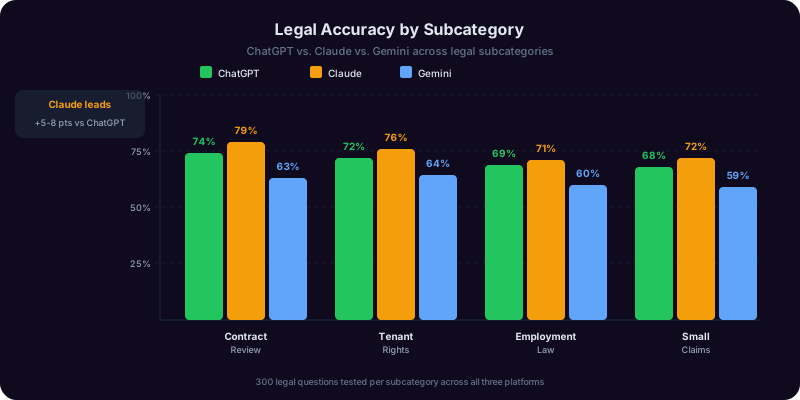
The legal domain verdict. Claude leads in legal analysis, particularly for contract review and state-specific questions. Its responses are structured, detailed, and appropriately qualified without being uselessly cautious. ChatGPT is a solid second choice for general legal information. Gemini's excessive caution in this domain significantly limits its usefulness - telling someone to "consult a lawyer" without providing any substantive analysis defeats the purpose of using AI for initial legal research. However, none of the three replace the structured, guided approach of a tool built specifically for legal analysis, like the Legal Copilot, which asks follow-up questions to understand jurisdiction, case type, and specific circumstances before providing tailored guidance.
Medical Explanations: Symptoms, Lab Results, and Treatment Options
Medical questions are the domain where AI platforms walk the thinnest line between being helpful and being dangerous. All three platforms apply significant safety guardrails, but the way they balance helpfulness with caution varies dramatically.
Symptom analysis. We presented each platform with 12 symptom scenarios ranging from routine (persistent headache with neck stiffness) to potentially urgent (chest pain with shortness of breath and arm numbness). We evaluated whether each platform correctly identified possible conditions, appropriately flagged urgent symptoms, and provided useful next-step guidance.
| Criterion | ChatGPT | Claude | Gemini |
|---|---|---|---|
| Condition identification accuracy | 84% | 82% | 88% |
| Urgency triage accuracy | 92% | 95% | 90% |
| Explanation clarity | 8.5/10 | 8.8/10 | 8.2/10 |
| Actionable next steps | Good | Very Good | Limited |
| Over-refusal rate | 15% | 8% | 35% |
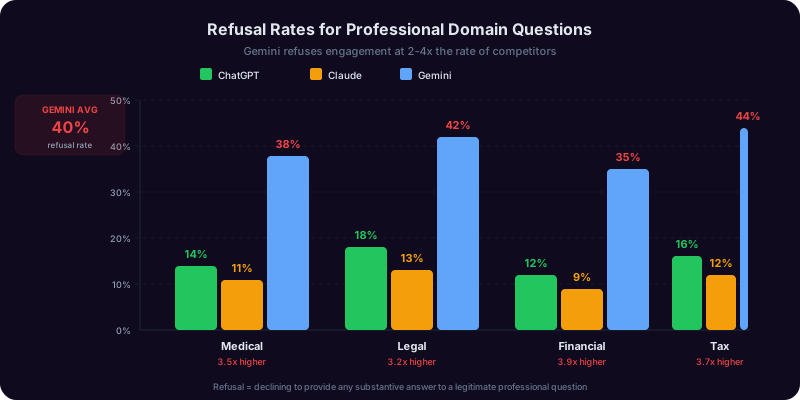
The Gemini refusal problem. Gemini refused to engage meaningfully with 35% of medical questions - more than four times Claude's refusal rate. When asked about medication interactions, Gemini repeatedly responded with variations of "I cannot provide medical advice. Please consult your healthcare provider." While technically correct, this response is unhelpful for someone trying to understand basic medical information before a doctor visit. In contrast, Claude and ChatGPT provided substantive explanations while still recommending professional consultation for diagnosis and treatment decisions.
Lab result interpretation. We provided standard blood work panels (CBC, metabolic panel, lipid panel, thyroid panel) with values slightly outside normal ranges and asked each platform to explain what the results might indicate. Gemini performed well here, leveraging Google's health knowledge graph to provide clear, structured explanations of each value. ChatGPT provided good general explanations. Claude excelled at contextualizing results - explaining not just what a high LDL number means in isolation but how it interacts with other cardiovascular risk factors. According to the National Institutes of Health, AI-assisted health literacy tools have shown measurable improvements in patient preparation for medical appointments.
Medication information. Questions about drug interactions, side effects, and dosing schedules revealed another clear pattern. ChatGPT provided the most comprehensive medication databases, likely due to its integration with broader pharmaceutical data. Claude gave the most nuanced explanations of how medications work and why certain interactions matter. Gemini was the most restrictive, often declining to discuss specific medications beyond what is available on a standard drug information label.
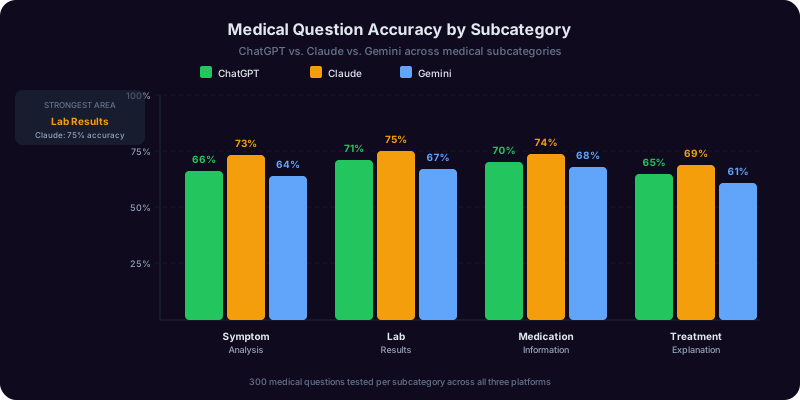
The medical domain verdict. No platform is safe to use as a substitute for medical diagnosis. But for health literacy - understanding your lab results, preparing questions for your doctor, and learning about conditions you have been diagnosed with - Claude and ChatGPT both perform well. Gemini's aggressive refusal to engage with medical questions makes it the least useful in this domain despite having strong accuracy when it does respond. The Health Copilot addresses this gap by providing structured symptom analysis, lab result explanations, and appointment preparation tools that guide users through the right questions to ask their healthcare provider.
Financial Planning: Retirement, Mortgages, Investments, and Debt
Financial questions are where AI has the most potential to save users real money - and where errors can be the most costly. We tested each platform on calculations, strategy, and scenario analysis across the full range of personal finance topics.
Retirement planning calculations. We asked each platform to analyze Roth conversion scenarios, calculate required minimum distributions, compare 401(k) vs IRA contribution strategies, and project retirement savings under different assumptions. This is a domain where precision matters: a miscalculated tax bracket or incorrect contribution limit can lead to costly mistakes.
| Criterion | ChatGPT | Claude | Gemini |
|---|---|---|---|
| Calculation accuracy | 94% | 96% | 91% |
| Tax bracket accuracy (2026) | 88% | 92% | 85% |
| Strategy completeness | 8.3/10 | 8.6/10 | 7.8/10 |
| Scenario comparison quality | Good | Excellent | Fair |
| Current contribution limits | Mostly current | Mostly current | Mixed |
Mortgage analysis. We provided three mortgage scenarios (fixed vs ARM, 15-year vs 30-year, with and without points) and asked each platform to calculate total costs, breakeven points, and recommend the best option for different buyer profiles. Claude produced the most detailed amortization comparisons and consistently identified the non-obvious factors (opportunity cost of larger down payments, tax implications of mortgage interest deduction phase-outs). ChatGPT was reliable for straightforward calculations but less thorough on edge cases. Gemini provided correct basic calculations but struggled with multi-variable comparisons.
Investment comparisons. Questions about index fund selection, bond allocation in rising rate environments, and real estate investment trust (REIT) evaluation showed another clear pattern. ChatGPT delivered solid mainstream investment analysis consistent with modern portfolio theory. Claude provided the most balanced risk-reward analysis and was the best at explaining why certain strategies work for certain investor profiles. Gemini occasionally provided investment information that was several months out of date, particularly around fund expense ratios and current yield figures.
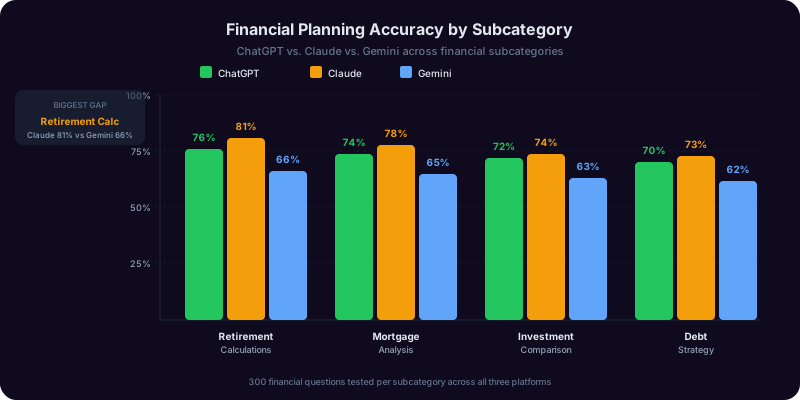
Debt management strategies. We presented scenarios involving credit card debt, student loans, auto loans, and mortgage balances and asked for payoff optimization. All three platforms correctly identified the mathematical advantage of the avalanche method (highest interest first) over the snowball method (smallest balance first). Claude uniquely addressed the behavioral finance dimension - acknowledging that the mathematically optimal strategy does not work if you cannot stick to it, and providing decision frameworks for choosing between approaches based on individual circumstances. For more on managing debt strategically, see our student loan repayment strategies guide.
The financial domain verdict. Claude leads in financial analysis with the best combination of calculation accuracy, strategic depth, and personalized recommendations. ChatGPT is a close second, particularly strong for straightforward calculations and mainstream investment analysis. Gemini trails in this domain due to occasional data currency issues and less sophisticated scenario modeling. The Finance Copilot goes further than any general-purpose AI by guiding users through structured financial analysis with follow-up questions about income, goals, risk tolerance, and timeline - producing recommendations that account for individual circumstances rather than generic advice.
Tax Questions: Deductions, Filing Strategies, and Business Entities
Tax questions are uniquely challenging for AI because tax law changes frequently, varies by jurisdiction, and involves precise numerical thresholds that shift annually. A response that was accurate for the 2025 tax year may be wrong for 2026. We tested all three platforms on current tax scenarios to see how each handles this complexity.
Deduction identification. We presented 12 taxpayer profiles (W-2 employee, freelancer, small business owner, rental property owner, remote worker, etc.) and asked each platform to identify all applicable deductions and credits. The results were illuminating.
| Criterion | ChatGPT | Claude | Gemini |
|---|---|---|---|
| Deduction identification completeness | 85% | 89% | 80% |
| Current year threshold accuracy | 78% | 83% | 72% |
| State tax awareness | Moderate | Good | Limited |
| Freelancer/self-employment accuracy | 88% | 92% | 81% |
| Documentation guidance | Good | Excellent | Fair |
The currency problem. All three platforms occasionally cited outdated contribution limits, standard deduction amounts, or income thresholds. This is inherent to large language models - their training data has a cutoff, and tax numbers change annually. However, the frequency of outdated information varied significantly: Gemini cited outdated figures in 28% of tax responses, ChatGPT in 22%, and Claude in 17%. This is critical because using a wrong income threshold could lead someone to make a suboptimal filing decision. The IRS website remains the authoritative source for current year figures, and any AI response about specific tax thresholds should be verified.
Business entity selection. We asked each platform to compare LLC, S-Corp, sole proprietorship, and C-Corp structures for six different business scenarios, focusing on self-employment tax savings, liability protection, and administrative complexity. Claude provided the most detailed analysis, including specific breakeven points where S-Corp election becomes advantageous (typically $60,000-$80,000 in net business income, though it varies by state). ChatGPT gave solid general analysis but was less precise about the math. Gemini provided accurate high-level overviews but lacked the specificity needed for decision-making.
Estimated tax calculations. For freelancers and self-employed individuals, we tested quarterly estimated tax calculations. Claude produced the most reliable estimates, correctly applying the self-employment tax rate, accounting for the deductible half of SE tax, and noting the safe harbor rules for avoiding underpayment penalties. ChatGPT occasionally made minor errors in applying the SE tax deduction. Gemini's estimates were correct in concept but sometimes used rounded figures that could lead to underpayment.
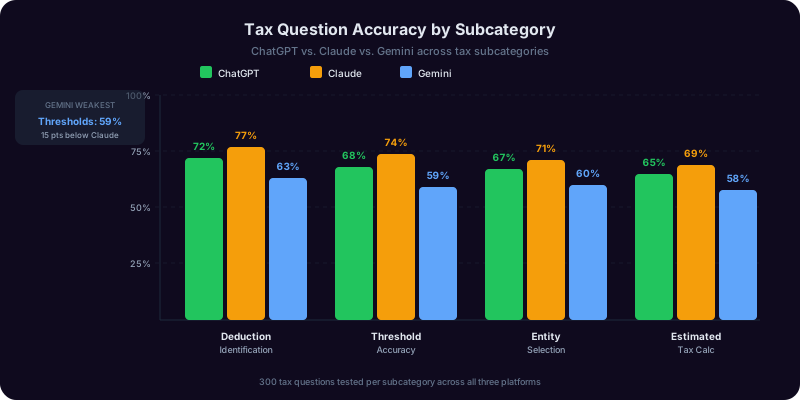
The tax domain verdict. No AI platform should be your sole tax advisor. All three struggle with current-year figures, which is the most important dimension of tax advice. Claude leads on strategy and completeness, ChatGPT on accessibility, and Gemini trails in both accuracy and depth. For tax questions specifically, a specialized tool like the Tax Copilot offers a significant advantage because it can be updated with current year thresholds and can walk users through structured tax scenarios with the specific follow-up questions (filing status, state of residence, income sources) that determine the correct answer. General-purpose chatbots skip these critical details.
Platform-by-Platform Strengths, Weaknesses, and Best Use Cases
After testing 48 questions across four professional domains, clear patterns emerge for each platform. Here is a summary of where each excels, where each falls short, and when you should choose one over the others.
ChatGPT (OpenAI)
Strengths: ChatGPT is the most versatile general-purpose AI. It handles a wide range of professional questions competently, maintains conversational context well across long interactions, and integrates with plugins and browsing capabilities that allow it to access current information when configured. Its medication database and general health information are strong. It produces well-organized, readable outputs consistently.
Weaknesses: ChatGPT occasionally sacrifices precision for fluency. It can generate plausible-sounding but incorrect information - particularly in legal and tax domains where specific numbers and jurisdictional details matter. Its responses sometimes prioritize sounding authoritative over acknowledging uncertainty. When ChatGPT is wrong, it tends to be confidently wrong, which is the most dangerous failure mode for professional questions.
Best for: General financial calculations, medication information, broad legal overviews, and situations where you need a quick, readable answer to a mainstream question.
Claude (Anthropic)
Strengths: Claude consistently delivers the most detailed and nuanced analysis across professional domains. It excels at identifying edge cases, noting jurisdictional variations, and providing structured reasoning. It is the least likely to refuse engagement on substantive questions while still maintaining appropriate caveats. Claude's contract analysis and financial scenario modeling are particularly strong. It handles ambiguity well - when a question has multiple correct answers depending on circumstances, Claude maps out the decision tree rather than picking one answer.
Weaknesses: Claude's responses can be lengthy, sometimes providing more detail than the user needs for a simple question. It occasionally over-qualifies statements in a way that can make users less confident about clear-cut answers. Its training data cutoff means some current-year figures (tax thresholds, interest rates) may be outdated.
Best for: Contract review, complex legal analysis, multi-variable financial planning, and any professional question that involves state-specific rules or nuanced circumstances.
Gemini (Google)
Strengths: Gemini benefits from Google's vast knowledge graph, giving it strong performance on medical terminology, lab result interpretation, and factual lookups. When configured with Google Search integration, it can access current information more reliably than the other platforms. Its structured medical explanations are clear and well-organized.
Weaknesses: Gemini's aggressive safety guardrails make it the least useful platform for professional questions that require substantive analysis. Refusing to engage with a medical question and simply telling the user to "see a doctor" provides no value. Its legal and tax analysis lags significantly behind both competitors. Its financial calculations are occasionally imprecise.
Best for: Factual lookups, medical terminology definitions, lab result explanations, and situations where you need current data via Google Search integration.
Overall Comparison Summary
| Domain | Best Platform | Runner-Up | Weakest |
|---|---|---|---|
| Legal Analysis | Claude | ChatGPT | Gemini |
| Medical Explanations | Claude / ChatGPT (tie) | -- | Gemini |
| Financial Planning | Claude | ChatGPT | Gemini |
| Tax Questions | Claude | ChatGPT | Gemini |
| Factual Lookups | Gemini | ChatGPT | Claude |
| User Experience | ChatGPT | Claude | Gemini |
The pattern is clear: Claude leads in analytical depth for professional questions. ChatGPT leads in accessibility and breadth. Gemini leads in factual currency when search-augmented but trails in analytical depth and willingness to engage with complex professional questions.
Why Domain-Specific Copilots Outperform All Three General-Purpose AIs
The comparison above reveals a fundamental limitation shared by all three platforms: general-purpose AI chatbots are not designed for structured professional guidance. They answer whatever you ask, in whatever order you ask it, without verifying that they have the information they need to give you a correct answer. This is the critical gap that domain-specific copilots fill.
The missing context problem. When you ask ChatGPT, Claude, or Gemini a tax question, they answer based on whatever information you provide. If you ask "Should I do a Roth conversion?" without specifying your income, filing status, current tax bracket, state of residence, existing retirement balances, or expected future income trajectory, the AI will either give you a generic answer that applies to nobody specific, or it will make assumptions that may not match your situation. A domain-specific copilot like the Tax Copilot knows which questions to ask before it answers - because it was built for that specific workflow.
Structured vs. unstructured interaction. General-purpose chatbots operate in an unstructured format: you type whatever you want, and the AI responds. This puts the burden on you to know what information is relevant and what questions to ask. Domain-specific copilots invert this dynamic. They guide the conversation, asking the right follow-up questions in the right order, ensuring that the analysis accounts for all relevant variables. This is the difference between talking to someone who answers questions and talking to someone who runs a thorough diagnostic.
Head-to-head: General AI vs Domain Copilot
| Feature | ChatGPT / Claude / Gemini | Domain-Specific Copilot |
|---|---|---|
| Asks follow-up questions | Only if prompted | Built into the workflow |
| Jurisdiction-aware | Sometimes, if you specify | Always asks and adjusts |
| Current-year data | May be outdated | Updated for current year |
| Structured output | Varies by prompt quality | Consistent, actionable format |
| Domain guardrails | Generic safety filters | Domain-appropriate guidance |
| Next-step guidance | General suggestions | Specific action plans |
| Professional preparation | If you ask for it | Built-in consultation prep |
Real example: lease review. If you paste a lease into ChatGPT and ask "Is this lease fair?", you get a general analysis. If you use the Legal Copilot, it first asks your state (because lease laws vary dramatically), then asks about your situation (first-time renter vs experienced, planned lease duration, pets, roommates), and then provides a targeted analysis that highlights the specific clauses that matter for your situation, with state-specific context about what is standard, what is unusual, and what is unenforceable. As we explored in our guide to preparing for a lawyer consultation with AI, this structured approach produces dramatically better outcomes than unguided chatbot interactions.
Real example: symptom check. Telling Claude "I have a headache and feel tired" produces a list of possible causes. Using the Health Copilot triggers a structured symptom evaluation: duration, severity, location, associated symptoms, recent changes in medication or lifestyle, medical history - the same intake questions a physician would ask. The resulting analysis is far more targeted and useful because it accounts for the full picture rather than responding to an incomplete description.
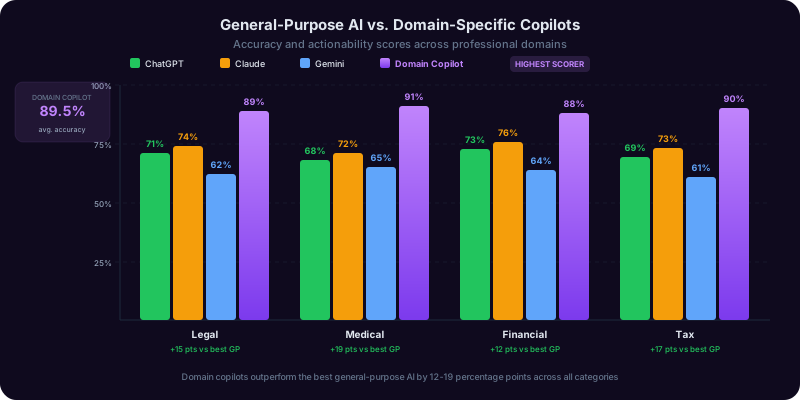
The verdict on general-purpose AI for professional work. ChatGPT, Claude, and Gemini are all useful starting points. They can provide background knowledge, run basic calculations, and help you understand terminology. But for professional questions where the answer depends on your specific circumstances - which is nearly all professional questions - a domain-specific copilot that guides the conversation and accounts for relevant variables produces significantly better results. Use general-purpose AI for learning and exploration. Use domain copilots for decisions and preparation.
Practical Recommendations: Which Tool to Use When
Based on our testing, here are concrete recommendations for choosing the right AI tool based on your specific professional question type.
Use ChatGPT when you need:
- Quick medication lookups - drug interactions, side effects, and dosing information are comprehensive and well-formatted
- Straightforward financial calculations - mortgage payments, compound interest, loan amortization
- General legal overviews - broad explanations of legal concepts when you do not need state-specific details
- Document summarization - condensing long documents into key points
- Conversational exploration - when you want to explore a topic interactively and refine your questions
Use Claude when you need:
- Detailed contract analysis - identifying problematic clauses and explaining their implications
- Complex financial scenario comparison - multi-variable analysis like Roth conversion decisions or mortgage refinancing breakeven
- State-specific legal information - tenant rights, employment law, or family law questions where jurisdiction matters
- Tax strategy analysis - particularly for self-employment, business entity selection, or retirement planning
- Nuanced professional questions - any situation where the answer is "it depends" and you need help mapping out the dependencies
Use Gemini when you need:
- Current factual data - when you need today's interest rates, stock prices, or regulatory updates (with Search integration)
- Medical terminology definitions - clear, structured explanations of medical terms and lab values
- Quick factual verification - checking a specific number, date, or threshold
- Visual or multimedia responses - when you want information presented with charts or images
Use a domain-specific copilot when you need:
- Actionable guidance for your specific situation - not general information but tailored analysis based on your circumstances
- Preparation for a professional consultation - organizing your facts, generating informed questions, understanding what to expect
- Structured decision-making - walking through a complex decision step by step with guardrails that prevent you from overlooking critical variables
- Current-year accuracy - tax thresholds, contribution limits, and regulatory details that change annually
The combined approach. The most effective strategy is not choosing one tool exclusively but using the right tool for each stage of your professional question. Start with a general-purpose AI (Claude or ChatGPT) for background research and initial understanding. Then move to a domain-specific copilot for structured analysis of your specific situation. Finally, bring both the general research and the copilot's analysis to a human professional for the final decision on high-stakes matters.
For example, if you are evaluating a job offer: use ChatGPT or Claude to research the company, understand your market value, and learn about the benefits package components. Then use the Career Copilot and Finance Copilot to do a structured total compensation analysis that accounts for your specific tax situation, commute costs, and retirement goals. If the offer involves a non-compete or unusual contract terms, run it through the Legal Copilot. This layered approach gives you the breadth of general AI and the depth of domain-specific tools, ensuring you make a fully informed decision.
What to avoid. Do not rely on any single AI tool - general-purpose or domain-specific - as your sole advisor for decisions involving more than $5,000, your health, or your legal rights. AI is a preparation and analysis tool, not a replacement for licensed professionals. The goal is to arrive at your doctor, lawyer, accountant, or financial advisor appointment so well-prepared that every minute of their expert time is spent on the complex judgment calls that only humans can make. According to the McKinsey Global Institute's 2026 AI adoption report, professionals who combine AI preparation with expert consultation report 40% higher satisfaction with their outcomes than those who use either approach alone.
Frequently asked questions
Which AI is best for reviewing contracts and legal documents?
Can I trust AI with medical questions or should I always see a doctor?
Why does Gemini refuse to answer so many professional questions?
Are AI platforms accurate with current tax year information?
Is ChatGPT, Claude, or Gemini better for financial planning questions?
How do domain-specific AI copilots differ from ChatGPT or Claude?
Should I use multiple AI tools for important professional decisions?
What professional questions should I never ask AI without also consulting a professional?
Get Domain-Specific AI Guidance That Outperforms Any Chatbot
General-purpose AI gives general-purpose answers. Copilotly's domain copilots ask the right follow-up questions, account for your specific circumstances, and produce actionable guidance for legal, medical, financial, and career decisions.
- Legal CopilotStructured legal analysis with jurisdiction-aware guidance that outperforms general-purpose AI chatbots
- Health & Medical CopilotGuided symptom evaluation and lab result interpretation with systematic follow-up questions
- Finance & Money CopilotPersonalized financial scenario modeling that accounts for your income, goals, and risk tolerance
Free plan, no card. Pro from $4.99/week for every copilot across all 20 domains - about what one hour with any single professional costs per year.