
Money & Finance
Creditor Negotiation Scripts That Cut Your Interest Rate (Plus Snowball vs Avalanche Math)
US households owe $18.8 trillion, with credit card balances alone past $1.21 trillion. The fastest way out combines a negotiated APR, the right payoff order, and balance transfer timing; this guide gives you the word-for-word scripts and the snowball vs avalanche math.
The US Debt Landscape in 2026: Where We Stand
Before choosing a payoff strategy, it helps to understand the scale of the problem. According to the Federal Reserve Bank of New York, total US household debt reached $18.8 trillion by early 2026. That number is not abstract. It translates to real monthly payments that squeeze family budgets, delay retirement, and generate chronic financial stress.
Here is how that $18.8 trillion breaks down:
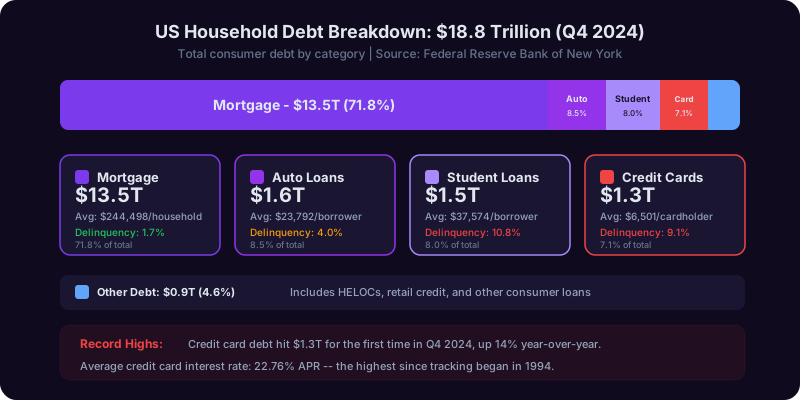
- Mortgages: $12.6 trillion (the largest category by far)
- Student loans: $1.77 trillion across 43 million borrowers
- Auto loans: $1.66 trillion, with average new car payments hitting $734/month
- Credit cards: $1.21 trillion, a record high, with average APRs above 22%
- Other debt: $1.56 trillion including medical debt, personal loans, and BNPL balances
The credit card number is the most alarming. Unlike mortgages (which build equity) or student loans (which may increase earning potential), credit card debt is almost purely consumptive. At a 22% APR, a $10,000 balance making minimum payments takes over 27 years to pay off and costs more than $18,000 in interest alone. That is nearly double the original balance paid in interest.
Delinquency rates are rising too. The percentage of credit card balances 90+ days past due climbed to 11.4% in late 2025, the highest since 2012. Auto loan delinquencies are following a similar trend. These are not signs of a healthy consumer economy. They indicate that millions of households are struggling to keep up with payments.
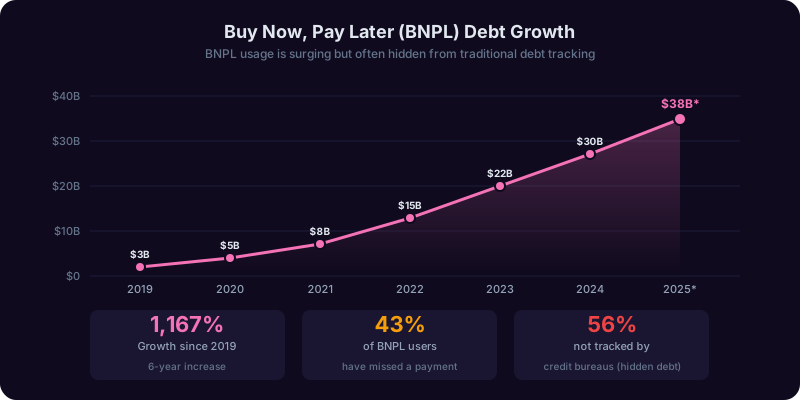
Buy Now, Pay Later (BNPL) debt adds another layer that traditional statistics undercount. Services like Afterpay, Klarna, and Affirm do not always report to credit bureaus, so the true debt burden is likely higher than official figures suggest. A 2025 CFPB report found that BNPL users are more likely to carry credit card balances and overdraft their bank accounts, suggesting these products often layer onto existing debt rather than replacing it.
The bottom line: if you are carrying debt, you are not alone. But statistics do not pay your bills. What matters now is choosing the right strategy to eliminate your specific debts as efficiently as possible. The rest of this guide will show you how.
The Debt Snowball Method: Psychology-First Payoff
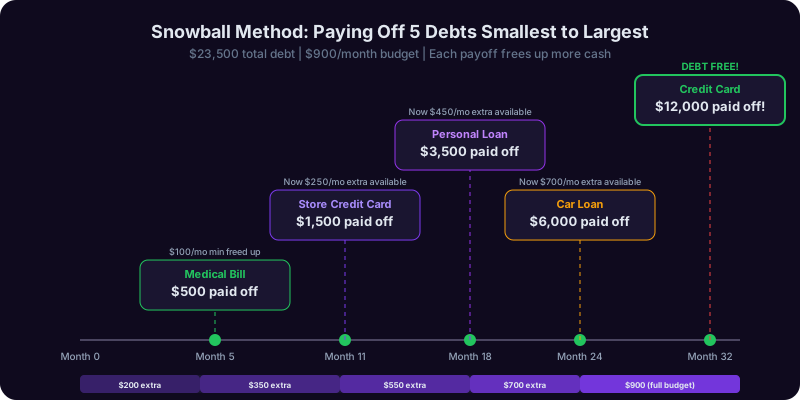
The debt snowball method, popularized by Dave Ramsey, prioritizes psychological momentum over mathematical optimization. The concept is simple: list your debts from smallest balance to largest, make minimum payments on everything, and throw every extra dollar at the smallest debt first. When that one is gone, roll its payment into the next smallest. Repeat until you are debt-free.
How It Works Step by Step
- List all debts from smallest balance to largest, regardless of interest rate
- Make minimum payments on every debt except the smallest
- Put as much extra money as possible toward the smallest debt
- When the smallest debt is paid off, take its entire payment (minimum + extra) and add it to the minimum payment on the next smallest debt
- Repeat until all debts are eliminated
Snowball Example
Suppose you have four debts:
| Debt | Balance | APR | Minimum Payment |
|---|---|---|---|
| Medical bill | $800 | 0% | $50 |
| Store credit card | $2,400 | 26% | $65 |
| Visa card | $7,500 | 22% | $190 |
| Car loan | $14,000 | 6.5% | $310 |
With the snowball method, you attack the $800 medical bill first, even though the store credit card at 26% APR is costing you more in interest. You clear the medical bill in a few months, which feels like a genuine win. Then you take that $50 payment plus your extra and slam the store card. The payments snowball larger with each debt you eliminate.
Why the Snowball Works
Research from the Harvard Business Review found that people who focused on paying off small debts first were more likely to eliminate their total debt than those who focused on high-interest debts. The reason is behavioral: early wins create a sense of progress and control that keeps people motivated. Debt payoff is a marathon, and motivation is the fuel.
The snowball method works best for people who:
- Have tried and failed to stick with debt payoff plans before
- Need visible progress to stay motivated
- Have several small debts that can be eliminated quickly
- Are more emotional than analytical about money
- Feel overwhelmed and need a simple system
The Snowball's Weakness
The obvious downside is cost. By ignoring interest rates, you pay more in total interest. In the example above, letting the 26% store card accrue interest while paying off a 0% medical bill costs real money. Depending on the balances and rate differences, this can add up to hundreds or even thousands of dollars over the payoff period. The question is whether that extra cost is worth the psychological benefit. For many people, the answer is yes, because the mathematically optimal plan they abandon is worse than the suboptimal plan they complete.
If you want to understand how your credit score might change as you pay down balances, our credit score guide explains how utilization ratios work.
The Debt Avalanche Method: Math-First Payoff
The debt avalanche method is the mathematically optimal strategy. Instead of ordering debts by balance, you order them by interest rate from highest to lowest. You make minimum payments on everything and put all extra money toward the highest-rate debt first. When that is paid off, you move to the next highest rate.
How It Works Step by Step
- List all debts from highest interest rate to lowest
- Make minimum payments on every debt except the one with the highest APR
- Put as much extra money as possible toward the highest-rate debt
- When that debt is paid off, roll its payment into the next highest-rate debt
- Repeat until all debts are eliminated
Avalanche Example (Same Debts)
Using the same four debts from the snowball section:
| Priority | Debt | Balance | APR |
|---|---|---|---|
| 1st | Store credit card | $2,400 | 26% |
| 2nd | Visa card | $7,500 | 22% |
| 3rd | Car loan | $14,000 | 6.5% |
| 4th | Medical bill | $800 | 0% |
With the avalanche, you hit the 26% store card first. Every extra dollar goes there. The 0% medical bill drops to the bottom of the list because it is not costing you anything in interest. Once the store card is gone, you attack the 22% Visa card.
Why the Avalanche Saves Money
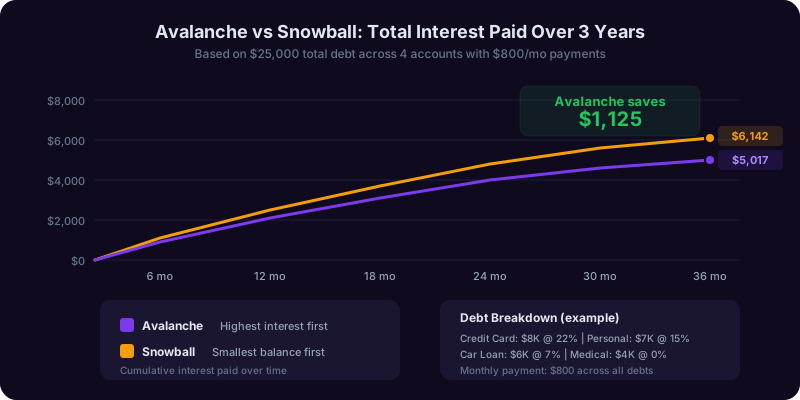
The math is straightforward. High-interest debt grows faster, so eliminating it first reduces the total interest you pay over the life of the plan. In a typical scenario with $25,000 in mixed debt, the avalanche saves $1,200 to $3,800 compared to the snowball, depending on the rate spread and balances.
The savings increase with:
- Larger rate differences between your debts (a 26% card vs a 6% car loan = big savings)
- Larger balances on high-rate debts (a $15,000 credit card at 24% vs a $500 medical bill = avalanche wins by a lot)
- Longer payoff timelines (more time = more interest accrual on the wrong debts)
The Avalanche Works Best For People Who:
- Are motivated by numbers and logic rather than emotional wins
- Have the discipline to stick with a plan even without early victories
- Have a large high-interest debt that dominates their total balance
- Are comfortable with spreadsheets or tracking tools
- Want to minimize total cost and payoff time
The Avalanche's Weakness
If your highest-rate debt also has the largest balance, you could go months or even a year without paying off a single account. This feels like running on a treadmill. You are making progress (the balance drops, interest costs decrease), but you never get the satisfaction of crossing a debt off the list. For some people, this demotivation leads to abandoning the plan entirely, which is the worst outcome of all.
The Finance Copilot can calculate the exact dollar difference between snowball and avalanche for your specific debts, so you can make an informed decision about whether the interest savings justify the slower psychological payoff.
This is general information, not financial advice. Consult a financial professional for guidance specific to your situation.
Hybrid Approaches and Balance Transfer Strategies
Snowball and avalanche are not your only options. Several hybrid and accelerator strategies can speed up your payoff timeline or make the journey more sustainable.
The Hybrid Method
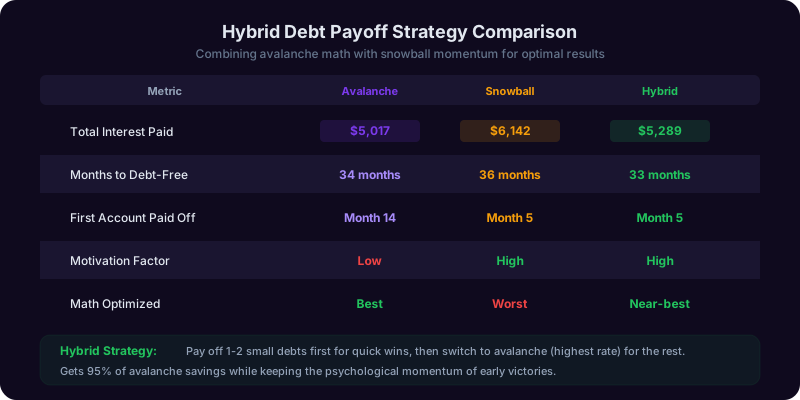
A hybrid approach combines the psychology of the snowball with the math of the avalanche. Here is one version that works well:
- Pay off any debt under $500 first (quick wins to build momentum)
- Once small debts are cleared, switch to avalanche order (highest rate first)
- If motivation starts to fade, temporarily switch to the next smallest balance for a quick win, then return to avalanche
This gives you the early victories of the snowball without sacrificing too much in interest. It is a practical middle ground for people who understand the math but also know they need emotional fuel.
Balance Transfer Strategy
A 0% APR balance transfer card lets you move high-interest credit card debt to a new card with no interest for a promotional period, typically 12 to 21 months. This can dramatically accelerate payoff because every dollar goes toward principal instead of interest.
How to execute a balance transfer:
- Apply for a 0% balance transfer card (you generally need a credit score of 670+ to qualify for the best offers)
- Transfer your highest-rate balance (or as much as the new card's limit allows)
- Divide the transferred balance by the number of promotional months to calculate your required monthly payment
- Set up autopay for that amount and do not miss a payment
- Do not make new purchases on the balance transfer card
The math: If you transfer a $6,000 balance from a 24% APR card to a 0% card with a 3% transfer fee ($180) and a 15-month promotional period, you pay $412/month and the total cost is $6,180. Without the transfer, the same $412/month at 24% APR would cost $6,924. That is a savings of $744.
Balance transfer risks:
- The promotional rate expires. If you have not paid off the balance, the rate jumps to 18-29%. Some cards apply retroactive interest to the entire original balance.
- Transfer fees (typically 3-5% of the balance) eat into savings
- Opening a new card temporarily lowers your credit score
- Having more available credit can tempt overspending
Cash-Out Refinance or HELOC for Debt Consolidation
Homeowners can potentially use home equity to consolidate high-interest debt at a much lower rate. A cash-out refinance or HELOC at 7-8% is dramatically cheaper than credit cards at 22-26%. However, you are converting unsecured debt into debt secured by your home. If you cannot make payments, you risk foreclosure. This strategy only works if you have the discipline to not run up the credit cards again after paying them off. For more on home equity decisions, see our first-time home buyer guide.
Debt Consolidation Loans
A personal loan from a bank, credit union, or online lender can combine multiple debts into one fixed monthly payment at a potentially lower rate. Good candidates have credit scores above 660 and can qualify for rates under 12%. The benefit is simplicity: one payment, one rate, a fixed payoff date. The risk is the same as balance transfers: if you do not address the spending habits that created the debt, you end up with a consolidation loan plus new credit card balances.
The Budgeting Copilot can help you model whether a balance transfer or consolidation loan makes sense for your specific situation by comparing total costs across scenarios.
Creditor Negotiation Scripts That Actually Work
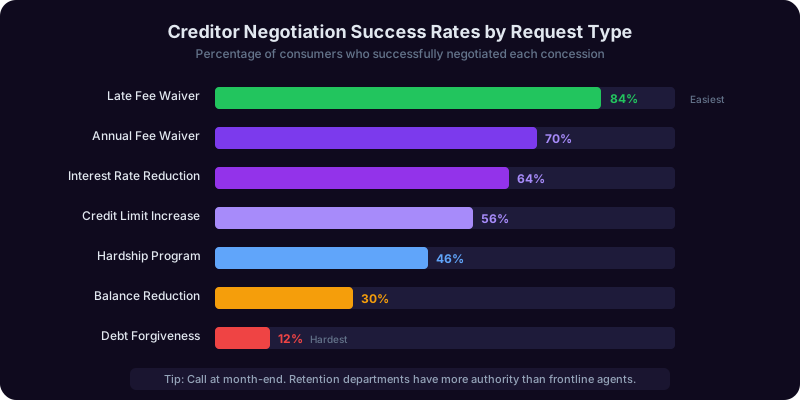
Most people do not realize that credit card interest rates, fees, and even balances are negotiable. Creditors would rather keep you as a paying customer than send your account to collections, where they recover only 10-20 cents on the dollar. That leverage is yours to use.
Script 1: Requesting a Lower Interest Rate
Call the number on the back of your card and say:
"Hi, I have been a customer since [year]. I have been making my payments on time, and I would like to request a lower interest rate on my account. I have received offers from other cards at [lower rate], and I would prefer to stay with you. Is there anything you can do to lower my current rate?"
Success rate: Studies show that approximately 70% of people who ask for a lower rate get one. The average reduction is 5-6 percentage points. On a $8,000 balance, a 6-point rate reduction saves roughly $480 per year. If the first representative says no, politely ask to speak with a retention specialist or supervisor. Call back on a different day if needed. Different representatives have different authorization levels.
Script 2: Requesting Fee Waivers
"I was charged a late fee of $[amount] on my last statement. I have been a customer for [years] and this is my first late payment. Could you waive this fee as a one-time courtesy?"
Late fees average $32-$41 per occurrence. Annual fees on some cards run $95-$550. Both are negotiable, especially if you have been a long-term customer with a good payment history. First-time waivers are almost always granted if you ask.
Script 3: Requesting a Hardship Program
If you are experiencing financial difficulty, most major credit card issuers have formal hardship programs that they do not advertise. These programs can offer:
- Temporarily reduced interest rates (sometimes as low as 0-5%)
- Reduced minimum payments
- Waived fees for 3-12 months
- Payment deferrals
"I am experiencing financial hardship due to [job loss / medical emergency / reduction in hours]. I want to continue paying my balance, but I need help. Do you have a hardship or financial assistance program that could temporarily reduce my interest rate or minimum payment?"
Be honest about your situation. Have your account number, monthly income, and a rough budget ready. The representative may ask what you can afford to pay monthly. Give a realistic number, not the lowest possible. Hardship programs typically last 6-12 months and may require closing the account to new charges during the program.
Script 4: Negotiating a Lump-Sum Settlement
"My account is [number of months] past due. I am not in a position to pay the full balance, but I can make a one-time payment of $[amount] to settle this account. Would you accept that as payment in full?"
Settlement is typically only possible on accounts that are already delinquent (90-180 days past due). Creditors may accept 40-60% of the balance as full settlement, but this has serious consequences we cover in the debt settlement section below. Always get any settlement agreement in writing before sending payment.
The National Foundation for Credit Counseling (NFCC) can connect you with a nonprofit credit counselor who will negotiate with creditors on your behalf at low or no cost.
Debt Settlement and Consolidation: Risks You Must Know
Debt settlement and debt consolidation are often confused. They are very different strategies with very different consequences.
Debt Consolidation: Combining Debts
Consolidation means combining multiple debts into a single loan or payment, ideally at a lower interest rate. Common forms include personal loans, balance transfer cards, debt management plans through credit counseling agencies, and home equity products.
Pros:
- Simplifies payments (one bill instead of five)
- Can lower your overall interest rate
- Fixed payoff timeline with a personal loan
- May lower monthly payments
Cons:
- Does not reduce the amount you owe
- May extend the payoff timeline (lower payments over more years = more total interest)
- Requires discipline to avoid accumulating new debt
- Fees (origination fees, balance transfer fees) reduce savings
- Secured options (HELOC, cash-out refi) put your home at risk
Debt Settlement: Paying Less Than You Owe
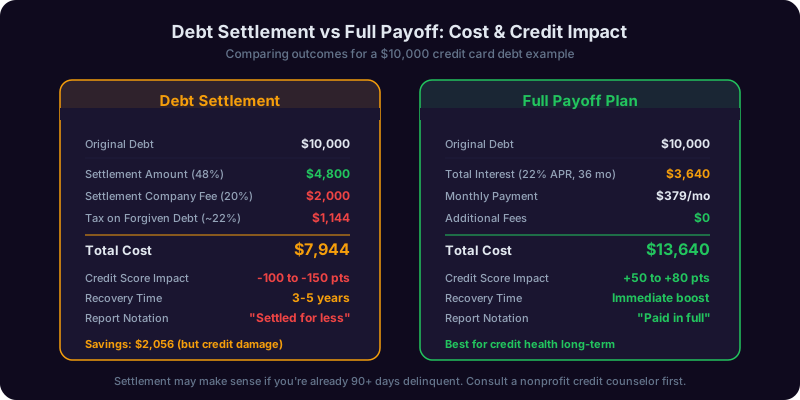
Settlement means negotiating with creditors to accept less than the full balance, usually through a third-party settlement company that charges fees of 15-25% of the enrolled debt. Here is how it typically works:
- You stop paying your creditors
- You make monthly deposits into a dedicated savings account
- The settlement company negotiates with creditors once enough money accumulates
- Creditors may accept 40-60% of the balance
The serious risks of debt settlement:
- Credit score destruction: Deliberately stopping payments tanks your credit score by 100-200 points. The settlement itself is reported as "settled for less than full amount" and stays on your credit report for 7 years.
- Lawsuits: Creditors can and do sue for unpaid balances. If they get a judgment, they can garnish wages or freeze bank accounts.
- Tax consequences: Forgiven debt over $600 is considered taxable income by the IRS. If a creditor forgives $5,000, you may owe income tax on that $5,000. You will receive a 1099-C form.
- Settlement company fees: 15-25% of enrolled debt is a significant cost. On $30,000 in debt, that is $4,500-$7,500 in fees alone.
- No guarantees: Creditors are not obligated to settle. Some may refuse entirely, leaving you with damaged credit and no resolution.
- Scam risk: The debt settlement industry has a long history of fraud. The CFPB warns consumers to be wary of companies that charge upfront fees or guarantee specific results.
When Settlement Might Make Sense
Settlement is a last resort, not a shortcut. It may be appropriate if you are already severely delinquent, cannot afford minimum payments even with hardship programs, are considering bankruptcy, and have a lump sum available to settle. For most people with a steady income, a structured payoff plan (snowball, avalanche, or hybrid) combined with creditor negotiations will produce a better outcome with far less collateral damage.
Before pursuing settlement, consult a nonprofit credit counselor through the NFCC. They can evaluate your full situation and may set up a Debt Management Plan (DMP) that lowers your rates without destroying your credit.
How AI Personalizes Your Debt Payoff Plan
Traditional debt advice gives you a method and tells you to apply it. AI-powered planning goes further by adapting the strategy to your specific financial profile, behavioral patterns, and life circumstances. Here is what that looks like in practice.
What AI Debt Planning Actually Does
An AI financial tool analyzes variables that a static calculator cannot:
- Income patterns: If you are salaried with a predictable paycheck, the plan looks different than if you are a freelancer with variable monthly income. AI can model irregular income and suggest variable payment amounts tied to actual earnings.
- Spending behavior: AI can identify categories where you consistently overspend and suggest specific reductions that fund accelerated debt payments without requiring willpower alone.
- Rate change modeling: If you have variable-rate debts or a balance transfer promotional period expiring, AI calculates the optimal reallocation of payments before and after rate changes.
- Tax implications: For student loan interest deductions, mortgage interest deductions, or taxable forgiveness on settled debts, AI factors tax effects into the true cost comparison between strategies. If you are also managing side hustle income, this gets even more complex.
- Emergency scenarios: AI can model what happens to your payoff plan if you lose income for 1-3 months, helping you decide whether to build an emergency fund simultaneously or focus entirely on debt.
How Copilotly Helps With Debt Payoff
The Finance Copilot can serve as your debt payoff planning partner. Here is what you can do:
- Input your complete debt inventory and get an instant comparison of snowball vs avalanche vs hybrid approaches, with exact dollar amounts for total interest paid and months to payoff
- Generate personalized negotiation scripts tailored to your specific creditors, account history, and hardship situation
- Model balance transfer scenarios including transfer fees, promotional periods, and what happens if you cannot pay off the balance before the rate jumps
- Create a monthly payment calendar that tells you exactly how much to pay on each debt each month, adjusted for your pay schedule
- Run what-if scenarios: What if you put your tax refund toward debt? What if you pick up a side gig earning $500/month? What if your car needs a $2,000 repair next month?
- Track progress and recalibrate the plan as circumstances change
AI vs Traditional Debt Calculators
Free online debt calculators handle basic snowball and avalanche math. They are useful starting points. AI planning goes beyond static math by considering the interplay between your debts, income, expenses, goals, and behavioral tendencies. It can tell you not just the optimal strategy but the most likely to succeed strategy for someone with your specific profile.
The Budgeting Copilot complements debt payoff by helping you find money in your existing budget to accelerate payments. Together, the Finance and Budgeting copilots create a complete system: one finds the extra cash, the other directs it to the right debt at the right time.
If you are working on improving your credit while paying down debt, the two goals reinforce each other. Reducing your credit utilization ratio (the percentage of available credit you are using) is one of the fastest ways to boost your credit score. Every dollar of debt you pay off improves your utilization and your score simultaneously.
This is general information, not financial advice. Consult a financial professional for guidance specific to your situation.
Frequently asked questions
Which is better, debt snowball or debt avalanche?
Should I pay off debt or save an emergency fund first?
Can I negotiate my credit card interest rate down?
Is debt settlement a good idea?
Should I include Buy Now Pay Later balances in my debt payoff plan?
How much can a balance transfer card save me?
What is a hardship program and how do I qualify?
How does paying off debt affect my credit score?
Get help with this from the Finance & Money Copilot
Describe your situation and get specific, actionable guidance - not the generic hedging a general-purpose chatbot gives you on finance & money questions.
- Finance & Money CopilotBuild a personalized debt payoff plan with snowball, avalanche, or hybrid strategy comparison
Free plan, no card. Pro from $4.99/week for every copilot across all 20 domains - about what one hour with any single professional costs per year.
Not a financial advisorThis is financial information, not financial advice. Consult a licensed financial professional.