
Money & Finance
Robo-Advisor vs Human Advisor: When Each Is Worth the Fee
A 1% AUM fee can cost hundreds of thousands over a career, while robo-advisors charge a fraction of that, but humans earn their keep in complex, emotional decisions. This comparison covers fees, performance data, fiduciary status, and a framework for when to use each or both.
The Financial Advice Landscape in 2026: What Has Changed
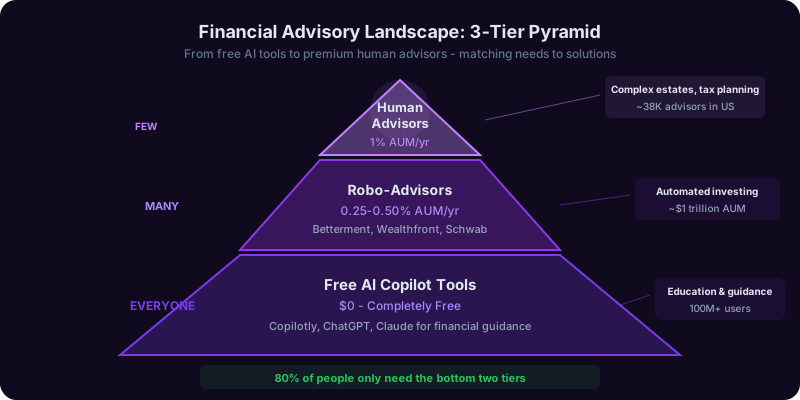
The financial advice industry has split into three distinct tiers, and understanding where each one excels is the first step to making a smart decision about your money. AI-powered tools now manage over $1.8 trillion in assets globally, up from roughly $1 trillion in 2023. Meanwhile, the number of Certified Financial Planners in the U.S. has grown to approximately 102,000 - still far short of the demand for personalized financial guidance.
The Three Tiers of Financial Advice
Tier 1: Free and low-cost AI tools. This includes browser-based AI copilots, budgeting apps like YNAB and Monarch Money with AI features, and free financial calculators. Cost: $0 to $15 per month. These tools handle budgeting, basic investment education, debt payoff strategies, and financial goal tracking. They are available 24/7, answer questions instantly, and never judge your spending habits.
Tier 2: Robo-advisors. Platforms like Betterment, Wealthfront, Schwab Intelligent Portfolios, and Vanguard Digital Advisor. Cost: 0% to 0.25% of assets under management (AUM) annually. They provide automated portfolio construction, rebalancing, tax-loss harvesting, and basic retirement projections. Betterment and Wealthfront each manage over $40 billion in client assets as of early 2026. Schwab Intelligent Portfolios manages over $80 billion with a 0% advisory fee (though it requires a higher cash allocation).
Tier 3: Human financial advisors. Fee-only financial planners, wealth managers, and full-service advisors. Cost: 0.50% to 1.50% of AUM annually, or $2,000 to $10,000+ for flat-fee financial plans. They handle complex tax strategies, estate planning, insurance analysis, behavioral coaching, business owner finances, and life transitions like divorce or inheritance.
Why This Comparison Matters Now
The lines between these tiers are blurring. Betterment now offers access to human advisors for premium clients. Vanguard pairs its robo-advisor with human CFPs. Many independent financial planners use AI tools in their own practices. The question is no longer "AI or human" - it is which combination of tools and human expertise gives you the best outcome for your specific situation and budget.
We are going to be honest throughout this guide. AI tools, including Copilotly, have real limitations. Human advisors have real advantages that technology cannot replicate. But human advisors also have real costs and real conflicts of interest that you need to understand. The goal is to help you spend your money on advice that actually improves your financial outcomes - not on services you do not need or technology that falls short of what you require.
For a foundational understanding of investing concepts that both AI tools and human advisors build upon, see our beginner investing guide.
Fee Structures Compared: The Real Cost of Financial Advice
Fees are the single most important variable in this comparison because they are the one factor you can control and predict. Investment returns are uncertain. Tax law changes. But fees compound against you with mathematical certainty, year after year. Here is exactly what each option costs.
AI Tools and Budgeting Apps: $0 to $180 Per Year
| Tool | Annual Cost | What You Get |
|---|---|---|
| Copilotly Finance Copilot | Free (browser extension) | AI-powered budgeting guidance, investment questions, financial planning conversations |
| ChatGPT / Claude for finance | $0 to $240/year | General financial Q&A, scenario analysis, tax concept explanations |
| YNAB | $109/year | Zero-based budgeting with AI categorization |
| Monarch Money | $120/year | Net worth tracking, AI-assisted budgeting, investment monitoring |
Robo-Advisors: $0 to $2,500 Per Year on $500K
| Platform | Advisory Fee | Annual Cost on $100K | Annual Cost on $500K |
|---|---|---|---|
| Schwab Intelligent Portfolios | 0.00% | $0 | $0 |
| SoFi Automated Investing | 0.00% | $0 | $0 |
| Betterment | 0.25% | $250 | $1,250 |
| Wealthfront | 0.25% | $250 | $1,250 |
| Vanguard Digital Advisor | 0.20% | $200 | $1,000 |
| Betterment Premium (with human access) | 0.65% | $650 | $3,250 |
| Vanguard Personal Advisor | 0.30% | $300 | $1,500 |
Human Financial Advisors: $2,500 to $15,000+ Per Year
Human advisor fees vary dramatically depending on the compensation model:
| Fee Model | Typical Cost | Annual Cost on $500K | Conflict of Interest Risk |
|---|---|---|---|
| Fee-only (AUM-based) | 0.50% to 1.00% | $2,500 to $5,000 | Low (but incentivized to grow AUM) |
| Flat-fee financial plan | $2,000 to $7,500/year | $2,000 to $7,500 | Lowest (fee does not depend on assets) |
| Hourly | $200 to $400/hour | Varies ($1,000 to $4,000) | Low |
| AUM-based (traditional) | 1.00% to 1.50% | $5,000 to $7,500 | Moderate (discouraged from paying off mortgage, etc.) |
| Commission-based | Varies (hidden in products) | $3,000 to $10,000+ | Highest (paid to sell specific products) |
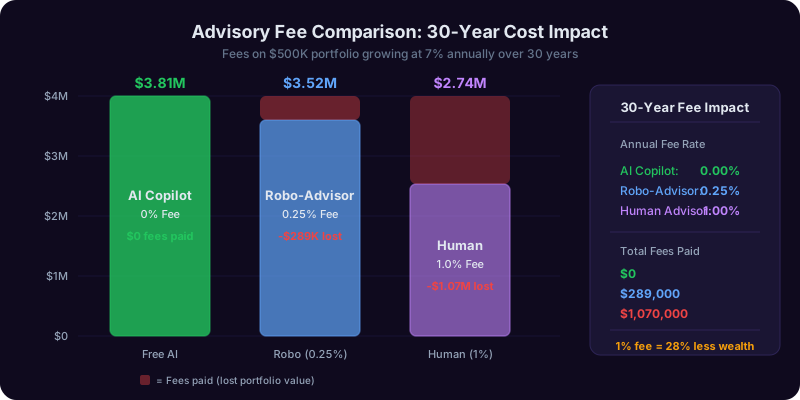
The 30-Year Fee Impact
On a $500,000 portfolio growing at 7% with $12,000 in annual contributions over 30 years:
- Free AI tool + self-directed index funds (0.03% fund expenses): Final balance of approximately $4,180,000
- Robo-advisor at 0.25%: Final balance of approximately $3,870,000 (roughly $310,000 less)
- Human advisor at 1.00%: Final balance of approximately $3,340,000 (roughly $840,000 less)
- Traditional advisor at 1.50%: Final balance of approximately $3,050,000 (roughly $1,130,000 less)
That 1.50% fee does not sound like much. But it costs you over $1.1 million over 30 years on a $500K starting portfolio. This is why the fee conversation matters so much. A human advisor needs to add significant value through tax optimization, behavioral coaching, and planning to justify that cost. Many do. Many do not. According to the SEC's investor bulletin on fees, even small differences in fees and expenses can have a major impact on your investment over time.
The Finance Copilot can model the exact fee impact on your specific portfolio size and help you determine whether the value a human advisor provides justifies their cost in your situation.
Where AI Financial Tools Excel: Speed, Scale, and Consistency
AI financial tools are not just cheaper versions of human advisors. In several important areas, they are genuinely better. Understanding these strengths helps you use AI tools where they add the most value.
Tax-Loss Harvesting: AI's Clearest Advantage
Tax-loss harvesting is the practice of selling losing investments to offset capital gains taxes, then immediately buying a similar (but not "substantially identical") investment to maintain market exposure. It is a pure rules-based activity - exactly the kind of task where software outperforms humans.
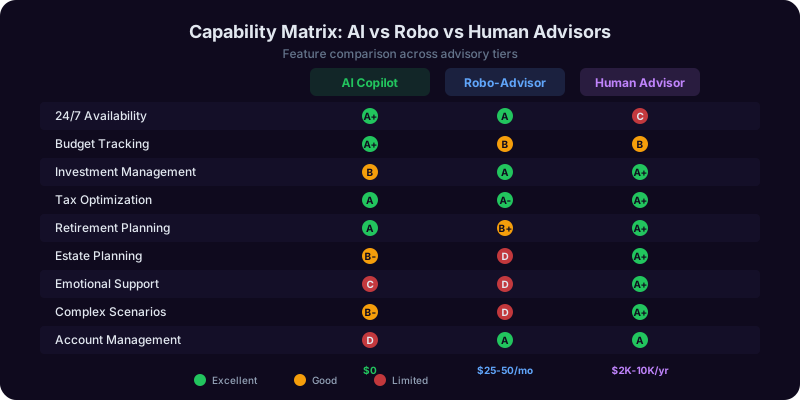
A human advisor might review your portfolio quarterly and harvest losses a few times per year. A robo-advisor like Wealthfront or Betterment scans your portfolio daily and harvests losses automatically whenever they appear. Wealthfront's published data claims their tax-loss harvesting adds an average of 1.8% to 2.6% in annual after-tax returns for taxable accounts. Even if the real number is half that, it is significant - and it often exceeds the 0.25% advisory fee, meaning the robo-advisor effectively pays for itself in taxable accounts.
Human advisors who manage hundreds of clients simply cannot monitor every position in every account every day. This is a task where automation wins decisively.
Portfolio Rebalancing: Disciplined and Emotion-Free
Rebalancing means selling outperforming assets and buying underperforming ones to maintain your target allocation. It is psychologically difficult - you are selling winners and buying losers. Most human advisors rebalance quarterly or when allocations drift beyond a threshold (typically 5%). Robo-advisors rebalance continuously, often using cash flows (new deposits, dividends, withdrawals) to rebalance without triggering unnecessary taxable events.
24/7 Availability and Instant Answers
Financial questions do not arise during business hours. You are reviewing your finances at 10 PM on a Sunday and you want to know whether you should prioritize your Roth IRA or pay down your student loans. A human advisor is unavailable. An AI tool gives you an answer in seconds - and unlike a Google search, it can factor in the details you provide about your income, interest rates, and tax bracket.
Budgeting and Spending Analysis
AI-powered budgeting tools are dramatically better than spreadsheets or human advisors at tracking and categorizing spending. They process thousands of transactions, identify patterns, and surface insights like "your dining spending increased 34% this month compared to your six-month average." A human advisor reviewing your spending once a quarter cannot match this granularity.
Consistent, Bias-Free Recommendations
An AI tool gives the same advice to a client with $10,000 as it does to a client with $10 million (assuming the same circumstances). It does not unconsciously prioritize higher-asset clients, does not have bad days, and does not let personal biases influence recommendations. It follows its programming consistently, every time. This matters because research from the Financial Industry Regulatory Authority (FINRA) has documented that advisor recommendations can be influenced by compensation structures and personal biases.
Financial Education at Your Pace
Many people feel embarrassed asking a financial advisor "basic" questions. AI tools have zero judgment. You can ask the same question ten different ways, request explanations at different complexity levels, and explore hypothetical scenarios without worrying about wasting an advisor's billable time. This is particularly valuable for people early in their financial journey. For understanding foundational concepts like credit scores or emergency fund strategies, AI tools are excellent starting points.
The Finance Copilot can answer unlimited financial questions, run scenario analyses, and help you build a budget - all at no cost and without the pressure of a paid consultation.
Where Human Financial Advisors Are Essential: Judgment, Empathy, and Complexity
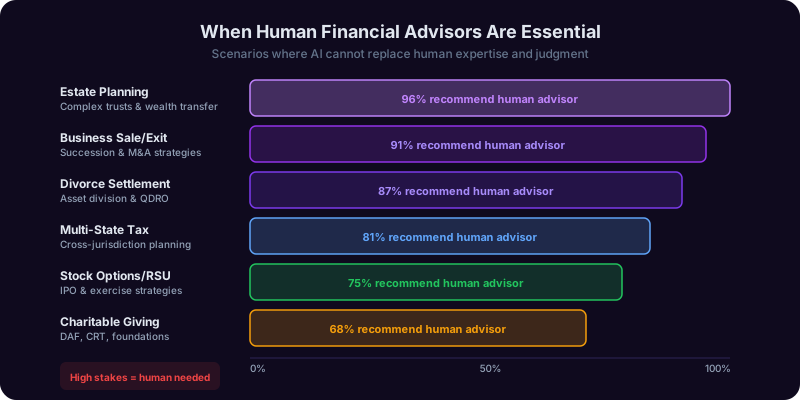
This is the section where we are going to be direct: there are situations where a human financial advisor is not just helpful but genuinely necessary, and no AI tool available today - including Copilotly - can substitute for that expertise. Recognizing these limits is more useful to you than pretending they do not exist.
Complex Estate Planning
If you have a net worth above $2 million, own property in multiple states, have a blended family, or need to structure trusts for minor children or disabled dependents, you need a human estate planning attorney and a financial advisor who understands how estate plans interact with investment strategy, tax planning, and insurance. AI tools can explain what a revocable living trust is. They cannot evaluate whether your specific family situation calls for an irrevocable life insurance trust, a charitable remainder trust, a generation-skipping trust, or some combination - and they cannot draft legally binding documents.
The federal estate tax exemption is $13.99 million per individual in 2026, but this is scheduled to drop to approximately $7 million in 2026 when the Tax Cuts and Jobs Act provisions sunset. High-net-worth families need proactive planning for this change, and that requires human judgment about family dynamics, risk tolerance, and charitable intent that AI cannot assess.
Business Owner Financial Planning
If you own a business, your financial life is fundamentally more complex than a W-2 employee's. You need guidance on entity structure (S-corp vs C-corp vs LLC), retirement plan selection (SEP IRA vs Solo 401(k) vs defined benefit plan), succession planning, key person insurance, buy-sell agreements, and the tax implications of an eventual sale. A business valued at $1 million or more requires coordinated planning between a financial advisor, CPA, and potentially a business valuation specialist. AI tools can explain each of these concepts individually. They cannot integrate them into a cohesive strategy that accounts for your specific business, partners, industry, and personal goals.
Behavioral Coaching During Market Crashes
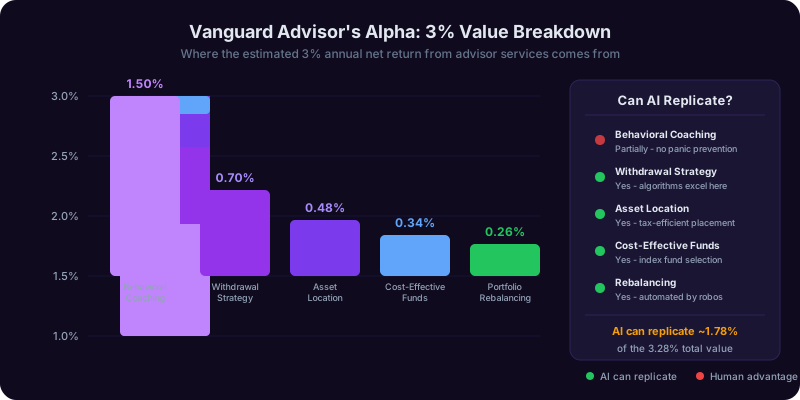
This is arguably the most valuable service a human advisor provides, and it is the hardest to quantify. Vanguard's research (their "Advisor's Alpha" framework) estimates that behavioral coaching alone adds approximately 1.50% in net returns by preventing clients from selling during downturns and making emotional decisions. During the March 2020 crash, clients with human advisors were significantly less likely to panic-sell than self-directed investors.
An AI tool can tell you "historically, the S&P 500 recovers from every downturn." A human advisor who knows you personally, who has sat across the table from you during good times, can talk you off the ledge in a way that a chatbot cannot. When your portfolio drops $200,000 in a month and you are terrified, the emotional reassurance of a trusted human is qualitatively different from text on a screen.
Divorce, Inheritance, and Life Transitions
Major life transitions create financial complexity that requires both technical expertise and emotional sensitivity. Dividing assets in a divorce, managing a sudden $500,000 inheritance, planning finances after a spouse's death, navigating early retirement due to a layoff - these situations involve legal considerations, tax implications, insurance decisions, and emotional vulnerability that demand a human professional who can listen, understand context, and coordinate with attorneys and CPAs.
Insurance Analysis
Determining the right amount and type of life insurance, disability insurance, long-term care insurance, and umbrella liability coverage requires evaluating your complete financial picture, health status, family obligations, and risk tolerance. AI tools can provide general guidelines ("most families need 10-12x income in life insurance"), but a human advisor can assess whether your specific situation calls for term life, whole life, a combination, or whether your employer's coverage is sufficient. Insurance product comparisons involve policy-specific fine print that varies by carrier and state - a level of detail that requires human review.
Fiduciary Accountability
A fee-only financial advisor who is a Certified Financial Planner (CFP) is legally bound to act in your best interest at all times. This fiduciary duty means they can be held liable if their advice harms you. An AI tool has no fiduciary duty. If it gives you incorrect guidance that costs you money, there is no legal recourse. This accountability gap matters most for high-stakes decisions.
For understanding the differences between Roth and Traditional IRAs or 401(k) options, AI tools are excellent. For restructuring a $3 million estate plan, hire a human.
Fiduciary vs Non-Fiduciary Advisors: A Critical Distinction
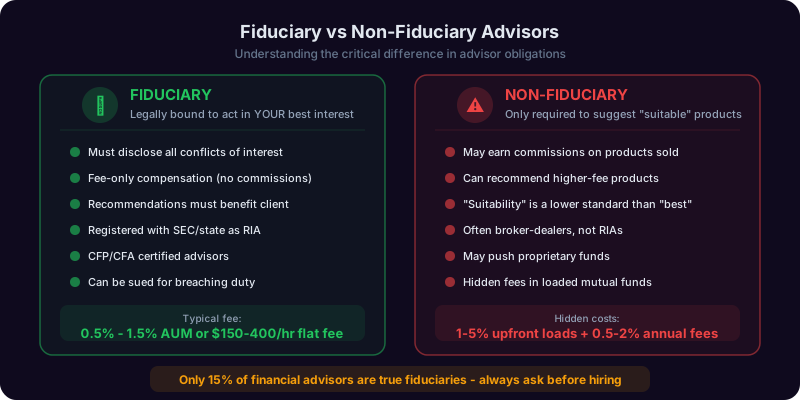
Before you hire any human financial advisor, you need to understand the single most important word in financial advice: fiduciary. This distinction affects every recommendation your advisor makes and determines whether they are legally required to put your interests first.
What Fiduciary Means
A fiduciary financial advisor is legally and ethically obligated to act in your best interest. They must recommend the investment, insurance product, or strategy that is best for you - not the one that pays them the highest commission. If a fiduciary recommends a product that benefits them at your expense, they can face regulatory action, lawsuits, and loss of their professional credentials.
A non-fiduciary advisor (also called a broker or registered representative) operates under a weaker "suitability" standard. They must recommend products that are "suitable" for your situation, but they are not required to recommend the best option. A suitable investment might carry a 1.5% expense ratio and pay the broker a 5% commission, while a better option with a 0.03% expense ratio exists but pays no commission. Under the suitability standard, recommending the expensive option is legal.
How to Identify Fiduciary Advisors
| Credential / Registration | Fiduciary Duty | How to Verify |
|---|---|---|
| CFP (Certified Financial Planner) | Yes, when providing financial planning | CFP Board verification tool |
| RIA (Registered Investment Advisor) | Yes, always | SEC IAPD database or state regulator |
| Fee-only advisor (NAPFA member) | Yes, by NAPFA requirement | NAPFA.org advisor search |
| Broker-dealer representative | No (suitability standard only) | FINRA BrokerCheck |
| Insurance agent | No (unless also an RIA) | State insurance department |
| Bank financial advisor | Varies (often no) | Ask directly and verify registration |
The Fee-Only Distinction
Fee-only means the advisor's sole compensation comes from fees paid directly by clients - no commissions, no referral fees, no revenue sharing from fund companies. This is the cleanest compensation model because it eliminates the primary source of conflicts of interest.
Fee-based (note the subtle difference in wording) means the advisor charges fees but also earns commissions on some products. This hybrid model creates potential conflicts. An advisor might recommend an annuity that pays them a 6% commission when a simpler, cheaper solution exists.
Questions to Ask Any Potential Advisor
- "Are you a fiduciary at all times?" Not just sometimes. Not just for financial planning. At all times, for every recommendation.
- "Are you fee-only?" If they say "fee-based," follow up: "What commissions or third-party compensation do you receive?"
- "Can I see your Form ADV Part 2?" This SEC-required document discloses fees, conflicts of interest, disciplinary history, and business practices. Any legitimate advisor will provide it immediately.
- "What is your all-in cost?" Advisory fee plus underlying fund expenses plus any platform or custodial fees. A 0.75% advisory fee on top of funds averaging 0.50% in expenses means your true cost is 1.25%.
- "How are you compensated for the specific products you recommend?" If the answer is anything other than "I am not compensated by product companies," proceed with caution.
How AI and Robo-Advisors Handle Fiduciary Duty
Robo-advisors registered as RIAs (Betterment, Wealthfront) do have a fiduciary duty. However, their fiduciary obligation is applied algorithmically - they recommend what their model determines is best, not what a human professional has evaluated for your specific context. Standalone AI tools like ChatGPT, Claude, and Copilotly are not fiduciaries and do not have any legal obligation regarding the quality of their financial guidance. This is why AI tools consistently include disclaimers that their output is not financial advice.
For straightforward questions about tax deductions or student loan repayment strategies, fiduciary duty matters less because the answers are factual. For high-stakes decisions involving six or seven figures, the legal accountability of a fiduciary advisor provides meaningful protection.
Performance Comparison: Do Robo-Advisors Keep Up With Human Advisors?
The performance question is the one everyone wants answered: does paying more for a human advisor actually get you better investment returns? The honest answer is nuanced, and it depends on what you mean by "performance."
Pure Investment Returns: Essentially Equivalent
Multiple studies comparing robo-advisor portfolios to human-managed portfolios with similar asset allocations have found no consistent performance advantage for either side on a gross-return basis. Both typically use the same underlying index funds or ETFs. A portfolio of 60% VTI and 40% BND performs identically whether it is assembled by an algorithm or a human.
The Backend Benchmarking Robo Report, which tracks actual robo-advisor performance across multiple platforms, shows that diversified robo-advisor portfolios have delivered returns consistent with their benchmark allocations, minus their advisory fees. A moderate-risk Betterment portfolio returned approximately 7.2% annualized over the trailing 5-year period through 2025, closely tracking a comparable index benchmark that returned approximately 7.5% before the 0.25% fee.
After-Tax Returns: Robo-Advisors Often Win
In taxable accounts, robo-advisors frequently outperform human advisors on an after-tax basis because of their superior tax-loss harvesting. Daily automated harvesting captures more losses than quarterly human review. Wealthfront and Betterment both publish data showing their tax-loss harvesting generates 1.0% to 2.0% in additional after-tax returns annually for most taxable accounts, depending on market volatility and the client's tax bracket.
For a client in the 32% federal bracket with a $500,000 taxable portfolio, 1.5% in annual tax-loss harvesting benefit equals approximately $7,500 per year - far exceeding the $1,250 annual fee on Betterment. This is the strongest financial argument for robo-advisors in taxable accounts.
Total Financial Outcome: Human Advisors Can Add Significant Value
Vanguard's widely cited "Advisor's Alpha" research estimates that a good financial advisor can add approximately 3% in net returns per year through a combination of:
| Value Source | Estimated Annual Benefit |
|---|---|
| Behavioral coaching (preventing panic selling) | ~1.50% |
| Asset allocation and rebalancing | ~0.35% |
| Tax-efficient withdrawal strategies | ~0.70% |
| Spending strategy in retirement | ~0.30% |
| Total cost-effective implementation | ~0.15% |
| Total estimated Advisor's Alpha | ~3.00% |
Several important caveats apply to this number. First, it is an estimate of potential value, not a guarantee. Second, much of the value comes from preventing mistakes that not all investors would make. If you are already disciplined enough to hold through downturns and rebalance regularly, the behavioral coaching component (the largest piece) adds less value for you. Third, you must subtract the advisor's fee from this benefit. If the advisor charges 1%, the net benefit is approximately 2% - still meaningful, but only if the advisor is actually delivering on all these value sources.
The Honest Assessment
For a disciplined investor with a straightforward financial situation (W-2 income, no business, no complex estate), a robo-advisor provides 80-90% of the investment management value at 20-30% of the cost. The gap between a robo-advisor and a good human advisor is primarily in planning, tax strategy, and behavioral coaching - not in investment selection or portfolio construction.
For investors with complex situations - business owners, high-net-worth families, people approaching retirement with multiple income sources - a skilled human advisor can add value that significantly exceeds their fee. The key word is skilled. A mediocre advisor charging 1% who puts you in expensive funds and never does meaningful financial planning is worse than a robo-advisor. Choose carefully.
Decision Framework: When to Use AI, When to Hire a Human, When to Combine Both
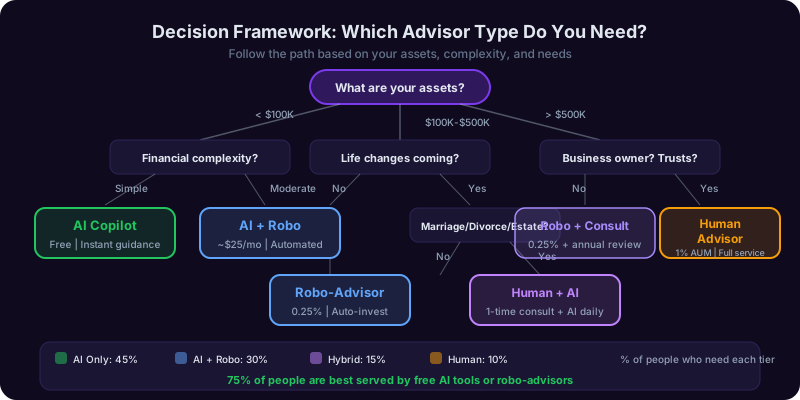
Rather than making a blanket recommendation, here is a framework based on your specific situation. Find the scenario that best matches your financial life.
Use AI Tools Only (No Human Advisor Needed)
This approach works well if:
- Your household income is under $150,000
- Your investable assets are under $250,000
- You are a W-2 employee (not self-employed or a business owner)
- Your financial goals are straightforward (retirement savings, emergency fund, debt payoff)
- You have no complex estate planning needs
- You are comfortable making your own financial decisions with AI guidance
Recommended setup: Use the Finance Copilot for budgeting, financial questions, and scenario analysis. Open accounts at Fidelity or Schwab. Invest in low-cost index funds. Use a robo-advisor for taxable accounts where tax-loss harvesting adds value. Total annual cost: $0 to $250 on a $100K portfolio.
Use a Robo-Advisor + AI Tools
This hybrid works well if:
- You want automated portfolio management and do not enjoy managing investments yourself
- You have a taxable brokerage account where tax-loss harvesting adds value
- Your financial situation is moderately complex but does not require ongoing human advice
- You value a hands-off approach to investing
Recommended setup: Use Betterment or Wealthfront for investment management ($0.25% AUM). Use AI tools for budgeting, tax questions, and financial education. Consider a one-time consultation with a fee-only CFP ($500 to $2,000) every 3-5 years for a comprehensive financial plan review.
Hire a Human Advisor + Use AI Tools as a Complement
You likely need a human advisor if any of these apply:
- You own a business or have significant self-employment income
- Your net worth exceeds $1 million
- You are within 10 years of retirement and need a detailed withdrawal strategy
- You are going through a divorce, received a large inheritance, or face another major life transition
- You need estate planning coordination (trusts, gifting strategies, charitable planning)
- You have stock options, RSUs, or deferred compensation from your employer
- You know you would panic-sell during a 30% market decline
Recommended setup: Hire a fee-only CFP fiduciary ($2,000 to $7,500 per year flat fee, or 0.50% to 1.00% AUM). Use the advisor for comprehensive planning, tax strategy, estate coordination, and behavioral coaching. Use AI tools for day-to-day budgeting, quick financial questions between advisor meetings, and education on concepts your advisor discusses.
The Combination That Works Best for Most People
For the majority of households, the most cost-effective approach is:
- AI tools for daily financial management - budgeting, spending tracking, quick questions, financial education
- A robo-advisor for taxable investment accounts - automated rebalancing and tax-loss harvesting
- Self-directed index funds for tax-advantaged accounts - Roth IRA, 401(k), HSA in low-cost index funds
- A fee-only CFP for periodic comprehensive reviews - every 2-3 years, or when major life changes occur
This combination gives you the daily convenience of AI, the tax efficiency of a robo-advisor, the low costs of self-directed indexing, and the human judgment of a fiduciary advisor when it matters most. Total annual cost on a $500K portfolio: approximately $1,500 to $3,000 - versus $5,000 to $7,500 for a traditional full-service advisor.
How Copilotly Fits In: AI That Complements Your Financial Strategy
We want to be transparent about what Copilotly can and cannot do in the context of financial planning. Understanding these boundaries helps you use it effectively alongside other tools and professional advice.
What the Finance Copilot Does Well
The Finance Copilot is a conversational AI that lives in your browser and helps with everyday financial questions and decisions. It excels at:
- Explaining financial concepts in plain language - from compound interest to backdoor Roth conversions to tax-loss harvesting
- Running scenario analyses - "If I contribute $500/month to my Roth IRA for 25 years at 7%, what will I have?"
- Budgeting guidance - helping you create spending plans, identify savings opportunities, and prioritize financial goals
- Comparing options - Roth vs Traditional, paying down debt vs investing, different savings account rates
- Tax concept education - explaining deductions, credits, and strategies (not preparing or filing taxes)
- Debt payoff strategies - modeling avalanche vs snowball methods with your actual balances and rates
What the Finance Copilot Does Not Do
We believe honesty about limitations builds more trust than overpromising. The Finance Copilot does not:
- Provide personalized financial advice - it offers information and education, not fiduciary advice tailored to your complete financial picture
- Access your accounts - it does not connect to your bank, brokerage, or credit card accounts
- Execute trades or transactions - it cannot buy investments, transfer money, or submit tax returns on your behalf
- Replace estate planning - it cannot draft trusts, evaluate life insurance needs, or coordinate with attorneys
- Guarantee accuracy on tax matters - tax law is complex and changes frequently; always verify with a CPA or the IRS for your specific situation
- Provide behavioral coaching - it can explain why panic-selling is harmful, but it lacks the personal relationship that makes human coaching effective during market crashes
Using Copilotly With a Robo-Advisor
If you use Betterment, Wealthfront, or another robo-advisor for investment management, the Finance Copilot fills the gaps that robo-advisors leave. Robo-advisors manage your portfolio but do not help you with budgeting, debt strategies, side hustle tax questions, or deciding whether to prioritize your 401(k) match, Roth IRA, or student loan payments. The Finance Copilot handles those conversations.
Using Copilotly With a Human Advisor
If you have a human financial advisor, Copilotly is useful between meetings. Most advisors meet clients once or twice per year. Between those meetings, questions come up: "Should I increase my 401(k) contribution after my raise?" "How does this new tax deduction work?" "What is the difference between a SEP IRA and a Solo 401(k)?" Rather than waiting weeks for your next advisor meeting or paying for an extra hour of their time, you can get instant answers from the Finance Copilot and bring better-informed questions to your next advisor session.
The Investing Copilot
The Investing Copilot focuses specifically on investment-related questions: understanding asset classes, evaluating fund options, learning about diversification, and exploring investment strategies. It complements the Finance Copilot's broader financial planning focus and pairs well with both robo-advisors (for conceptual understanding of what the algorithm is doing) and human advisors (for more informed discussions about portfolio strategy).
Both copilots include clear disclaimers that their output is educational information, not personalized financial advice. For decisions involving significant money, complex tax situations, or life-changing events, we recommend consulting a qualified professional. The goal is to make you a more informed consumer of financial services - whether those services come from an algorithm, a human, or both.
This article is for informational and educational purposes only. It does not constitute financial, tax, or investment advice. Consult a qualified financial advisor or tax professional for guidance specific to your situation.
Frequently asked questions
Can AI financial tools replace a human financial advisor completely?
How much does a financial advisor cost compared to a robo-advisor?
What is a fiduciary financial advisor and why does it matter?
Do robo-advisors perform as well as human advisors on investment returns?
What is tax-loss harvesting and why are robo-advisors better at it?
When should I definitely hire a human financial advisor instead of using AI tools?
Are AI financial tools safe to use for my personal finances?
How can I use AI tools alongside my existing financial advisor to get better results?
Get help with this from the Finance & Money Copilot
Describe your situation and get specific, actionable guidance - not the generic hedging a general-purpose chatbot gives you on finance & money questions.
- Finance & Money CopilotGet free AI-powered budgeting guidance, financial scenario analysis, and answers to everyday money questions
Free plan, no card. Pro from $4.99/week for every copilot across all 20 domains - about what one hour with any single professional costs per year.
Not a financial advisorThis is financial information, not financial advice. Consult a licensed financial professional.